

Question 121
Note: This question is part of a series of questions that present the same scenario. Each question in the series contains a unique solution that might meet the stated goals. Some question sets might have more than one correct solution, while others might not have a correct solution.
After you answer a question in this section, you will NOT be able to return to it. As a result, these questions will not appear in the review screen.
You plan to use a Python script to run an Azure Machine Learning experiment. The script creates a reference to the experiment run context, loads data from a file, identifies the set of unique values for the label column, and completes the experiment run:
from azureml.core import Run
import pandas as pd
run = Run.get_context()
data = pd.read_csv('data.csv')
label_vals = data['label'].unique()
# Add code to record metrics here
run.complete()
The experiment must record the unique labels in the data as metrics for the run that can be reviewed later.
You must add code to the script to record the unique label values as run metrics at the point indicated by the comment.
Solution: Replace the comment with the following code:
run.log_table('Label Values', label_vals)
Does the solution meet the goal?
After you answer a question in this section, you will NOT be able to return to it. As a result, these questions will not appear in the review screen.
You plan to use a Python script to run an Azure Machine Learning experiment. The script creates a reference to the experiment run context, loads data from a file, identifies the set of unique values for the label column, and completes the experiment run:
from azureml.core import Run
import pandas as pd
run = Run.get_context()
data = pd.read_csv('data.csv')
label_vals = data['label'].unique()
# Add code to record metrics here
run.complete()
The experiment must record the unique labels in the data as metrics for the run that can be reviewed later.
You must add code to the script to record the unique label values as run metrics at the point indicated by the comment.
Solution: Replace the comment with the following code:
run.log_table('Label Values', label_vals)
Does the solution meet the goal?
Question 122
You are creating a machine learning model. You have a dataset that contains null rows.
You need to use the Clean Missing Data module in Azure Machine Learning Studio to identify and resolve the null and missing data in the dataset.
Which parameter should you use?
You need to use the Clean Missing Data module in Azure Machine Learning Studio to identify and resolve the null and missing data in the dataset.
Which parameter should you use?
Question 123
You have a model with a large difference between the training and validation error values.
You must create a new model and perform cross-validation.
You need to identify a parameter set for the new model using Azure Machine Learning Studio.
Which module you should use for each step? To answer, drag the appropriate modules to the correct steps. Each module may be used once or more than once, or not at all. You may need to drag the split bar between panes or scroll to view content.
NOTE: Each correct selection is worth one point.
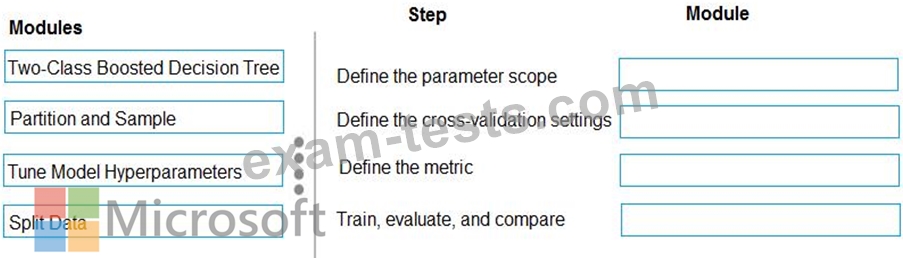
You must create a new model and perform cross-validation.
You need to identify a parameter set for the new model using Azure Machine Learning Studio.
Which module you should use for each step? To answer, drag the appropriate modules to the correct steps. Each module may be used once or more than once, or not at all. You may need to drag the split bar between panes or scroll to view content.
NOTE: Each correct selection is worth one point.

Question 124
You create a batch inference pipeline by using the Azure ML SDK. You run the pipeline by using the following code:
from azureml.pipeline.core import Pipeline
from azureml.core.experiment import Experiment
pipeline = Pipeline(workspace=ws, steps=[parallelrun_step])
pipeline_run = Experiment(ws, 'batch_pipeline').submit(pipeline)
You need to monitor the progress of the pipeline execution.
What are two possible ways to achieve this goal? Each correct answer presents a complete solution.
NOTE: Each correct selection is worth one point.
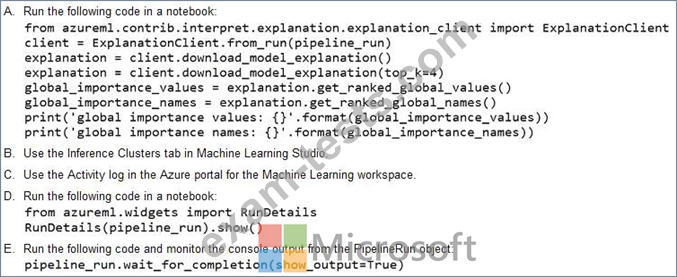
from azureml.pipeline.core import Pipeline
from azureml.core.experiment import Experiment
pipeline = Pipeline(workspace=ws, steps=[parallelrun_step])
pipeline_run = Experiment(ws, 'batch_pipeline').submit(pipeline)
You need to monitor the progress of the pipeline execution.
What are two possible ways to achieve this goal? Each correct answer presents a complete solution.
NOTE: Each correct selection is worth one point.
Question 125
You are performing a classification task in Azure Machine Learning Studio.
You must prepare balanced testing and training samples based on a provided data set.
You need to split the data with a 0.75:0.25 ratio.
Which value should you use for each parameter? To answer, select the appropriate options in the answer area.
NOTE: Each correct selection is worth one point.

You must prepare balanced testing and training samples based on a provided data set.
You need to split the data with a 0.75:0.25 ratio.
Which value should you use for each parameter? To answer, select the appropriate options in the answer area.
NOTE: Each correct selection is worth one point.

