

Question 126
You are analyzing a dataset containing historical data from a local taxi company. You are developing a regression model.
You must predict the fare of a taxi trip.
You need to select performance metrics to correctly evaluate the regression model.
Which two metrics can you use? Each correct answer presents a complete solution?
NOTE: Each correct selection is worth one point.
You must predict the fare of a taxi trip.
You need to select performance metrics to correctly evaluate the regression model.
Which two metrics can you use? Each correct answer presents a complete solution?
NOTE: Each correct selection is worth one point.
Question 127
You are implementing a machine learning model to predict stock prices.
The model uses a PostgreSQL database and requires GPU processing.
You need to create a virtual machine that is pre-configured with the required tools.
What should you do?
The model uses a PostgreSQL database and requires GPU processing.
You need to create a virtual machine that is pre-configured with the required tools.
What should you do?
Question 128
You train a machine learning model.
You must deploy the model as a real-time inference service for testing. The service requires low CPU utilization and less than 48 MB of RAM. The compute target for the deployed service must initialize automatically while minimizing cost and administrative overhead.
Which compute target should you use?
You must deploy the model as a real-time inference service for testing. The service requires low CPU utilization and less than 48 MB of RAM. The compute target for the deployed service must initialize automatically while minimizing cost and administrative overhead.
Which compute target should you use?
Question 129
Note: This question is part of a series of questions that present the same scenario. Each question in the series contains a unique solution that might meet the stated goals. Some question sets might have more than one correct solution, while others might not have a correct solution.
After you answer a question in this section, you will NOT be able to return to it. As a result, these questions will not appear in the review screen.
You are using Azure Machine Learning to run an experiment that trains a classification model.
You want to use Hyperdrive to find parameters that optimize the AUC metric for the model. You configure a HyperDriveConfig for the experiment by running the following code:

variable named y_test variable, and the predicted probabilities from the model are stored in a variable named y_predicted. You need to add logging to the script to allow Hyperdrive to optimize hyperparameters for the AUC metric. Solution: Run the following code:

Does the solution meet the goal?
After you answer a question in this section, you will NOT be able to return to it. As a result, these questions will not appear in the review screen.
You are using Azure Machine Learning to run an experiment that trains a classification model.
You want to use Hyperdrive to find parameters that optimize the AUC metric for the model. You configure a HyperDriveConfig for the experiment by running the following code:
variable named y_test variable, and the predicted probabilities from the model are stored in a variable named y_predicted. You need to add logging to the script to allow Hyperdrive to optimize hyperparameters for the AUC metric. Solution: Run the following code:
Does the solution meet the goal?
Question 130
You have an Azure blob container that contains a set of TSV files. The Azure blob container is registered as a datastore for an Azure Machine Learning service workspace. Each TSV file uses the same data schema.
You plan to aggregate data for all of the TSV files together and then register the aggregated data as a dataset in an Azure Machine Learning workspace by using the Azure Machine Learning SDK for Python.
You run the following code.

For each of the following statements, select Yes if the statement is true. Otherwise, select No.
NOTE: Each correct selection is worth one point.
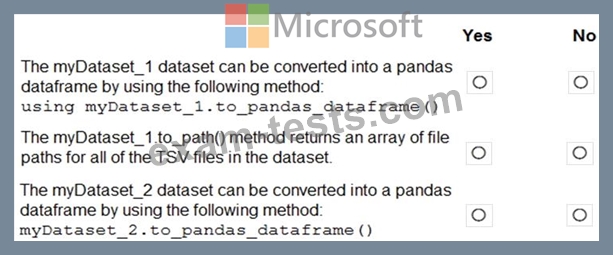
You plan to aggregate data for all of the TSV files together and then register the aggregated data as a dataset in an Azure Machine Learning workspace by using the Azure Machine Learning SDK for Python.
You run the following code.
For each of the following statements, select Yes if the statement is true. Otherwise, select No.
NOTE: Each correct selection is worth one point.
