

Question 81
You have a model with a large difference between the training and validation error values.
You must create a new model and perform cross-validation.
You need to identify a parameter set for the new model using Azure Machine Learning Studio.
Which module you should use for each step? To answer, drag the appropriate modules to the correct steps. Each module may be used once or more than once, or not at all. You may need to drag the split bar between panes or scroll to view content.
NOTE: Each correct selection is worth one point.
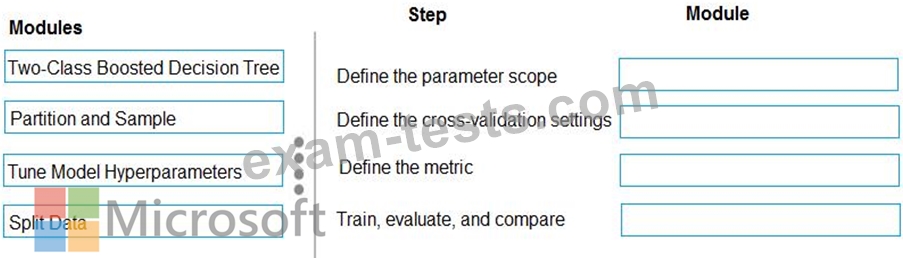
You must create a new model and perform cross-validation.
You need to identify a parameter set for the new model using Azure Machine Learning Studio.
Which module you should use for each step? To answer, drag the appropriate modules to the correct steps. Each module may be used once or more than once, or not at all. You may need to drag the split bar between panes or scroll to view content.
NOTE: Each correct selection is worth one point.

Question 82
You are creating an experiment by using Azure Machine Learning Studio.
You must divide the data into four subsets for evaluation. There is a high degree of missing values in the data.
You must prepare the data for analysis.
You need to select appropriate methods for producing the experiment.
Which three modules should you run in sequence? To answer, move the appropriate actions from the list of actions to the answer area and arrange them in the correct order.
NOTE: More than one order of answer choices is correct. You will receive credit for any of the correct orders you select.

You must divide the data into four subsets for evaluation. There is a high degree of missing values in the data.
You must prepare the data for analysis.
You need to select appropriate methods for producing the experiment.
Which three modules should you run in sequence? To answer, move the appropriate actions from the list of actions to the answer area and arrange them in the correct order.
NOTE: More than one order of answer choices is correct. You will receive credit for any of the correct orders you select.


Question 83
You manage an Azure Machine Learning workspace.
You plan to train a natural language processing (NLP) model that will assign labels ' or designated tokens in unstructured text You need to configure the NLP task by using automated machine learning.
Which configuration values should you use? To answer, select the appropriate options in the answer area.
NOTE Each correct selection is worth one point.

You plan to train a natural language processing (NLP) model that will assign labels ' or designated tokens in unstructured text You need to configure the NLP task by using automated machine learning.
Which configuration values should you use? To answer, select the appropriate options in the answer area.
NOTE Each correct selection is worth one point.


Question 84
You use an Azure Machine Learning workspace.
You create the following Python code:

For each of the following statements, select Yes if the statement is true. Otherwise, select No.
NOTE: Each correct selection is worth one point.
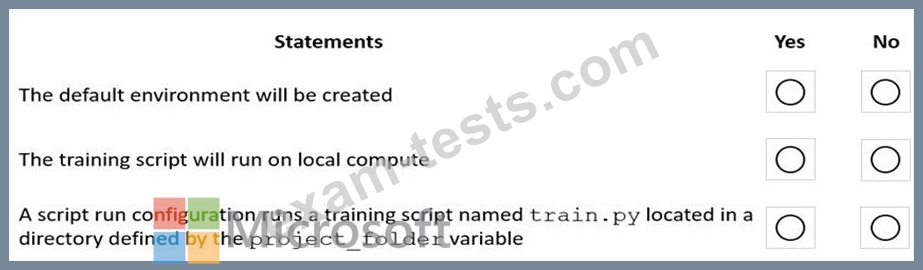
You create the following Python code:
For each of the following statements, select Yes if the statement is true. Otherwise, select No.
NOTE: Each correct selection is worth one point.

Question 85
You create a batch inference pipeline by using the Azure ML SDK. You run the pipeline by using the following code:
from azureml.pipeline.core import Pipeline
from azureml.core.experiment import Experiment
pipeline = Pipeline(workspace=ws, steps=[parallelrun_step])
pipeline_run = Experiment(ws, 'batch_pipeline').submit(pipeline)
You need to monitor the progress of the pipeline execution.
What are two possible ways to achieve this goal? Each correct answer presents a complete solution.
NOTE: Each correct selection is worth one point.

from azureml.pipeline.core import Pipeline
from azureml.core.experiment import Experiment
pipeline = Pipeline(workspace=ws, steps=[parallelrun_step])
pipeline_run = Experiment(ws, 'batch_pipeline').submit(pipeline)
You need to monitor the progress of the pipeline execution.
What are two possible ways to achieve this goal? Each correct answer presents a complete solution.
NOTE: Each correct selection is worth one point.