Question 126
Note: This question is part of a series of questions that present the same scenario. Each question in the series contains a unique solution that might meet the stated goals. Some question sets might have more than one correct solution, while others might not have a correct solution.
After you answer a question in this section, you will NOT be able to return to it. As a result, these questions will not appear in the review screen.
You plan to create an Azure Databricks workspace that has a tiered structure. The workspace will contain the following three workloads:
A workload for data engineers who will use Python and SQL.
A workload for jobs that will run notebooks that use Python, Scala, and SOL.
A workload that data scientists will use to perform ad hoc analysis in Scala and R.
The enterprise architecture team at your company identifies the following standards for Databricks environments:
The data engineers must share a cluster.
The job cluster will be managed by using a request process whereby data scientists and data engineers provide packaged notebooks for deployment to the cluster.
All the data scientists must be assigned their own cluster that terminates automatically after 120 minutes of inactivity. Currently, there are three data scientists.
You need to create the Databricks clusters for the workloads.
Solution: You create a High Concurrency cluster for each data scientist, a High Concurrency cluster for the data engineers, and a Standard cluster for the jobs.
Does this meet the goal?
After you answer a question in this section, you will NOT be able to return to it. As a result, these questions will not appear in the review screen.
You plan to create an Azure Databricks workspace that has a tiered structure. The workspace will contain the following three workloads:
A workload for data engineers who will use Python and SQL.
A workload for jobs that will run notebooks that use Python, Scala, and SOL.
A workload that data scientists will use to perform ad hoc analysis in Scala and R.
The enterprise architecture team at your company identifies the following standards for Databricks environments:
The data engineers must share a cluster.
The job cluster will be managed by using a request process whereby data scientists and data engineers provide packaged notebooks for deployment to the cluster.
All the data scientists must be assigned their own cluster that terminates automatically after 120 minutes of inactivity. Currently, there are three data scientists.
You need to create the Databricks clusters for the workloads.
Solution: You create a High Concurrency cluster for each data scientist, a High Concurrency cluster for the data engineers, and a Standard cluster for the jobs.
Does this meet the goal?
Question 127
You have an Azure Synapse Analytics dedicated SQL pool that contains a large fact table. The table contains
50 columns and 5 billion rows and is a heap.
Most queries against the table aggregate values from approximately 100 million rows and return only two columns.
You discover that the queries against the fact table are very slow.
Which type of index should you add to provide the fastest query times?
50 columns and 5 billion rows and is a heap.
Most queries against the table aggregate values from approximately 100 million rows and return only two columns.
You discover that the queries against the fact table are very slow.
Which type of index should you add to provide the fastest query times?
Question 128
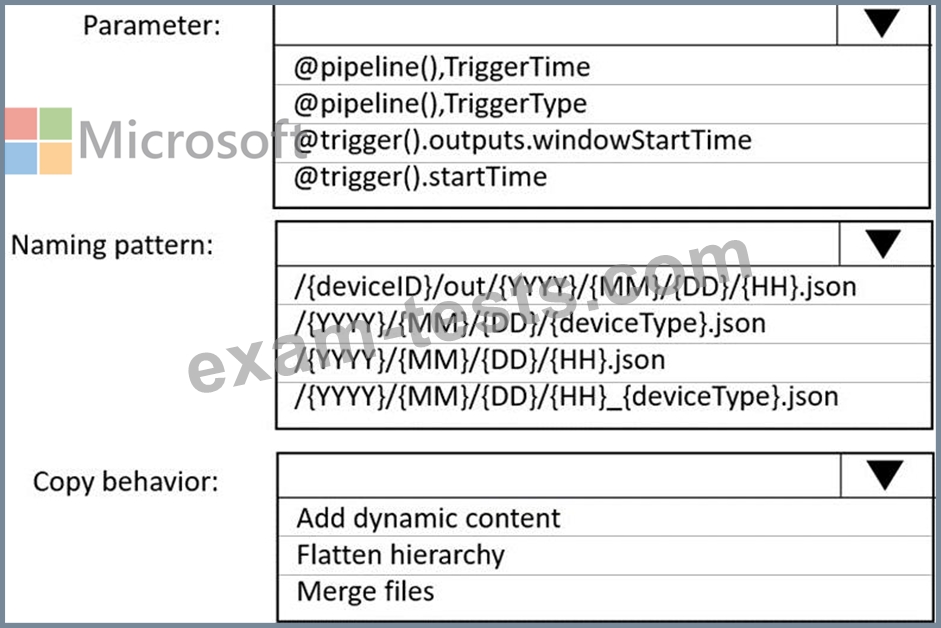
You are building an Azure Data Factory solution to process data received from Azure Event Hubs, and then ingested into an Azure Data Lake Storage Gen2 container.
The data will be ingested every five minutes from devices into JSON files. The files have the following naming pattern.
/{deviceType}/in/{YYYY}/{MM}/{DD}/{HH}/{deviceID}_{YYYY}{MM}{DD}HH}{mm}.json You need to prepare the data for batch data processing so that there is one dataset per hour per deviceType. The solution must minimize read times.
How should you configure the sink for the copy activity? To answer, select the appropriate options in the answer area.
NOTE: Each correct selection is worth one point.
The data will be ingested every five minutes from devices into JSON files. The files have the following naming pattern.
/{deviceType}/in/{YYYY}/{MM}/{DD}/{HH}/{deviceID}_{YYYY}{MM}{DD}HH}{mm}.json You need to prepare the data for batch data processing so that there is one dataset per hour per deviceType. The solution must minimize read times.
How should you configure the sink for the copy activity? To answer, select the appropriate options in the answer area.
NOTE: Each correct selection is worth one point.

Question 129
You have an Azure Synapse Analytics dedicated SQL pool named Pool1 and an Azure Data Lake Storage Gen2 account named Account 1.
You plan to access the files in Accoun1l by using an external table.
You need to create a data source in Pool1 that you can reference when you create the external table.
How should you complete the Transact-SQL statement? To answer, select the appropriate options in the answer area.
NOTE Each coned selection is worth one point.
You plan to access the files in Accoun1l by using an external table.
You need to create a data source in Pool1 that you can reference when you create the external table.
How should you complete the Transact-SQL statement? To answer, select the appropriate options in the answer area.
NOTE Each coned selection is worth one point.

Question 130
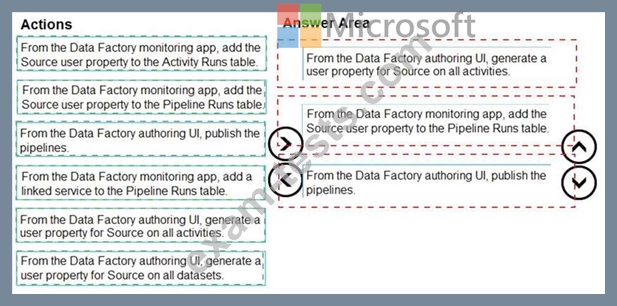
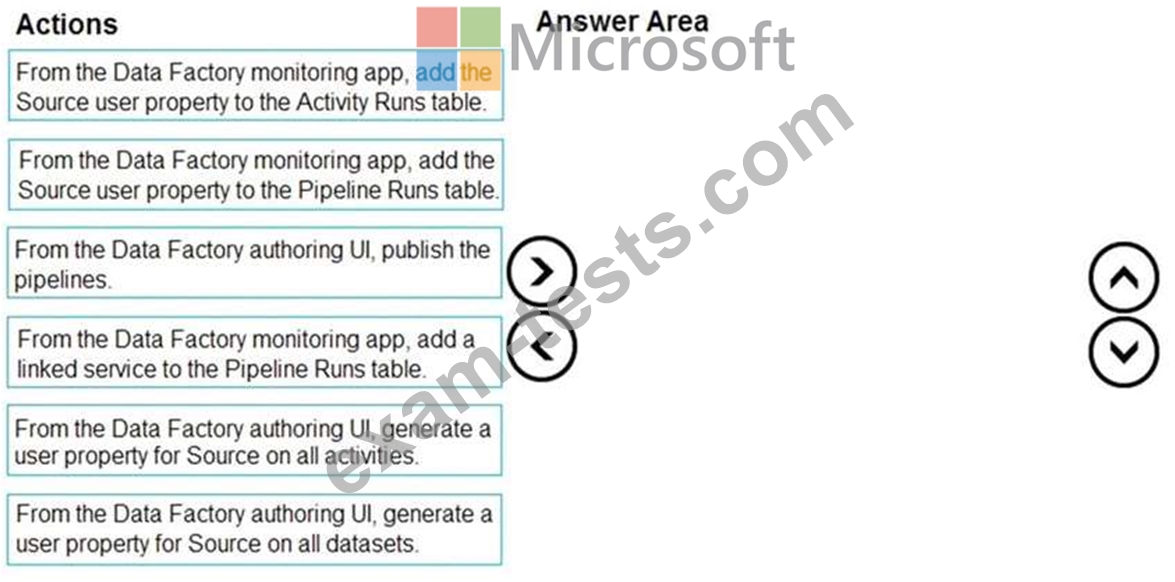
You plan to monitor an Azure data factory by using the Monitor & Manage app.
You need to identify the status and duration of activities that reference a table in a source database.
Which three actions should you perform in sequence? To answer, move the actions from the list of actions to the answer are and arrange them in the correct order.
You need to identify the status and duration of activities that reference a table in a source database.
Which three actions should you perform in sequence? To answer, move the actions from the list of actions to the answer are and arrange them in the correct order.