Question 36
You have an Azure event hub named retailhub that has 16 partitions. Transactions are posted to retailhub. Each transaction includes the transaction ID, the individual line items, and the payment details. The transaction ID is used as the partition key.
You are designing an Azure Stream Analytics job to identify potentially fraudulent transactions at a retail store. The job will use retailhub as the input. The job will output the transaction ID, the individual line items, the payment details, a fraud score, and a fraud indicator.
You plan to send the output to an Azure event hub named fraudhub.
You need to ensure that the fraud detection solution is highly scalable and processes transactions as quickly as possible.
How should you structure the output of the Stream Analytics job? To answer, select the appropriate options in the answer area.
NOTE: Each correct selection is worth one point.

You are designing an Azure Stream Analytics job to identify potentially fraudulent transactions at a retail store. The job will use retailhub as the input. The job will output the transaction ID, the individual line items, the payment details, a fraud score, and a fraud indicator.
You plan to send the output to an Azure event hub named fraudhub.
You need to ensure that the fraud detection solution is highly scalable and processes transactions as quickly as possible.
How should you structure the output of the Stream Analytics job? To answer, select the appropriate options in the answer area.
NOTE: Each correct selection is worth one point.

Question 37
You are building an Azure Data Factory solution to process data received from Azure Event Hubs, and then ingested into an Azure Data Lake Storage Gen2 container.
The data will be ingested every five minutes from devices into JSON files. The files have the following naming pattern.
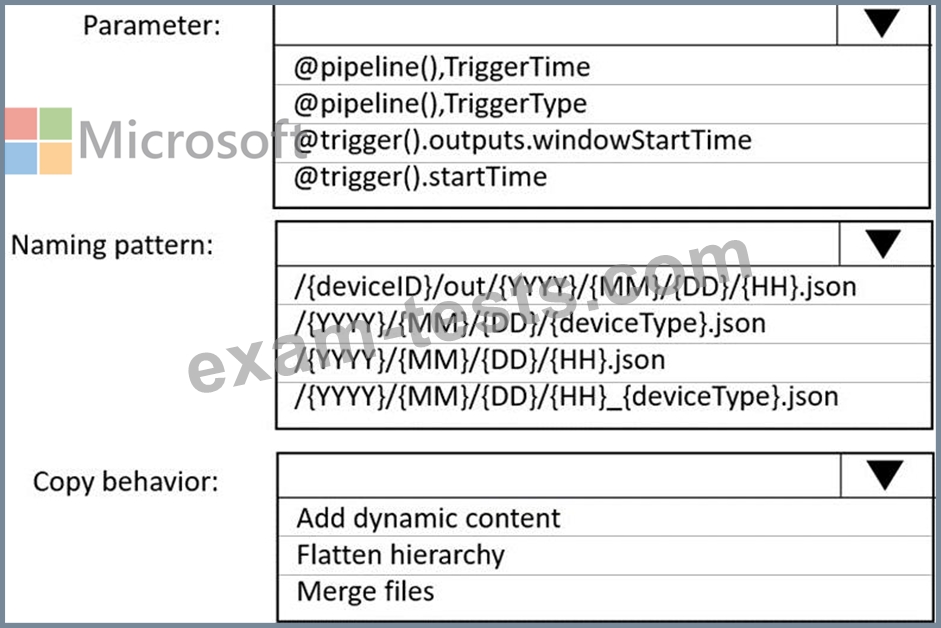
/{deviceType}/in/{YYYY}/{MM}/{DD}/{HH}/{deviceID}_{YYYY}{MM}{DD}HH}{mm}.json You need to prepare the data for batch data processing so that there is one dataset per hour per deviceType. The solution must minimize read times.
How should you configure the sink for the copy activity? To answer, select the appropriate options in the answer area.
NOTE: Each correct selection is worth one point.
The data will be ingested every five minutes from devices into JSON files. The files have the following naming pattern.
/{deviceType}/in/{YYYY}/{MM}/{DD}/{HH}/{deviceID}_{YYYY}{MM}{DD}HH}{mm}.json You need to prepare the data for batch data processing so that there is one dataset per hour per deviceType. The solution must minimize read times.
How should you configure the sink for the copy activity? To answer, select the appropriate options in the answer area.
NOTE: Each correct selection is worth one point.

Question 38
You have the following Azure Stream Analytics query.

For each of the following statements, select Yes if the statement is true. Otherwise, select No.
NOTE: Each correct selection is worth one point.

For each of the following statements, select Yes if the statement is true. Otherwise, select No.
NOTE: Each correct selection is worth one point.

Question 39
Note: This question is part of a series of questions that present the same scenario. Each question in the series contains a unique solution that might meet the stated goals. Some question sets might have more than one correct solution, while others might not have a correct solution.
After you answer a question in this section, you will NOT be able to return to it. As a result, these questions will not appear in the review screen.
You have an Azure Synapse Analytics dedicated SQL pool that contains a table named Table1.
You have files that are ingested and loaded into an Azure Data Lake Storage Gen2 container named container1.
You plan to insert data from the files in container1 into Table1 and transform the data. Each row of data in the files will produce one row in the serving layer of Table1.
You need to ensure that when the source data files are loaded to container1, the DateTime is stored as an additional column in Table1.
Solution: You use an Azure Synapse Analytics serverless SQL pool to create an external table that has an additional DateTime column.
Does this meet the goal?
After you answer a question in this section, you will NOT be able to return to it. As a result, these questions will not appear in the review screen.
You have an Azure Synapse Analytics dedicated SQL pool that contains a table named Table1.
You have files that are ingested and loaded into an Azure Data Lake Storage Gen2 container named container1.
You plan to insert data from the files in container1 into Table1 and transform the data. Each row of data in the files will produce one row in the serving layer of Table1.
You need to ensure that when the source data files are loaded to container1, the DateTime is stored as an additional column in Table1.
Solution: You use an Azure Synapse Analytics serverless SQL pool to create an external table that has an additional DateTime column.
Does this meet the goal?
Question 40
You have an Azure Synapse Analytics dedicated SQL pool that contains the users shown in the following table.

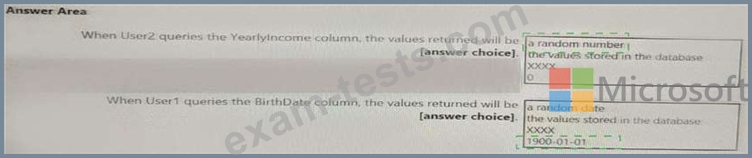
User1 executes a query on the database, and the query returns the results shown in the following exhibit.
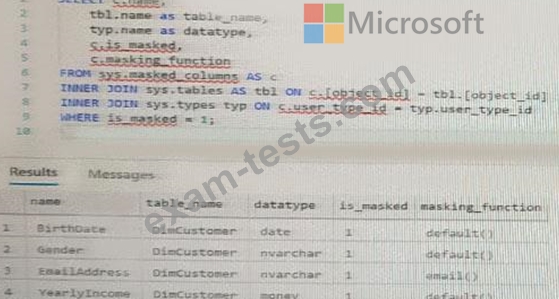
User1 is the only user who has access to the unmasked data.
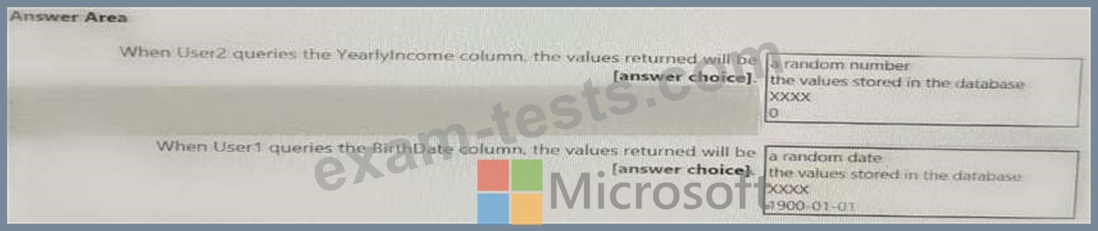
Use the drop-down menus to select the answer choice that completes each statement based on the information presented in the graphic.
User1 executes a query on the database, and the query returns the results shown in the following exhibit.
User1 is the only user who has access to the unmasked data.
Use the drop-down menus to select the answer choice that completes each statement based on the information presented in the graphic.