

Question 66
Note: This question is part of a series of questions that present the same scenario. Each question in the series contains a unique solution that might meet the stated goals. Some question sets might have more than one correct solution, while others might not have a correct solution.
After you answer a question in this section, you will NOT be able to return to it. As a result, these questions will not appear in the review screen.
You have an Azure SQL database named Sales.
You need to implement disaster recovery for Sales to meet the following requirements:
* During normal operations, provide at least two readable copies of Sales.
* Ensure that Sales remains available if a datacenter fails.
Solution: You deploy an Azure SQL database that uses the Business Critical service tier and Availability Zones.
Does this meet the goal?
After you answer a question in this section, you will NOT be able to return to it. As a result, these questions will not appear in the review screen.
You have an Azure SQL database named Sales.
You need to implement disaster recovery for Sales to meet the following requirements:
* During normal operations, provide at least two readable copies of Sales.
* Ensure that Sales remains available if a datacenter fails.
Solution: You deploy an Azure SQL database that uses the Business Critical service tier and Availability Zones.
Does this meet the goal?
Question 67
You have SQL Server on an Azure virtual machine that contains a database named DB1.
The database reports a CHECKSUM error.
You need to recover the database.
How should you complete the statements? To answer, select the appropriate options in the answer area.
NOTE: Each correct selection is worth one point.
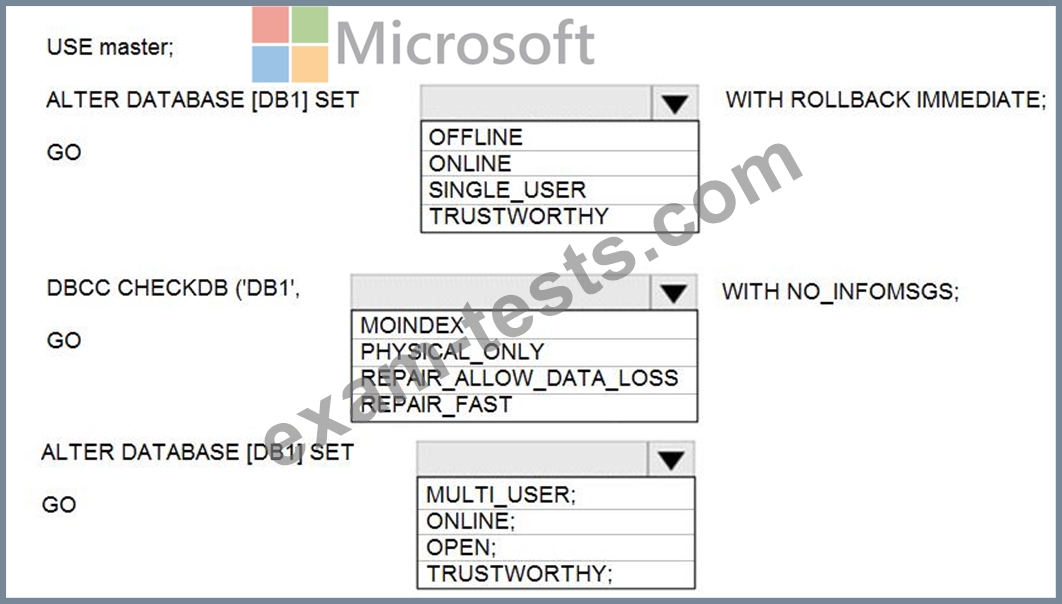
The database reports a CHECKSUM error.
You need to recover the database.
How should you complete the statements? To answer, select the appropriate options in the answer area.
NOTE: Each correct selection is worth one point.

Question 68
You have the following Azure Data Factory pipelines:
Ingest Data from System1
Ingest Data from System2
Populate Dimensions
Populate Facts
Ingest Data from System1 and Ingest Data from System2 have no dependencies. Populate Dimensions must execute after Ingest Data from System1 and Ingest Data from System2. Populate Facts must execute after the Populate Dimensions pipeline. All the pipelines must execute every eight hours.
What should you do to schedule the pipelines for execution?
Ingest Data from System1
Ingest Data from System2
Populate Dimensions
Populate Facts
Ingest Data from System1 and Ingest Data from System2 have no dependencies. Populate Dimensions must execute after Ingest Data from System1 and Ingest Data from System2. Populate Facts must execute after the Populate Dimensions pipeline. All the pipelines must execute every eight hours.
What should you do to schedule the pipelines for execution?
Question 69
You have an Azure SQL database named sqldb1.
You need to minimize the possibility of Query Store transitioning to a read-only state.
What should you do?
You need to minimize the possibility of Query Store transitioning to a read-only state.
What should you do?
Question 70
You have several Azure SQL databases on the same Azure SQL Database server in a resource group named ResourceGroup1.
You must be alerted when CPU usage exceeds 80 percent for any database. The solution must apply to any additional databases that are created on the Azure SQL server.
Which resource type should you use to create the alert?
You must be alerted when CPU usage exceeds 80 percent for any database. The solution must apply to any additional databases that are created on the Azure SQL server.
Which resource type should you use to create the alert?