

Question 26
You have an Azure data factory that has two pipelines named PipelineA and PipelineB.
PipelineA has four activities as shown in the following exhibit.

PipelineB has two activities as shown in the following exhibit.

You create an alert for the data factory that uses Failed pipeline runs metrics for both pipelines and all failure types. The metric has the following settings:
Operator: Greater than
Aggregation type: Total
Threshold value: 2
Aggregation granularity (Period): 5 minutes
Frequency of evaluation: Every 5 minutes
Data Factory monitoring records the failures shown in the following table.
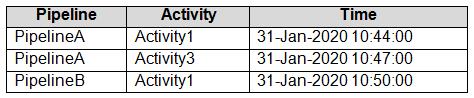
For each of the following statements, select Yes if the statement is true. Otherwise, select No.
NOTE: Each correct selection is worth one point.
PipelineA has four activities as shown in the following exhibit.
PipelineB has two activities as shown in the following exhibit.
You create an alert for the data factory that uses Failed pipeline runs metrics for both pipelines and all failure types. The metric has the following settings:
Operator: Greater than
Aggregation type: Total
Threshold value: 2
Aggregation granularity (Period): 5 minutes
Frequency of evaluation: Every 5 minutes
Data Factory monitoring records the failures shown in the following table.
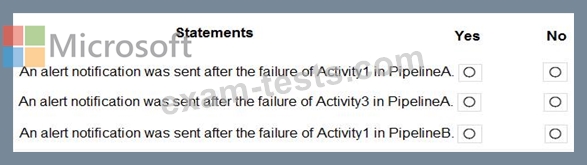
For each of the following statements, select Yes if the statement is true. Otherwise, select No.
NOTE: Each correct selection is worth one point.

Question 27
HOTSPOT
You have an Azure SQL database named DB1. The automatic tuning options for DB1 are configured as shown in the following exhibit.

For each of the following statements, select Yes if the statement is true. Otherwise, select No.
NOTE: Each correct selection is worth one point.
Hot Area:

You have an Azure SQL database named DB1. The automatic tuning options for DB1 are configured as shown in the following exhibit.
For each of the following statements, select Yes if the statement is true. Otherwise, select No.
NOTE: Each correct selection is worth one point.
Hot Area:

Question 28
You have an on-premises app named App1 that stores data in an on-premises Microsoft SQL Server 2016 database named DB1.
You plan to deploy additional instances of App1 to separate Azure regions. Each region will have a separate instance of App1 and DB1. The separate instances of DB1 will sync by using Azure SQL Data Sync.
You need to recommend a database service for the deployment. The solution must minimize administrative effort.
What should you include in the recommendation?
You plan to deploy additional instances of App1 to separate Azure regions. Each region will have a separate instance of App1 and DB1. The separate instances of DB1 will sync by using Azure SQL Data Sync.
You need to recommend a database service for the deployment. The solution must minimize administrative effort.
What should you include in the recommendation?
Question 29
You are creating a new notebook in Azure Databricks that will support R as the primary language but will also support Scala and SQL.
Which switch should you use to switch between languages?
Which switch should you use to switch between languages?
Question 30
You have an Azure SQL database named DB1.
You need to display the estimated execution plan of a query by using the query editor in the Azure portal.
What should you do first?
You need to display the estimated execution plan of a query by using the query editor in the Azure portal.
What should you do first?