Question 56
You configure a long-term retention policy for an Azure SQL database as shown in the exhibit. (Click the Exhibit tab.)

The first weekly backup occurred on January 4, 2020. The dates for the first 10 weekly backups are:
January 4, 2020
January 11, 2020
January 18, 2020
January 25, 2020
February 1, 2020
February 8, 2020
February 15, 2020
February 22, 2020
February 29, 2020
March 7, 2020
Use the drop-down menus to select the answer choice that completes each statement based on the information presented in the graphic.
NOTE: Each correct selection is worth one point.

The first weekly backup occurred on January 4, 2020. The dates for the first 10 weekly backups are:
January 4, 2020
January 11, 2020
January 18, 2020
January 25, 2020
February 1, 2020
February 8, 2020
February 15, 2020
February 22, 2020
February 29, 2020
March 7, 2020
Use the drop-down menus to select the answer choice that completes each statement based on the information presented in the graphic.
NOTE: Each correct selection is worth one point.


Question 57
You have an on-premises Microsoft SQL Server 2019 instance named SQL1 that hosts a database named db1.
You have an Azure subscription that contains an Azure SQL managed instance named MI1 and an Azure Storage account named storage1.
You need to ensure that you can back up db1 to storage1. The solution must meet the following requirements:
* Use block blob storage.
* Maximize security.
You have an Azure subscription that contains an Azure SQL managed instance named MI1 and an Azure Storage account named storage1.
You need to ensure that you can back up db1 to storage1. The solution must meet the following requirements:
* Use block blob storage.
* Maximize security.
Question 58
Note: This question is part of a series of questions that present the same scenario. Each question in the series contains a unique solution that might meet the stated goals. Some question sets might have more than one correct solution, while others might not have a correct solution.
After you answer a question in this section, you will NOT be able to return to it. As a result, these questions will not appear in the review screen.
You have two Azure SQL Database servers named Server1 and Server2. Each server contains an Azure SQL database named Database1.
You need to restore Database1 from Server1 to Server2. The solution must replace the existing Database1 on Server2.
Solution: From Microsoft SQL Server Management Studio (SSMS), you rename Database1 on Server2 as Database2. From the Azure portal, you create a new database on Server2 by restoring the backup of Database1 from Server1, and then you delete Database2.
Does this meet the goal?
After you answer a question in this section, you will NOT be able to return to it. As a result, these questions will not appear in the review screen.
You have two Azure SQL Database servers named Server1 and Server2. Each server contains an Azure SQL database named Database1.
You need to restore Database1 from Server1 to Server2. The solution must replace the existing Database1 on Server2.
Solution: From Microsoft SQL Server Management Studio (SSMS), you rename Database1 on Server2 as Database2. From the Azure portal, you create a new database on Server2 by restoring the backup of Database1 from Server1, and then you delete Database2.
Does this meet the goal?
Question 59
You have an Azure SQL database.
Users report that the executions of a stored procedure are slower than usual. You suspect that a regressed query is causing the performance issue.
You need to view the query execution plan to verify whether a regressed query is causing the issue. The solution must minimize effort.
What should you use?
Users report that the executions of a stored procedure are slower than usual. You suspect that a regressed query is causing the performance issue.
You need to view the query execution plan to verify whether a regressed query is causing the issue. The solution must minimize effort.
What should you use?
Question 60
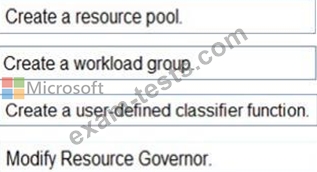
You have an Azure SQL managed instance named SQLMI1 that has Resource Governor enabled and is used by two apps named App1 and App2.
You need to configure SQLMI1 to limit the CPU and memory resources that can be allocated to App1.
Which four actions should you perform in sequence? To answer, move the appropriate actions from the list of actions to the answer area and arrange them in the correct order.

You need to configure SQLMI1 to limit the CPU and memory resources that can be allocated to App1.
Which four actions should you perform in sequence? To answer, move the appropriate actions from the list of actions to the answer area and arrange them in the correct order.