

Question 141
You have an Azure SQL Database instance named DatabaseA on a server named Server1.
You plan to add a new user named App1 to DatabaseA and grant App1 db_datacenter permissions. App1 will use SQL Server Authentication.
You need to create App1. The solution must ensure that App1 can be given access to other databases by using the same credentials.
Which three actions should you perform in sequence? To answer, move the appropriate actions from the list of actions to the answer area and arrange them in the correct order.

You plan to add a new user named App1 to DatabaseA and grant App1 db_datacenter permissions. App1 will use SQL Server Authentication.
You need to create App1. The solution must ensure that App1 can be given access to other databases by using the same credentials.
Which three actions should you perform in sequence? To answer, move the appropriate actions from the list of actions to the answer area and arrange them in the correct order.


Question 142
You have an application that uses a Microsoft SQL Server database on a Microsoft Azure virtual machine.
The application experiences performance issues, which you suspect are related to the connection pooling.
The issues are prevalent only when there are more than 150 concurrent connections.
You need to identify whether the performance issues are related to the connection pooling.
Which dynamic management view should you query?
The application experiences performance issues, which you suspect are related to the connection pooling.
The issues are prevalent only when there are more than 150 concurrent connections.
You need to identify whether the performance issues are related to the connection pooling.
Which dynamic management view should you query?
Question 143
You have an Azure SQL database.
You need to identify whether a delayed query execution is associated to a RESOURCE wait.
How should you complete the Transact -SQL statement? To answer, select the appropriate option in the answer area.
NOTE: Each correct selection is worth one point.

You need to identify whether a delayed query execution is associated to a RESOURCE wait.
How should you complete the Transact -SQL statement? To answer, select the appropriate option in the answer area.
NOTE: Each correct selection is worth one point.

Question 144
You have an on-premises Microsoft SQL Server 2019 instance that hosts a database named DB1.
You plan to perform an online migration of DB1 to an Azure SQL managed instance by using the Azure Database Migration Service.
You need to create a backup of DB1 that is accessible to the Azure Database Migration Service.
What should you run for the backup and where should you store the backup? To answer, select the appropriate options in the answer area.
NOTE: Each correct selection is worth one point.

You plan to perform an online migration of DB1 to an Azure SQL managed instance by using the Azure Database Migration Service.
You need to create a backup of DB1 that is accessible to the Azure Database Migration Service.
What should you run for the backup and where should you store the backup? To answer, select the appropriate options in the answer area.
NOTE: Each correct selection is worth one point.

Question 145
You have an Azure data factory that has two pipelines named PipelineA and PipelineB.
PipelineA has four activities as shown in the following exhibit.

PipelineB has two activities as shown in the following exhibit.

You create an alert for the data factory that uses Failed pipeline runs metrics for both pipelines and all failure types. The metric has the following settings:
Operator: Greater than
Aggregation type: Total
Threshold value: 2
Aggregation granularity (Period): 5 minutes
Frequency of evaluation: Every 5 minutes
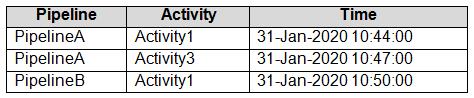
Data Factory monitoring records the failures shown in the following table.
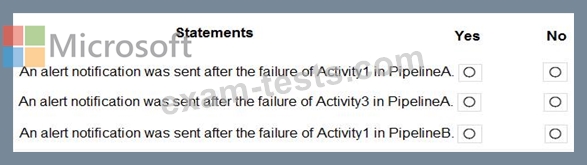
For each of the following statements, select Yes if the statement is true. Otherwise, select No.
NOTE: Each correct selection is worth one point.
PipelineA has four activities as shown in the following exhibit.
PipelineB has two activities as shown in the following exhibit.
You create an alert for the data factory that uses Failed pipeline runs metrics for both pipelines and all failure types. The metric has the following settings:
Operator: Greater than
Aggregation type: Total
Threshold value: 2
Aggregation granularity (Period): 5 minutes
Frequency of evaluation: Every 5 minutes
Data Factory monitoring records the failures shown in the following table.
For each of the following statements, select Yes if the statement is true. Otherwise, select No.
NOTE: Each correct selection is worth one point.
