

Question 171
Your on-premises network contains a server that hosts a 60-TB database named DB 1. The network has a 10-Mbps internet connection.
You need to migrate DB 1 to Azure. The solution must minimize how long it takes to migrate the database.
What should you use?
You need to migrate DB 1 to Azure. The solution must minimize how long it takes to migrate the database.
What should you use?
Question 172
You have a Microsoft SQL Server database named DB1 that contains a table named Table1.
The database role membership for a user named User1 is shown in the following exhibit.

Use the drop-down menus to select the answer choice that completes each statement based on the information presented in the graphic.
NOTE: Each correct selection is worth one point.

The database role membership for a user named User1 is shown in the following exhibit.
Use the drop-down menus to select the answer choice that completes each statement based on the information presented in the graphic.
NOTE: Each correct selection is worth one point.


Question 173
You have an Azure SQL database.
You run the following PowerShell script.

For each of the following statements, select Yes if the statement is true. Otherwise, select No.
NOTE: Each correct selection is worth one point.

You run the following PowerShell script.
For each of the following statements, select Yes if the statement is true. Otherwise, select No.
NOTE: Each correct selection is worth one point.


Question 174
You have an Azure virtual machine named VM1 on a virtual network named VNet1. Outbound traffic from VM1 to the internet is blocked.
You have an Azure SQL database named SqlDb1 on a logical server named SqlSrv1.
You need to implement connectivity between VM1 and SqlDb1 to meet the following requirements:
* Ensure that VM1 cannot connect to any Azure SQL Server other than SqlSrv1.
* Restrict network connectivity to SqlSrv1.
What should you create on VNet1?
You have an Azure SQL database named SqlDb1 on a logical server named SqlSrv1.
You need to implement connectivity between VM1 and SqlDb1 to meet the following requirements:
* Ensure that VM1 cannot connect to any Azure SQL Server other than SqlSrv1.
* Restrict network connectivity to SqlSrv1.
What should you create on VNet1?
Question 175
You have an Azure data factory that has two pipelines named PipelineA and PipelineB.
PipelineA has four activities as shown in the following exhibit.

PipelineB has two activities as shown in the following exhibit.

You create an alert for the data factory that uses Failed pipeline runs metrics for both pipelines and all failure types. The metric has the following settings:
Operator: Greater than
Aggregation type: Total
Threshold value: 2
Aggregation granularity (Period): 5 minutes
Frequency of evaluation: Every 5 minutes
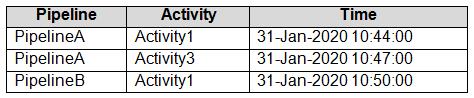
Data Factory monitoring records the failures shown in the following table.
For each of the following statements, select Yes if the statement is true. Otherwise, select No.
NOTE: Each correct selection is worth one point.
PipelineA has four activities as shown in the following exhibit.
PipelineB has two activities as shown in the following exhibit.
You create an alert for the data factory that uses Failed pipeline runs metrics for both pipelines and all failure types. The metric has the following settings:
Operator: Greater than
Aggregation type: Total
Threshold value: 2
Aggregation granularity (Period): 5 minutes
Frequency of evaluation: Every 5 minutes
Data Factory monitoring records the failures shown in the following table.
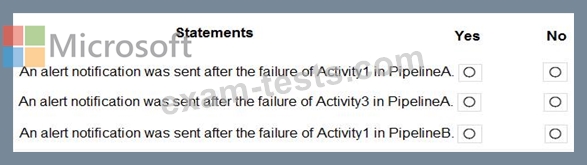
For each of the following statements, select Yes if the statement is true. Otherwise, select No.
NOTE: Each correct selection is worth one point.
