

Question 26
You have an Azure Cosmos DB for NoSQL account that has multiple write regions.
You need to receive an alert when requests that target the database exceed the available request units per second (RU/s).
Which Azure Monitor signal should you use?
You need to receive an alert when requests that target the database exceed the available request units per second (RU/s).
Which Azure Monitor signal should you use?
Question 27
You are designing an Azure Cosmos DB Core (SQL) API solution to store data from IoT devices. Writes from the devices will be occur every second.
The following is a sample of the data.

You need to select a partition key that meets the following requirements for writes:
Minimizes the partition skew
Avoids capacity limits
Avoids hot partitions
What should you do?
The following is a sample of the data.
You need to select a partition key that meets the following requirements for writes:
Minimizes the partition skew
Avoids capacity limits
Avoids hot partitions
What should you do?
Question 28
You have an Azure Cosmos DB Core (SQL) API account used by an application named App1.
You open the Insights pane for the account and see the following chart.

Use the drop-down menus to select the answer choice that answers each question based on the information presented in the graphic.
NOTE: Each correct selection is worth one point.

You open the Insights pane for the account and see the following chart.
Use the drop-down menus to select the answer choice that answers each question based on the information presented in the graphic.
NOTE: Each correct selection is worth one point.

Question 29
You have a container named container1 in an Azure Cosmos DB Core (SQL) API account.
The following is a sample of a document in container1.
{
"studentId": "631282",
"firstName": "James",
"lastName": "Smith",
"enrollmentYear": 1990,
"isActivelyEnrolled": true,
"address": {
"street": "",
"city": "",
"stateProvince": "",
"postal": "",
}
}
The container1 container has the following indexing policy.
{
"indexingMode": "consistent",
"includePaths": [
{
"path": "/*"
},
{
"path": "/address/city/?"
}
],
"excludePaths": [
{
"path": "/address/*"
},
{
"path": "/firstName/?"
}
]
}
For each of the following statements, select Yes if the statement is true. Otherwise, select No.
NOTE: Each correct selection is worth one point.
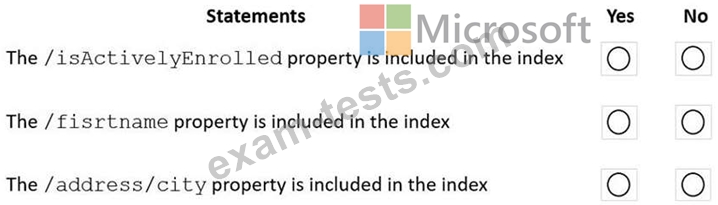
The following is a sample of a document in container1.
{
"studentId": "631282",
"firstName": "James",
"lastName": "Smith",
"enrollmentYear": 1990,
"isActivelyEnrolled": true,
"address": {
"street": "",
"city": "",
"stateProvince": "",
"postal": "",
}
}
The container1 container has the following indexing policy.
{
"indexingMode": "consistent",
"includePaths": [
{
"path": "/*"
},
{
"path": "/address/city/?"
}
],
"excludePaths": [
{
"path": "/address/*"
},
{
"path": "/firstName/?"
}
]
}
For each of the following statements, select Yes if the statement is true. Otherwise, select No.
NOTE: Each correct selection is worth one point.

Question 30
You have an Azure Cosmos DB account named account1 that has a default consistency level of session.
You have an app named App1.
You need to ensure that the read operations of App1 can request either bounded staleness or consistent prefix consistency.
What should you modify for each consistency level? To answer, select the appropriate options in the answer area.
NOTE: Each correct selection is worth one point.

You have an app named App1.
You need to ensure that the read operations of App1 can request either bounded staleness or consistent prefix consistency.
What should you modify for each consistency level? To answer, select the appropriate options in the answer area.
NOTE: Each correct selection is worth one point.
