

Question 46
You have an Azure Cosmos DB for NoSQL account.
You plan 10 create a container named container1. The container1 container will store items that include two properties named nm and age The most commonly executed queries will query container1 for a specific name. The following is a sample of the query.
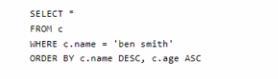
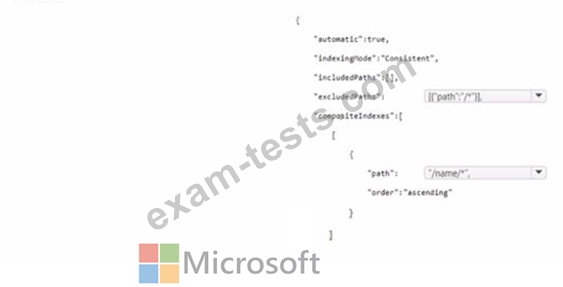
You need to define an opt-in Indexing policy for container1. The solution must meet the following requirements:
* Minimize the number of request units consumed by the queries.
* Ensure that the _etag property is excluded from indexing.
How should you define the indexing poky? To answer, select the appropriate options in the answer area.
NOTE: Each correct selection Is worth one point.

You plan 10 create a container named container1. The container1 container will store items that include two properties named nm and age The most commonly executed queries will query container1 for a specific name. The following is a sample of the query.
You need to define an opt-in Indexing policy for container1. The solution must meet the following requirements:
* Minimize the number of request units consumed by the queries.
* Ensure that the _etag property is excluded from indexing.
How should you define the indexing poky? To answer, select the appropriate options in the answer area.
NOTE: Each correct selection Is worth one point.

Question 47
You have an Azure Cosmos DB for NoSQL account.
The change feed is enabled on a container named invoice.
You create an Azure function that has a trigger on the change feed.
What is received by the Azure function?
The change feed is enabled on a container named invoice.
You create an Azure function that has a trigger on the change feed.
What is received by the Azure function?
Question 48
You have a container in an Azure Cosmos DB Core (SQL) API account.
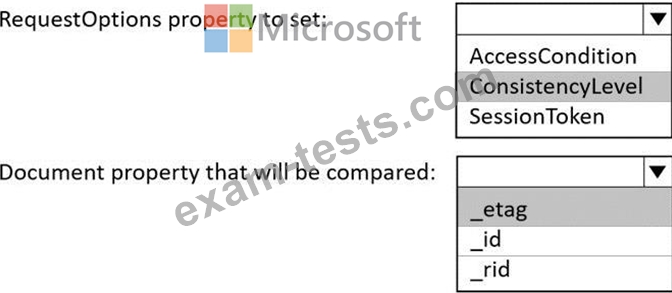
You need to use the Azure Cosmos DB SDK to replace a document by using optimistic concurrency.
What should you include in the code? To answer, select the appropriate options in the answer area.
NOTE: Each correct selection is worth one point.

You need to use the Azure Cosmos DB SDK to replace a document by using optimistic concurrency.
What should you include in the code? To answer, select the appropriate options in the answer area.
NOTE: Each correct selection is worth one point.

Question 49
You have an app that stores data in an Azure Cosmos DB Core (SQL) API account The app performs queries that return large result sets.
You need to return a complete result set to the app by using pagination. Each page of results must return 80 items.
Which three actions should you perform in sequence? To answer, move the appropriate actions from the list of actions to the answer area and arrange them in the correct order.

You need to return a complete result set to the app by using pagination. Each page of results must return 80 items.
Which three actions should you perform in sequence? To answer, move the appropriate actions from the list of actions to the answer area and arrange them in the correct order.

Question 50
You have three containers in an Azure Cosmos DB Core (SQL) API account as shown in the following table.

You have the following Azure functions:
A function named Fn1 that reads the change feed of cn1
A function named Fn2 that reads the change feed of cn2
A function named Fn3 that reads the change feed of cn3
You perform the following actions:
Delete an item named item1 from cn1.
Update an item named item2 in cn2.
For an item named item3 in cn3, update the item time to live to 3,600 seconds.
For each of the following statements, select Yes if the statement is true. Otherwise, select No.
NOTE: Each correct selection is worth one point.

You have the following Azure functions:
A function named Fn1 that reads the change feed of cn1
A function named Fn2 that reads the change feed of cn2
A function named Fn3 that reads the change feed of cn3
You perform the following actions:
Delete an item named item1 from cn1.
Update an item named item2 in cn2.
For an item named item3 in cn3, update the item time to live to 3,600 seconds.
For each of the following statements, select Yes if the statement is true. Otherwise, select No.
NOTE: Each correct selection is worth one point.

