

Question 6
You have a Fabric tenant that uses a Microsoft tower Bl Premium capacity. You need to enable scale-out for a semantic model. What should you do first?
Question 7
You are implementing two dimension tables named Customers and Products in a Fabric warehouse.
You need to use slowly changing dimension (SCO) to manage the versioning of data. The solution must meet the requirements shown in the following table.

Which type of SCD should you use for each table? To answer, drag the appropriate SCD types to the correct tables. Each SCD type may be used once, more than once, or not at all. You may need to drag the split bar between panes or scroll to view content.
NOTE: Each correct selection is worth one point.

You need to use slowly changing dimension (SCO) to manage the versioning of data. The solution must meet the requirements shown in the following table.
Which type of SCD should you use for each table? To answer, drag the appropriate SCD types to the correct tables. Each SCD type may be used once, more than once, or not at all. You may need to drag the split bar between panes or scroll to view content.
NOTE: Each correct selection is worth one point.


Question 8
You have a Fabric tenant that contains customer churn data stored as Parquet files in OneLake. The data contains details about customer demographics and product usage.
You create a Fabric notebook to read the data into a Spark DataFrame. You then create column charts in the notebook that show the distribution of retained customers as compared to lost customers based on geography, the number of products purchased, age. and customer tenure.
Which type of analytics are you performing?
You create a Fabric notebook to read the data into a Spark DataFrame. You then create column charts in the notebook that show the distribution of retained customers as compared to lost customers based on geography, the number of products purchased, age. and customer tenure.
Which type of analytics are you performing?
Question 9
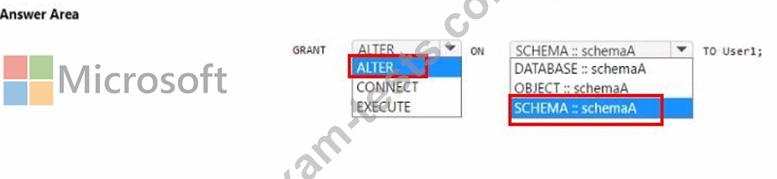
You have a Fabric tenant that contains a warehouse named Warehouse1. Warehouse1 contains three schemas named schemaA, schemaB. and schemaC You need to ensure that a user named User1 can truncate tables in schemaA only.
How should you complete the T-SQL statement? To answer, select the appropriate options in the answer area.
NOTE: Each correct selection is worth one point.
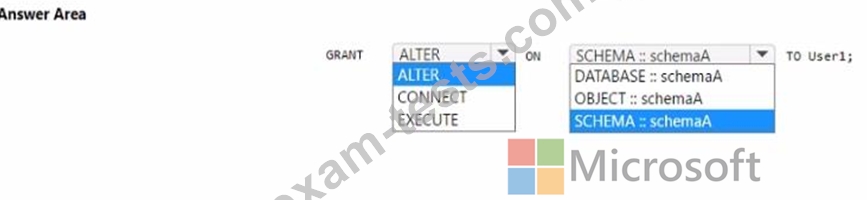
How should you complete the T-SQL statement? To answer, select the appropriate options in the answer area.
NOTE: Each correct selection is worth one point.
Question 10
You have a Fabric tenant that contains a Microsoft Power Bl report.
You are exploring a new semantic model.
You need to display the following column statistics:
* Count
* Average
* Null count
* Distinct count
* Standard deviation
Which Power Query function should you run?
You are exploring a new semantic model.
You need to display the following column statistics:
* Count
* Average
* Null count
* Distinct count
* Standard deviation
Which Power Query function should you run?