A Snowflake table named 'SALES DATA contains a 'TRANSACTION DATE column stored as VARCHAR. The data in this column is inconsistent; some rows have dates in 'YYYY-MM-DD' format, others in 'MM/DD/YYYY' format, and some contain invalid date strings like 'N/A'. You need to standardize all dates to 'YYYY-MM-DD' format and store them in a new column called FORMATTED DATE in a new table 'STANDARDIZED_SALES DATA. Which of the following approaches, using Snowpark Python and SQL, most effectively handles these inconsistencies and minimizes errors during data transformation? Select all that apply:
Correct Answer: B,D
Options B and D are the most effective. Option B uses with different formats to handle inconsistencies. If a format fails, it returns NULL, providing a clean way to handle invalid dates. Combining this with VARCHAR formats the valid dates to 'YYYY-MM-DD'. Option D suggests creating a view. Views are useful for testing transformation logic without immediately impacting the base table, allowing experimentation before committing to a data transformation pipeline. Materializing the data into a table would be a subsequent step, after verifying the transformation's correctness. Option A, while flexible, is less performant because UDFs (User-Defined Functions) generally add overhead compared to built-in SQL functions. Option C is inefficient and not a recommended practice in Snowpark for vectorized operations. Option E will not work in most of the cases, as the AUTO parameter cannot reliably differentiate all provided formats. Furthermore, it does not account for data quality issues where there is no date format.
Question 12
You are analyzing a dataset of website traffic and conversions in Snowflake, aiming to understand the relationship between the number of pages visited CPAGES VISITED) and the conversion rate (CONVERSION_RATE). You perform a simple linear regression using the 'REGR SLOPE and 'REGR INTERCEPT functions. However, after plotting the data and the regression line, you observe significant heteroscedasticity (non-constant variance of errors). Which of the following actions, performed within Snowflake during the data preparation and feature engineering phase, are MOST appropriate to address this heteroscedasticity and improve the validity of your linear regression model? (Select all that apply)
Correct Answer: A,E
Heteroscedasticity violates one of the assumptions of linear regression, leading to unreliable standard errors and potentially biased coefficient estimates. Option A (Logarithmic Transformation): Applying a logarithmic transformation to the dependent variable ('CONVERSION_RATE) is a common technique to stabilize the variance when the variance increases with the mean. This is particularly effective when the errors are proportional to the dependent variable. Option E (Box-Cox Transformation): A Box-Cox transformation is a more general approach to transforming the dependent variable to achieve normality and homoscedasticity. It estimates a parameter (lambda) that determines the optimal transformation. Log transformation is a special case of box cox transformation, where lambda = O. Option B describes weighted least squares regression, but directly implementing this within Snowflake SQL efficiently, including calculating the initial OLS regression and subsequent weights, would be complex and may not be practically feasible without Snowpark/Python integration. It's theoretically correct but challenging to implement in pure SQL. Option C, Standardization, addresses multicollinearity issues (if present) but doesn't directly tackle heteroscedasticity. It scales the variables but doesn't change the relationship between the mean and variance of the errors. Option D, outlier removal, can be a valid step in data preparation, but it's not a direct solution to heteroscedasticity. It might help reduce the impact of outliers on the model, but it doesn't address the underlying pattern of non-constant variance. Outlier treatment requires calculation of residuals first, which is not always easy, and may cause data loss, but it might indirectly reduce heteroscedasticity.
Question 13
You have trained a logistic regression model in Python using scikit-learn and plan to deploy it as a Python stored procedure in Snowflake. You need to serialize the model for deployment. Consider the following code snippet:
Correct Answer: C,D
The correct answers are C and D. The 'model_bytes' variable is defined within the scope of the 'train_moder function and is not accessible within the 'predict' function (C). Additionally, using 'pickle' to deserialize data from untrusted sources poses significant security risks. Snowflake stages can be used to store model objects, however, in this example, the model is serialized but never uploaded to the stage, rendering it useless. Option B is incorrect because the code will fail due to scope issue. Option A is incorrect because code will not execute successfully and pickle library can be potentially dangerous.
Question 14
You've built a customer churn prediction model in Snowflake, and are using the AUC as your primary performance metric. You notice that your model consistently performs well (AUC > 0.85) on your validation set but significantly worse (AUC < 0.7) in production. What are the possible reasons for this discrepancy? (Select all that apply)
Correct Answer: A,B,C,D
A, B, C, and D are all valid reasons for performance degradation in production. Sampling bias (A) means the training/validation data doesn't accurately reflect the production data. Temporal bias (B) arises when customer behavior changes over time. Overfitting (C) leads to good performance on the training/validation set but poor generalization to new data. Missing data (D) can negatively impact the model's ability to make accurate predictions. AUC is a reliable metric, especially when combined with other metrics, so E is incorrect.
Question 15
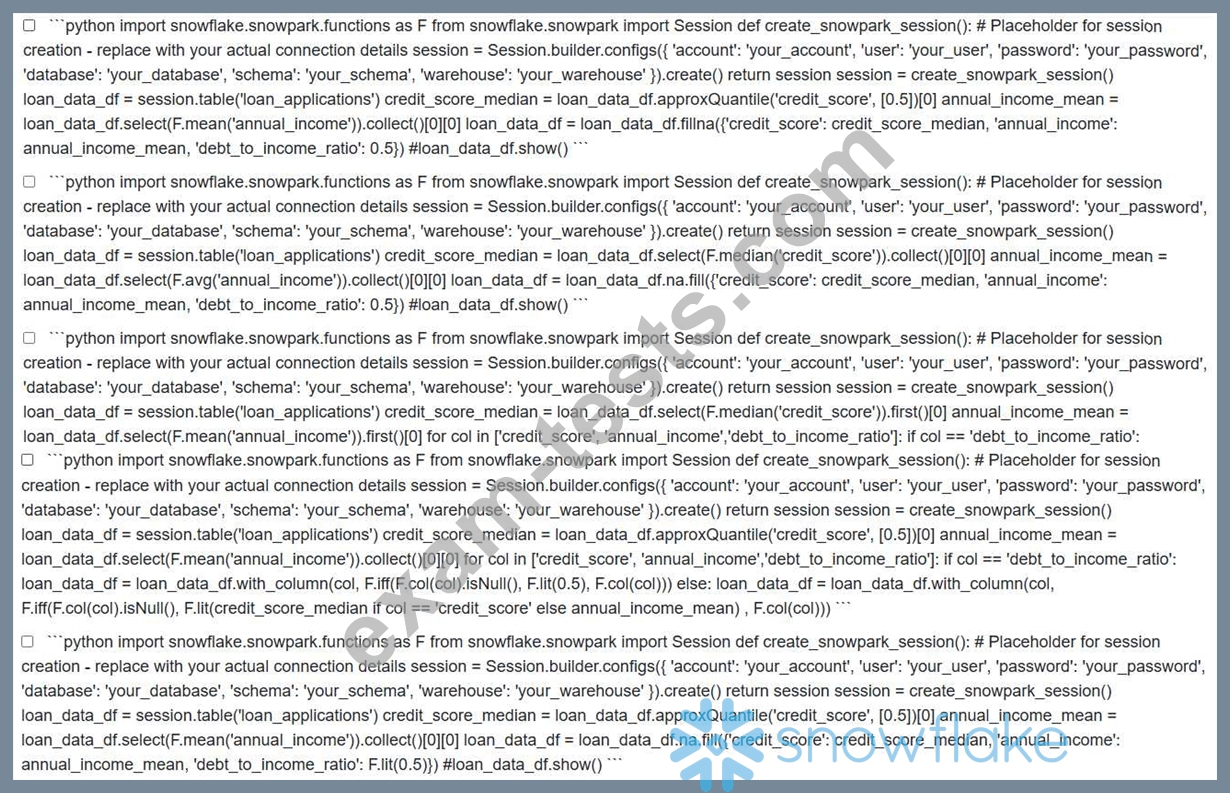
You are building a model to predict loan defaults using data stored in Snowflake. As part of your feature engineering process within a Snowflake Notebook, you need to handle missing values in several columns: 'annual _ income', and You want to use a combination of imputation strategies: replace missing values with the median, 'annual_income' with the mean, and with a constant value of 0.5. You are leveraging the Snowpark DataFrame API. Which of the following code snippets correctly implements this imputation strategy?
Correct Answer: A,D
Options A and D both correctly implement the specified imputation strategy. Option A uses 'fillna' method with respective median and mean values, calculated using 'approxQuantile' and mean for missing values.Option B uses 'na.fill' which is used in Spark, and Snowflake is not compatible. Option C calculates the median and mean, but incorrectly tries to use the local Python variables inside F.lit() functions, which are executed on the Snowflake server. Option D uses loops for column selection. Option E tries to apply a literal value within a dictionary being used to fill the missing values. This is not correct, and it's important to ensure that a correct implementation is used.