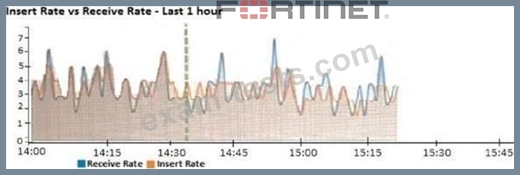
Refer to the exhibit. Which statement is correct regarding the event displayed?
Correct Answer: D
Question 2
View the exhibit. What does the data point at 14:35 tell you?
Correct Answer: C
Question 3
What is the purpose of running the command diagnose sql status sqlreportd?
Correct Answer: C
The command diagnose sql status sqlreportd is used in FortiAnalyzer to obtain specific information about the SQL reporting process and caching status. Here's what this command accomplishes and an analysis of each option: Command Functionality: sqlreportd is the FortiAnalyzer daemon responsible for managing SQL-based reporting processes. The diagnose sql status sqlreportd command provides information on active SQL query connections and the hcache (historical cache) status, which helps in monitoring and troubleshooting SQL report generation. Option Analysis: Option A - To View a List of Scheduled Reports: This option is incorrect because the command does not list scheduled reports. Instead, it focuses on SQL reporting processes and cache details. Option B - To List the Current SQL Processes Running: While the command may show active SQL connections, its primary focus is not a detailed list of all SQL processes but rather the connections and cache status for reporting. Option C - To Display the SQL Query Connections and hcache Status: This is correct. The command specifically provides information on SQL query connections related to the reporting process (sqlreportd) and displays the hcache status. Option D - To Identify the Database Log Insertion Status: This is incorrect. The command does not provide details on log insertion status. Log insertion status is typically monitored through different diagnostic commands focused on database processes and log handling. Conclusion: Correct Answe r : C. To display the SQL query connections and hcache status This command is used to monitor SQL reporting activities and cache status, aiding in the analysis of report generation performance and connection health. Reference: FortiAnalyzer 7.4.1 documentation on SQL diagnostic commands, particularly those related to reporting (sqlreportd) and caching mechanisms.
Question 4
Which two statements are true regarding fabric connectors? (Choose two.)
Correct Answer: A,C
Question 5
Which SQL query is in the correct order to query to database in the FortiAnalyzer?
Correct Answer: D
In FortiAnalyzer's SQL query syntax, the typical order for querying the database follows the standard SQL format, which is: SELECT <column(s)> FROM <table> WHERE <condition(s)> GROUP BY <column(s)> Option D correctly follows this structure: SELECT devid FROM $log: This specifies that the query is selecting the devid column from the $log table. WHERE 'user' = ': This part of the query is intended to filter results based on a condition involving the user column. Although there appears to be a minor typographical issue (possibly missing the user value after =), it structurally adheres to the correct SQL order. GROUP BY devid: This groups the results by devid, which is correctly positioned at the end of the query. Let's briefly examine why the other options are incorrect: Option A: SELECT devid FROM $log GROUP BY devid WHERE 'user', 'users1' This is incorrect because the GROUP BY clause appears before the WHERE clause, which is out of order in SQL syntax. Option B: SELECT FROM $log WHERE devid 'user', USER1' GROUP BY devid This is incorrect because it lacks a column in the SELECT statement and the WHERE clause syntax is malformed. Option C: SELCT devid WHERE 'user' - 'USER1' FROM $log GROUP BY devid This is incorrect because the SELECT keyword is misspelled as SELCT, and the WHERE condition syntax is invalid.