

Question 11
In an operator's MPLSVPN network, there are two devices, PE1 and PE2, for MPLSVPN data forwarding. PE1 receives a 172.16.1.0/24 private network route from the client, and transforms it into a VPNv4 route on PE1 and assigns labels. Released to PE2 as 1027. The outgoing label of the MPLSLSR-ID from PE2 to PE1 is 1025.
When the client on PE2 accesses 172.16.1.0/24, the inner and outer labels of the frame sent by PE2 should be the combination of the following options?
When the client on PE2 accesses 172.16.1.0/24, the inner and outer labels of the frame sent by PE2 should be the combination of the following options?
Question 12
OSPFv2 is an IGP running on an IPv4 network, OSPFvV3 is an ICP running on an IPv6 network. OSPFv3 and OSPFv2 have the same message types, including Hallo messages, DD messages, LSU messages, LSU messages and SACK messages.
Regarding OSPFv3 packets, which of the following statements is correct?
Regarding OSPFv3 packets, which of the following statements is correct?
Question 13
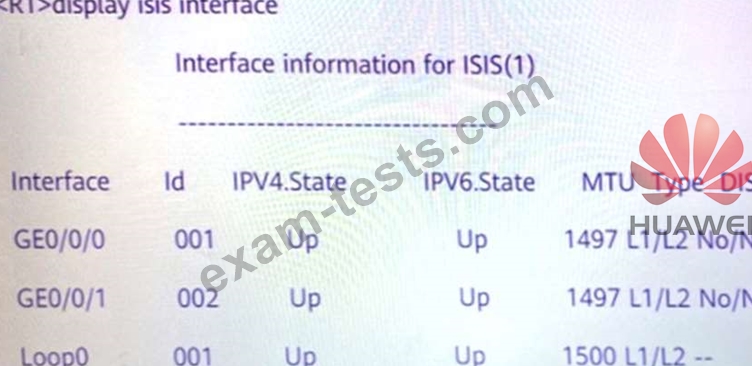
According to this picture, what can we judge? (Multiple choice)
Question 14
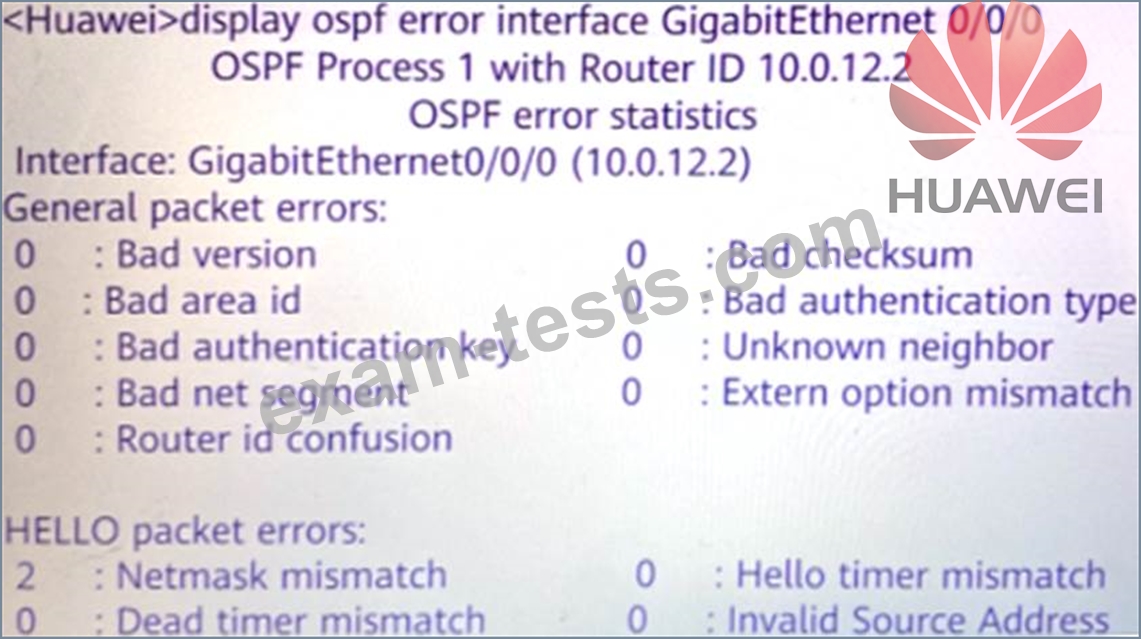
A network engineer outputs the following information when troubleshooting OSPF. Based on this, determine which reason causes the adjacency relationship to fail to be established normally?
Question 15
A certain park deployed IPv6 for service testing. At the initial stage of deployment, engineers wanted to achieve network interoperability through Pv6 static routing. When creating IPv6 static routes. You can specify both the outgoing interface and the next hop, or only the outgoing interface or only the next hop.