

Question 11
Exhibit.

RTA is an edge route of the MPLS backbone network. It provides the access for users under layer 2 switches
and differentiates user by subinterface. User access VALN 100 and has subscribed to the His ViIP , and
services. According to 802 1p priorities, the value 0 indicates the HIS service, 1 indicates the VoIp service and
4 indicate the IPTV service. The DiffSerc model is deployed in E-LSP mode on the MPLS network,
And the STC is configured for subinterface on the access side of RTA (the qos phb disable command is not
configured). Outgoing on the traffic on the G1/0/0.1 suninterface involves the His VoIP, and services on the
access side of RTA. Which statements about EXP about values corresponding to these three services is true?
RTA is an edge route of the MPLS backbone network. It provides the access for users under layer 2 switches
and differentiates user by subinterface. User access VALN 100 and has subscribed to the His ViIP , and
services. According to 802 1p priorities, the value 0 indicates the HIS service, 1 indicates the VoIp service and
4 indicate the IPTV service. The DiffSerc model is deployed in E-LSP mode on the MPLS network,
And the STC is configured for subinterface on the access side of RTA (the qos phb disable command is not
configured). Outgoing on the traffic on the G1/0/0.1 suninterface involves the His VoIP, and services on the
access side of RTA. Which statements about EXP about values corresponding to these three services is true?
Question 12
Exhibit:

Which of the following statements are false?
Which of the following statements are false?
Question 13
Which of the following statements about the MAC address learning in VPLS are true? (ACD)
Question 14
As shown in the figure, DUT stands for the device under test and RTA is used to support the test. Which combination of the following configurations is mandatory for fast convergence?
1. BFD
2. Minimum LSP refreshing interval
3. Most sensitive SPF timer
4. Minimum Hello packet sending interval
5. Minimum LSP sending interval
6. Longest computing time of SPF slices
7. Minimum LSP retransmission interval
8. Minimum LSP generation time
9. Flash-flood
10. GR function
11. Setting cost-style to wide
1. BFD
2. Minimum LSP refreshing interval
3. Most sensitive SPF timer
4. Minimum Hello packet sending interval
5. Minimum LSP sending interval
6. Longest computing time of SPF slices
7. Minimum LSP retransmission interval
8. Minimum LSP generation time
9. Flash-flood
10. GR function
11. Setting cost-style to wide
Question 15
Exhibit.
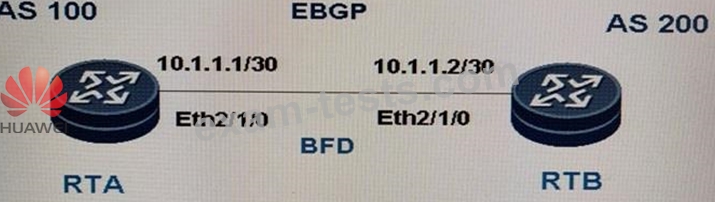
As shown in the figure, RTA and have one BGP session. To detect fault fast,the BFD for BGP feature needs to
be configured on RTA and RTB. BGP-related configurations are as follows:
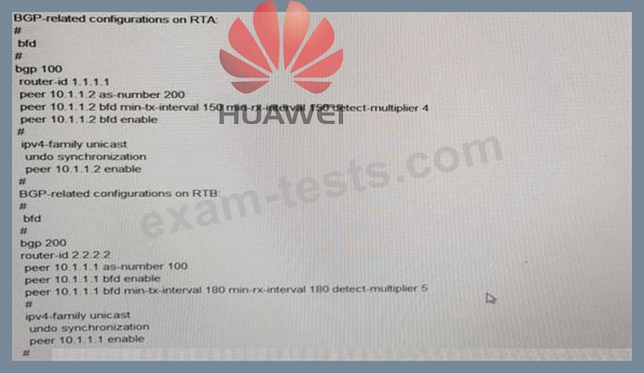
The only Ethernet link between RTA and RTB becomes faulty when the BGP neighbor session is in
ESTABLISHED state and the BFD session is in the UP state. Which statements is true? (Note: BFD works in
asynchronous mode)
As shown in the figure, RTA and have one BGP session. To detect fault fast,the BFD for BGP feature needs to
be configured on RTA and RTB. BGP-related configurations are as follows:
The only Ethernet link between RTA and RTB becomes faulty when the BGP neighbor session is in
ESTABLISHED state and the BFD session is in the UP state. Which statements is true? (Note: BFD works in
asynchronous mode)