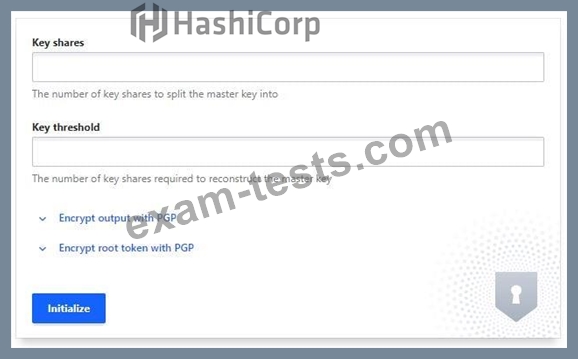
You've hit the URL for the Vault UI, but you're presented with this screen. Why doesn't Vault present you with a way to log in?
Correct Answer: B
Comprehensive and Detailed in Depth Explanation: The initialization page means Vault is new or reset. Let's evaluate: * A:Storage issues don't trigger this screen; they'd cause errors post-init. Incorrect. * B:Vault requires initialization (vault operator init) to set up keys and enable login. Correct. * C:Policies apply post-login, not pre-init. Incorrect. * D:Config errors would prevent Vault from starting, not show this screen. Incorrect. Overall Explanation from Vault Docs: "Before Vault can be used, it must be initialized and unsealed... This screen indicates Vault has not been initialized yet." Reference:https://developer.hashicorp.com/vault/docs/commands/operator/init
Question 77
As a best practice, the root token should be stored in which of the following ways?
Correct Answer: A
The root token is the initial token created when initializing Vault. It has unlimited privileges and can perform any operation in Vault. As a best practice, the root token should be revoked and never stored after initial setup. This is because the root token is a single point of failure and a potential security risk if it is compromised or leaked. Instead of using the root token, Vault operators should create other tokens with appropriate policies and roles that allow them to perform their tasks. If a new root token is needed in an emergency, the vault operator generate-root command can be used to create one on-the-fly with the consent of a quorum of unseal key holders. References: Tokens | Vault | HashiCorp Developer, Generate root tokens using unseal keys | Vault | HashiCorp Developer
Question 78
When generating dynamic credentials, Vault also creates associated metadata, including information like time duration, renewability, and more, and links it to the credentials. What is this referred to as?
Correct Answer: C
Comprehensive and Detailed in Depth Explanation: * A:Secrets are the credentials themselves, not the metadata. Incorrect. * B:Tokens authenticate clients, not the metadata for credentials. Incorrect. * C:A lease is metadata tied to dynamic secrets, managing their lifecycle (TTL, renewability). Correct. * D:Secrets engines generate secrets, not the metadata. Incorrect. Overall Explanation from Vault Docs: "With every dynamic secret... Vault creates a lease: metadata containing TTL, renewability, etc." Reference:https://developer.hashicorp.com/vault/docs/concepts/lease
Question 79
Your co-worker has asked you to perform certain operations in Vault and has provided you with a token accessor (not the token itself). What Vault operations would you be allowed to perform using only the provided accessor? (Select three)
Correct Answer: A,B,D
Comprehensive and Detailed In-Depth Explanation: A token accessor is a reference to a token, not the token itself, and supports limited operations: * A: vault token renew -accessor <accessor> extends the token's TTL if renewable, per the token docs. * B: vault token revoke -accessor <accessor> revokes the token, making it invalid, a supported accessor action. * D: vault token lookup -accessor <accessor> displays token properties (e.g., TTL, policies), a key accessor use case. * C: Creating child tokens requires the parent token, not just its accessor, as it involves authentication and policy inheritance, which accessors can't perform. Accessors can't authenticate to Vault for secret access; they're for management tasks like these, per the tokens documentation. References: Token Accessors Token Commands
Question 80
You are configuring your application to retrieve a new PKI certificate upon provisioning. The Vault admins have given you an AppRole role-id and secret-id to inject into the CI/CD pipeline job that provisions your app. The application uses the credentials to successfully authenticate to Vault using the API. Which of the following is true about the step next required after authenticating to Vault?
Correct Answer: A
Comprehensive and Detailed In-Depth Explanation: After authenticating with AppRole using the role-id and secret-id via the API (e.g., POST /v1/auth/approle /login), Vault returns a response containing a client_token. This token must be extracted for subsequent requests, such as retrieving a PKI certificate. The Vault documentation states: "When you use the Vault API to authenticate, the Vault API response will include a client_token that is tied to a specific policy. Once you receive that response, it is up to the user (or application) to parse that response and retrieve the token. Once the token is retrieved, a second API request needs to be sent to Vault to request the new PKI certificate." -Vault API: AppRole * A: Correct. The client_token from the response (e.g., under .auth.client_token) is required for the next request (e.g., POST /v1/pki/issue/<role>): "The client token is necessary to make subsequent requests to Vault, including requesting the new PKI certificate." -Vault API Documentation * B: Incorrect. Authentication doesn't return a PKI certificate; a separate request is needed. * C: Incorrect. The role-id and secret-id are for authentication, not certificate retrieval: "Authentication and interaction with a secrets engine are separate actions." -Vault API: AppRole * D: Partially true but vague; it omits the critical step of retrieving the token first. References: Vault API: AppRole Vault PKI Secrets Engine