

Question 6
Refer to the exhibit.
Refer to the exhibit.
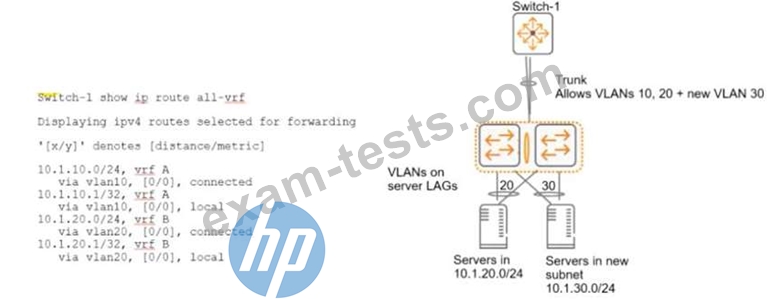
You are adding a VLAN 30, subnet 10.0.30.0/24 to the network shown in the exhibit. (This network is simplified to just the relevant switches for this item.) This subnet belongs in VRF A, and you have added a Layer 3 VLAN 30 interface attached to this VRF on Switch-1. You want to make the services in this VLAN available to devices in 10.1.20.0/24 in VRF B.
Is this part of a valid setup for meeting these requirements?
Solution: Add VRF B as the secondary VRF on VLAN interface 30.
Refer to the exhibit.
You are adding a VLAN 30, subnet 10.0.30.0/24 to the network shown in the exhibit. (This network is simplified to just the relevant switches for this item.) This subnet belongs in VRF A, and you have added a Layer 3 VLAN 30 interface attached to this VRF on Switch-1. You want to make the services in this VLAN available to devices in 10.1.20.0/24 in VRF B.
Is this part of a valid setup for meeting these requirements?
Solution: Add VRF B as the secondary VRF on VLAN interface 30.
Question 7
Does this correctly describe how the Virtual Switching Extension (VSX) fabric reacts to various component failure scenarios?
Solution: The ISL and keepalive goes down, and after a few seconds, the keepalive link restores. Switch-l and Switch-2 remains up. The Split-recovery mode is enabled. In this case the secondary switch shutdowns SVls when keepalive is restored.
Solution: The ISL and keepalive goes down, and after a few seconds, the keepalive link restores. Switch-l and Switch-2 remains up. The Split-recovery mode is enabled. In this case the secondary switch shutdowns SVls when keepalive is restored.
Question 8
Does this correctly describe NetEdit's notification capabilities?
Solution: NetEdit notifies admins of errors using Its Internal email server.
Solution: NetEdit notifies admins of errors using Its Internal email server.
Question 9
Is this correct positioning of AtubaOS-CX switches in the data center?
Solution: Aruba CX 8325 switches are an appropriate choice for leaf switches in a leaf-spine topology that uses Virtual Extensible LAN (VXLAN) with Ethernet VPN (EVPN).
Solution: Aruba CX 8325 switches are an appropriate choice for leaf switches in a leaf-spine topology that uses Virtual Extensible LAN (VXLAN) with Ethernet VPN (EVPN).
Question 10
The architect designs a spine and leaf network for a single data center that will use multiple leaf switches as Virtual Tunnel End Points (VTEP). The architect needs to select the type of Integrated Routing & Bridging (IRB) for the solution.
Is this statement about the IRB type true?
Solution: In the Asymmetric IRB egress VTEPs bridge the traffic to the destination networks.
Is this statement about the IRB type true?
Solution: In the Asymmetric IRB egress VTEPs bridge the traffic to the destination networks.