
- Home
- PECB Certification
- ISO-IEC-27001-Lead-Auditor Exam
- PECB.ISO-IEC-27001-Lead-Auditor.v2024-10-22.q296 Practice Test

Question 1
You are an experienced ISMS audit team leader conducting a third-party surveillance audit of an internet services provider. You are reviewing the organization's risk assessment processes for conformity with ISO/IEC 27001:2022.
Which three of the following audit findings would prompt you to raise a nonconformity report?
Which three of the following audit findings would prompt you to raise a nonconformity report?
Correct Answer: B,E,F
Explanation
The three audit findings that would prompt you to raise a nonconformity report are:
*The organisation is treating information security risks in the order in which they are identified
*The organisation's risk assessment criteria have not been reviewed and approved by top management
*The organisation's information security risk assessment process is based solely on an assessment of the impact of each risk According to ISO/IEC 27001:2022, clause 6.1.2, the organisation must establish and maintain an information security risk management process that is consistent with the organisation's context and aligned with its overall risk management approach1. This process must include the following steps:
*Establishing the risk assessment criteria, which must be approved by top management and reflect the organisation's risk appetite and objectives2
*Identifying the information security risks, which must consider the assets, threats, vulnerabilities, impacts, and likelihoods3
*Analysing the information security risks, which must determine the levels of risk and compare them with the risk criteria4
*Evaluating the information security risks, which must prioritise the risks and decide whether they need treatment or not5 Therefore, the audit findings B, E, and F indicate that the organisation is not following the required steps of the information security risk management process, and thus are nonconformities with the standard.
The other audit findings are not necessarily nonconformities, as they may be acceptable depending on the organisation's context and justification. For example:
*Audit finding A may be acceptable if the organisation has identified and treated the additional information security risks that are relevant to its scope and objectives, and has documented the rationale for doing so6
*Audit finding C may be acceptable if the organisation has assigned clear roles and responsibilities for the information security risk management process, and has ensured that the risk owners have the authority and competence to manage the risks7
*Audit finding D may be acceptable if the organisation has defined and communicated the meaning and implications of the emoji-based risk classification, and has ensured that it is consistent with the risk criteria and the risk treatment process8
*Audit finding G may be acceptable if the organisation has justified the use of discrete values for the probability of the information security risks, and has ensured that they are realistic and consistent with the risk criteria and the risk analysis method9
*Audit finding H may be acceptable if the organisation has established and maintained different systems for assessing operational and strategic information security risks, and has ensured that they are integrated and aligned with the overall risk management approach and the ISMS objectives10 References: 1: ISO/IEC 27001:2022, 6.1.2; 2: ISO/IEC 27001:2022, 6.1.2 a); 3: ISO/IEC 27001:2022, 6.1.2 b); 4: ISO/IEC 27001:2022, 6.1.2 c); 5: ISO/IEC 27001:2022, 6.1.2 d); 6: ISO/IEC 27001:2022, A.0.2; 7:
ISO/IEC 27001:2022, 5.3; 8: ISO/IEC 27001:2022, 6.1.2 a) 2); 9: ISO/IEC 27001:2022, 6.1.2 c) 2); 10:
ISO/IEC 27001:2022, 6.1.2 a) 1); : ISO/IEC 27001:2022; : ISO/IEC 27001:2022; : ISO/IEC 27001:2022; :
ISO/IEC 27001:2022; : ISO/IEC 27001:2022; : ISO/IEC 27001:2022; : ISO/IEC 27001:2022; : ISO/IEC
27001:2022; : ISO/IEC 27001:2022; : ISO/IEC 27001:2022
The three audit findings that would prompt you to raise a nonconformity report are:
*The organisation is treating information security risks in the order in which they are identified
*The organisation's risk assessment criteria have not been reviewed and approved by top management
*The organisation's information security risk assessment process is based solely on an assessment of the impact of each risk According to ISO/IEC 27001:2022, clause 6.1.2, the organisation must establish and maintain an information security risk management process that is consistent with the organisation's context and aligned with its overall risk management approach1. This process must include the following steps:
*Establishing the risk assessment criteria, which must be approved by top management and reflect the organisation's risk appetite and objectives2
*Identifying the information security risks, which must consider the assets, threats, vulnerabilities, impacts, and likelihoods3
*Analysing the information security risks, which must determine the levels of risk and compare them with the risk criteria4
*Evaluating the information security risks, which must prioritise the risks and decide whether they need treatment or not5 Therefore, the audit findings B, E, and F indicate that the organisation is not following the required steps of the information security risk management process, and thus are nonconformities with the standard.
The other audit findings are not necessarily nonconformities, as they may be acceptable depending on the organisation's context and justification. For example:
*Audit finding A may be acceptable if the organisation has identified and treated the additional information security risks that are relevant to its scope and objectives, and has documented the rationale for doing so6
*Audit finding C may be acceptable if the organisation has assigned clear roles and responsibilities for the information security risk management process, and has ensured that the risk owners have the authority and competence to manage the risks7
*Audit finding D may be acceptable if the organisation has defined and communicated the meaning and implications of the emoji-based risk classification, and has ensured that it is consistent with the risk criteria and the risk treatment process8
*Audit finding G may be acceptable if the organisation has justified the use of discrete values for the probability of the information security risks, and has ensured that they are realistic and consistent with the risk criteria and the risk analysis method9
*Audit finding H may be acceptable if the organisation has established and maintained different systems for assessing operational and strategic information security risks, and has ensured that they are integrated and aligned with the overall risk management approach and the ISMS objectives10 References: 1: ISO/IEC 27001:2022, 6.1.2; 2: ISO/IEC 27001:2022, 6.1.2 a); 3: ISO/IEC 27001:2022, 6.1.2 b); 4: ISO/IEC 27001:2022, 6.1.2 c); 5: ISO/IEC 27001:2022, 6.1.2 d); 6: ISO/IEC 27001:2022, A.0.2; 7:
ISO/IEC 27001:2022, 5.3; 8: ISO/IEC 27001:2022, 6.1.2 a) 2); 9: ISO/IEC 27001:2022, 6.1.2 c) 2); 10:
ISO/IEC 27001:2022, 6.1.2 a) 1); : ISO/IEC 27001:2022; : ISO/IEC 27001:2022; : ISO/IEC 27001:2022; :
ISO/IEC 27001:2022; : ISO/IEC 27001:2022; : ISO/IEC 27001:2022; : ISO/IEC 27001:2022; : ISO/IEC
27001:2022; : ISO/IEC 27001:2022; : ISO/IEC 27001:2022
Question 2
What controls can you do to protect sensitive data in your computer when you go out for lunch?
Correct Answer: C
Explanation
You should lock your computer by pressing Windows+L or CTRL-ALT-DELETE and then click "Lock Computer", because this is the most effective way to protect sensitive data in your computer when you go out for lunch. By locking your computer, you are preventing unauthorized access to your computer and its contents, as well as complying with the organization's access control policy and information security policy.
Locking your computer requires a password or a biometric authentication to unlock it, which adds a layer of security to your data. The other options are not sufficient or reliable, as they do not prevent someone from accessing your computer or viewing your screen. References: [CQI & IRCA Certified ISO/IEC 27001:2022 Lead Auditor Training Course], ISO/IEC 27001:2022 Information technology - Security techniques - Information security management systems - Requirements, How to lock your PC
You should lock your computer by pressing Windows+L or CTRL-ALT-DELETE and then click "Lock Computer", because this is the most effective way to protect sensitive data in your computer when you go out for lunch. By locking your computer, you are preventing unauthorized access to your computer and its contents, as well as complying with the organization's access control policy and information security policy.
Locking your computer requires a password or a biometric authentication to unlock it, which adds a layer of security to your data. The other options are not sufficient or reliable, as they do not prevent someone from accessing your computer or viewing your screen. References: [CQI & IRCA Certified ISO/IEC 27001:2022 Lead Auditor Training Course], ISO/IEC 27001:2022 Information technology - Security techniques - Information security management systems - Requirements, How to lock your PC
Question 3
Select the words that best complete the sentence:
To complete the sentence with the best word(s), click on the blank section you want to complete so that it is highlighted in red, and then click on the applicable text from the options below. Alternatively, you may drag and drop the option to the appropriate blank section.
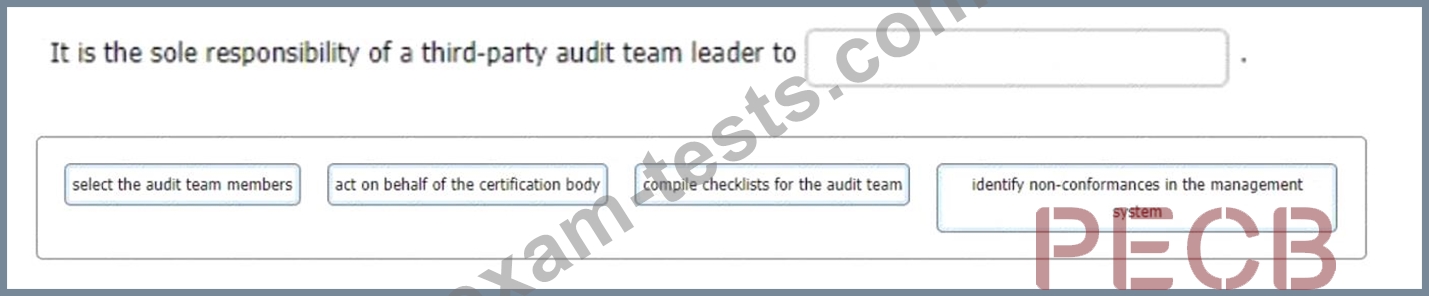
To complete the sentence with the best word(s), click on the blank section you want to complete so that it is highlighted in red, and then click on the applicable text from the options below. Alternatively, you may drag and drop the option to the appropriate blank section.
Correct Answer:
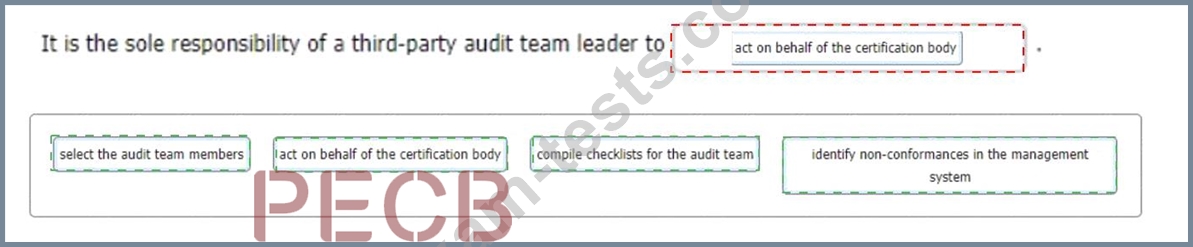
Explanation

* A third-party audit team leader is a person who leads an audit team that conducts audits on behalf of an external organization, such as a certification body, that provides certification or accreditation services to other organizations12.
* One of the main responsibilities of a third-party audit team leader is to act on behalf of the certification body, which means to represent its interests, policies, and procedures during the audit process12.
* Acting on behalf of the certification body involves communicating with the audit client and the auditee, planning and conducting the audit, reporting and evaluating the audit results, and making recommendations for certification or accreditation decisions12.
* Acting on behalf of the certification body also requires maintaining professional integrity, impartiality, confidentiality, and competence throughout the audit process12.
References :=
* ISO 19011:2022 Guidelines for auditing management systems
* ISO/IEC 17021-1:2022 Conformity assessment - Requirements for bodies providing audit and certification of management systems - Part 1: Requirements
Question 4
Objectives, criteria, and scope are critical features of a third-party ISMS audit. Which two issues are audit objectives?
Correct Answer: B,D
Audit objectives are the specific purposes or goals that the customer or the certification body wants to achieve through the audit. They define what the audit intends to accomplish and provide the basis for planning and conducting the audit. Audit objectives may vary depending on the type, scope, and criteria of the audit, but they should be clear, measurable, and achievable.
Some examples of audit objectives for a third-party ISMS audit are:
Assess conformity with ISO/IEC 27001 requirements: This objective means that the audit aims to verify that the organisation's ISMS meets the requirements of the ISO/IEC 27001 standard, which specifies the best practices for establishing, implementing, maintaining, and improving an information security management system. The audit will evaluate the organisation's ISMS documentation, processes, controls, and performance against the standard's clauses and annex A controls.
Confirm sites operating the ISMS: This objective means that the audit aims to confirm that the organisation's ISMS covers all the relevant sites or locations where the organisation operates or provides its services. The audit will verify that the scope of the ISMS is accurate and consistent with the organisation's context, objectives, and risks.
The other phrases are not audit objectives, but rather:
Evaluate customer processes and functions: This is not an audit objective, but rather a possible audit criterion or a requirement that the organisation's processes and functions should meet. The audit criterion is the reference against which the audit evidence is compared to determine conformity or nonconformity. The audit criterion may include ISO/IEC 27001 requirements, customer requirements, or other applicable standards or regulations.
Fulfil the audit plan: This is not an audit objective, but rather a task or an activity that the auditor performs during the audit. The audit plan is a document that describes the arrangements and details of the audit, such as the objectives, scope, criteria, schedule, roles, and responsibilities. The auditor should follow and fulfil the audit plan to ensure that the audit is conducted effectively and efficiently.
Determine the scope of the ISMS: This is not an audit objective, but rather a prerequisite or an input for conducting the audit. The scope of the ISMS is the extent and boundaries of the information security management system within the organisation. It defines what processes, activities, locations, assets, and stakeholders are included or excluded from the ISMS. The scope of the ISMS should be determined by the organisation before applying for certification or undergoing an audit.
Review organisation efficiency: This is not an audit objective, but rather a possible outcome or a result of conducting an audit. The organisation efficiency is a measure of how well the organisation uses its resources to achieve its goals and objectives. The audit may help review and improve the organisation efficiency by identifying strengths, weaknesses, opportunities, and threats in its information security management system.
References:
ISO/IEC 27001:2022 Lead Auditor (Information Security Management Systems) objectives and content from Quality.org and PECB ISO 19011:2018 Guidelines for auditing management systems [Section 5.3.1]
Some examples of audit objectives for a third-party ISMS audit are:
Assess conformity with ISO/IEC 27001 requirements: This objective means that the audit aims to verify that the organisation's ISMS meets the requirements of the ISO/IEC 27001 standard, which specifies the best practices for establishing, implementing, maintaining, and improving an information security management system. The audit will evaluate the organisation's ISMS documentation, processes, controls, and performance against the standard's clauses and annex A controls.
Confirm sites operating the ISMS: This objective means that the audit aims to confirm that the organisation's ISMS covers all the relevant sites or locations where the organisation operates or provides its services. The audit will verify that the scope of the ISMS is accurate and consistent with the organisation's context, objectives, and risks.
The other phrases are not audit objectives, but rather:
Evaluate customer processes and functions: This is not an audit objective, but rather a possible audit criterion or a requirement that the organisation's processes and functions should meet. The audit criterion is the reference against which the audit evidence is compared to determine conformity or nonconformity. The audit criterion may include ISO/IEC 27001 requirements, customer requirements, or other applicable standards or regulations.
Fulfil the audit plan: This is not an audit objective, but rather a task or an activity that the auditor performs during the audit. The audit plan is a document that describes the arrangements and details of the audit, such as the objectives, scope, criteria, schedule, roles, and responsibilities. The auditor should follow and fulfil the audit plan to ensure that the audit is conducted effectively and efficiently.
Determine the scope of the ISMS: This is not an audit objective, but rather a prerequisite or an input for conducting the audit. The scope of the ISMS is the extent and boundaries of the information security management system within the organisation. It defines what processes, activities, locations, assets, and stakeholders are included or excluded from the ISMS. The scope of the ISMS should be determined by the organisation before applying for certification or undergoing an audit.
Review organisation efficiency: This is not an audit objective, but rather a possible outcome or a result of conducting an audit. The organisation efficiency is a measure of how well the organisation uses its resources to achieve its goals and objectives. The audit may help review and improve the organisation efficiency by identifying strengths, weaknesses, opportunities, and threats in its information security management system.
References:
ISO/IEC 27001:2022 Lead Auditor (Information Security Management Systems) objectives and content from Quality.org and PECB ISO 19011:2018 Guidelines for auditing management systems [Section 5.3.1]
Question 5
Select the words that best complete the sentence:

Correct Answer:

Explanation:
A third-party audit is an independent assessment of an organisation's management system by an external auditor, who is not affiliated with the organisation or its customers. The auditor verifies that the management system meets the requirements of a specific standard, such as ISO 27001, and evaluates its effectiveness and performance. The auditor also identifies any strengths, weaknesses, opportunities, or risks of the management system, and provides recommendations for improvement. The purpose of a third-party audit is to provide an objective and impartial evaluation of the organisation's management system, and to inform a certification decision by a certification body. A certification body is an organisation that grants a certificate of conformity to the organisation, after reviewing the audit report and evidence, and confirming that the management system meets the certification criteria. A certification decision is the outcome of the certification process, which can be positive (granting, maintaining, renewing, or expanding the scope of certification) or negative (suspending, withdrawing, or reducing the scope of certification). References:
* PECB Candidate Handbook ISO 27001 Lead Auditor, pages 19-25
* ISO 19011:2018 - Guidelines for auditing management systems
* The ISO 27001 audit process | ISMS.online

- Other Version
- 285PECB.ISO-IEC-27001-Lead-Auditor.v2026-07-14.q104
- 5564PECB.ISO-IEC-27001-Lead-Auditor.v2025-07-30.q306
- 2889PECB.ISO-IEC-27001-Lead-Auditor.v2024-07-04.q280
- 1967PECB.ISO-IEC-27001-Lead-Auditor.v2024-05-07.q128
- 1726PECB.ISO-IEC-27001-Lead-Auditor.v2023-05-01.q35
- 1698PECB.ISO-IEC-27001-Lead-Auditor.v2022-05-18.q33
- 1921PECB.ISO-IEC-27001-Lead-Auditor.v2022-01-24.q33
- 118PECB.Exams4sures.ISO-IEC-27001-Lead-Auditor.v2021-11-27.by.elva.33q.pdf
- Latest Upload
- 113SAP.C-S4CPB-2602.v2026-09-02.q7
- 109Cisco.700-805.v2026-09-02.q86
- 161MSSC.CLT-4.0.v2026-09-02.q43
- 126Fitness.NCSF-CPT.v2026-09-02.q18
- 174Google.Generative-AI-Leader.v2026-09-02.q77
- 139PECB.ISO-14001-Lead-Auditor.v2026-09-01.q39
- 126Google.GCP-DE.v2026-09-01.q27
- 159Cisco.300-820.v2026-09-01.q105
- 153Cisco.500-220.v2026-09-01.q72
- 247EXIN.PR2F.v2026-08-31.q524
[×]
Download PDF File
Enter your email address to download PECB.ISO-IEC-27001-Lead-Auditor.v2024-10-22.q296 Practice Test