Which two statements about SRX Series device chassis clusters are correct? (Choose two.)
Correct Answer: A,D
Explanation SRX Series device chassis clusters are created by physically connecting two identical cluster-supported SRX Series devices using a pair of the same type of Ethernet connections. The connection is made for both a control link and a fabric (data) link between the two devices. The chassis cluster data plane is connected with revenue ports, which are the ports that carry user traffic. The chassis cluster can contain a maximum of two devices, as only two nodes can form a cluster. The chassis cluster data plane is not connected with SPC ports, which are the ports that provide services processing. The chassis cluster cannot contain more than two devices, as this would violate the cluster design. References: Chassis Cluster Overview, Connecting SRX Series Firewalls to Create a Chassis Cluster
Question 22
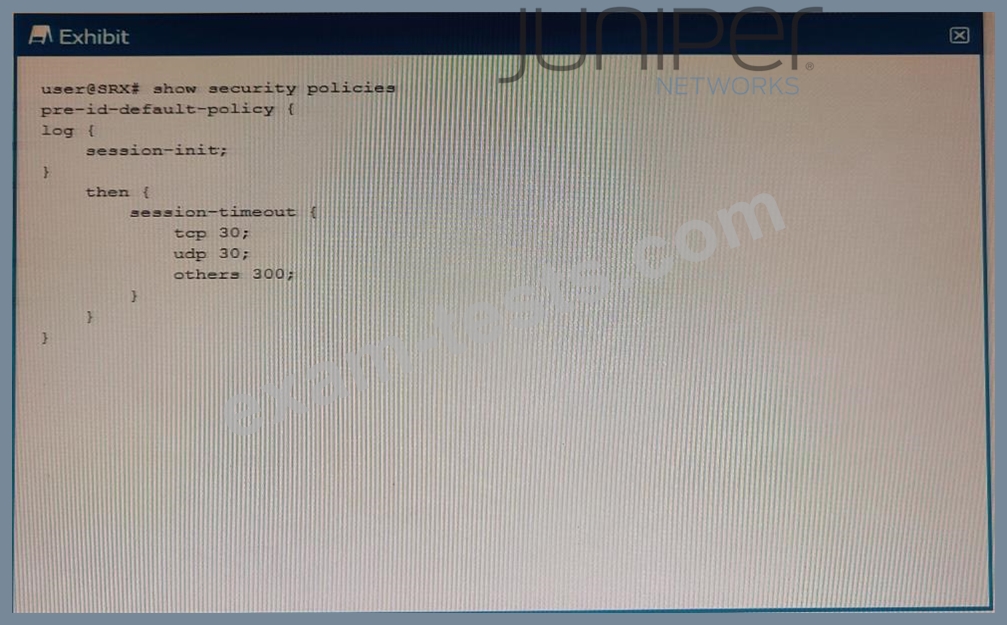
Exhibit Which two statements are correct about the configuration shown in the exhibit? (Choose two.)
Correct Answer: B,C
The configuration shown in the exhibit is for a Juniper SRX Series firewall. The session-init parameter is used to control how the firewall processes unknown traffic flows. With the session-init parameter set to 300, any traffic flows that the firewall does not recognize will be dropped after 300 milliseconds. Additionally, every session that enters the device, whether it is known or unknown, will generate an event, which can be used for logging and troubleshooting purposes. The session-lose parameter is used to control how the firewall handles established sessions that are terminated.
Question 23
Which two statements about SRX chassis clustering are correct? (Choose two.)
Correct Answer: A,C
Explanation SRX chassis clustering is a high availability feature that allows two SRX Series devices to operate as a single logical device. The two devices are connected by a control link and a fabric link, which are used to synchronize the configuration, state, and traffic between the nodes. The control plane is responsible for managing the cluster configuration, monitoring the health and status of the nodes, and performing failover operations. The data plane is responsible for processing and forwarding the traffic through the cluster. SRX chassis clustering supports two modes for the data plane: active/passive and active/active. In active/passive mode, only one node is active for each redundancy group, which is a logical grouping of interfaces and services. The active node handles all the traffic for the redundancy group, while the passive node acts as a backup. In active/active mode, both nodes are active for different redundancy groups, and they can share the traffic load for the cluster. SRX chassis clustering supports only one mode for the control plane: active/passive. In this mode, only one node is the primary node, which is the master of the cluster configuration and the source of truth for the cluster state. The primary node also initiates the failover process in case of a node or interface failure. The other node is the secondary node, which is the slave of the cluster configuration and the backup of the cluster state. The secondary node takes over the primary role if the primary node fails or is manually disabled. References: Chassis Cluster Overview, SRX Series Chassis Cluster Configuration Overview, Chassis Cluster Overview
Question 24
You need to deploy an SRX Series device in your virtual environment. In this scenario, what are two benefits of using a CSRX? (Choose two.)
Correct Answer: C,D
Two benefits of using a cSRX in your virtual environment are: The cSRX supports firewall, NAT, IPS, and UTM services: The cSRX is a containerized version of the SRX Series firewall that runs as a Docker container on Linux hosts. It provides the same features and functionality as the SRX Series physical firewalls, such as firewall, NAT, IPS, and UTM services. The cSRX can protect your virtual workloads and applications from various threats and attacks. The cSRX has low memory requirements: The cSRX is designed to be lightweight and efficient, with low memory and CPU requirements. The cSRX can run on as little as 1 GB of RAM and 1 vCPU, making it suitable for resource-constrained environments.
Question 25
What is the maximum number of supported interfaces on a vSRX hosted in a VMware environment?