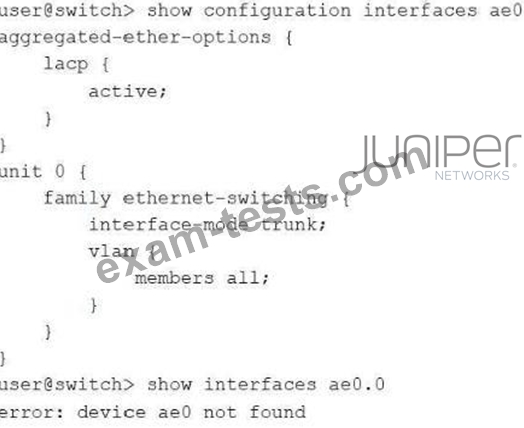
Click the Exhibit button. You are troubleshooting an aggregated Ethernet interface on a Juniper Networks EX Series Switch. The aggregated Ethernet interface does not appear in the output shown in the exhibit. Which action will solve this problem?
Correct Answer: A
On EX Series switches, aggregated Ethernet (ae) interfaces do not exist by default; before any ae interface can be created, referenced, or brought into service, an administrator must first reserve the desired number of aggregated Ethernet device slots by configuring set chassis aggregated-devices ethernet device-count number at the [edit chassis] hierarchy. This statement allocates the internal resources needed for that many ae interfaces to exist as valid, configurable objects; until it is committed, any interface-level configuration referencing ae0 (such as the aggregated-ether-options and family ethernet-switching stanzas shown in the exhibit) is accepted syntactically by the CLI but never actually instantiates a live ae0 device, which is exactly why show interfaces ae0.0 returns 'device ae0 not found' despite the interface appearing fully configured. Increasing the device-count to at least 1 (or higher, to cover the number of LAG bundles planned) immediately resolves this and allows ae0 to appear as an operational interface once its member links are also associated with it. This is a foundational and frequently overlooked prerequisite step in LAG deployment on Juniper switches. There is no separate licensing requirement for aggregated Ethernet functionality on EX Series switches, a reboot is not needed since the chassis statement takes effect upon commit, and the LACP mode (active versus passive) is unrelated to whether the ae interface object itself exists in the first place. Reference topics: Junos Enterprise Switching - Link Aggregation, Configuring the Aggregated Ethernet Device Count.
Question 37
Your switches are managed using Junos Space Network Director. You want to secure the switches using a Network Director filter profile. A filter profile containing one term shown in the exhibit is deployed to ports on managed devices. Which traffic will be accepted by the filter?
Correct Answer: C
Question 38
You are establishing a new BGP session to an EBGP peer using loopback addresses. In addition to your general EBGP settings, which BGP feature must be enabled for this session to establish?
Correct Answer: A
By default, EBGP sessions are built with the expectation that peers are directly connected at Layer 3, and Junos enforces this by sending EBGP packets with a TTL of 1. When loopback addresses are used as the session endpoints instead of the directly connected physical interface addresses, the resulting IP packets must traverse at least one additional router hop between the two loopbacks, and a TTL of 1 will expire in transit before reaching the remote loopback, causing the TCP handshake - and therefore the BGP session - to fail even though a valid route to the peer's loopback exists. The multihop statement (configured as an EBGP multihop parameter with an accompanying TTL value, most commonly set to 2 for a single intermediate hop) instructs Junos to increase the TTL used for that peer's BGP packets so they survive the extra hop count between loopbacks. This is a mandatory addition any time an EBGP session is deliberately built against non- directly-connected addresses, whereas IBGP sessions, by contrast, do not have this default restriction because IBGP already assumes peers may be multiple hops apart within the same AS. Multipath affects load-balancing across equal-cost paths, damping suppresses flapping routes, and passive controls whether a router waits for the remote peer to initiate the TCP connection - none of these resolve the TTL expiration problem inherent to loopback-based EBGP peering. Reference topics: Junos Enterprise Routing - BGP, Configuring EBGP Multihop Sessions.
Question 39
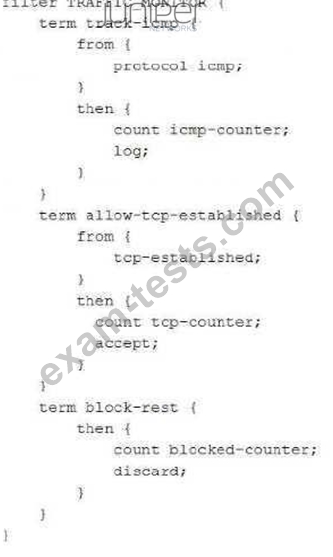
Refer to Exhibit: You have applied a firewall filter as an ingress filter on the ge-0/0/0 interface of your Juniper Networks EX Series Switch as shown in the exhibit. An external host sends an ICMP ping packet to the router. Which statement is correct about how this packet is processed?
Correct Answer: A
Junos firewall filters evaluate terms sequentially from top to bottom, and a term is only terminal for a packet if its then clause contains an explicit terminating action such as accept, discard, reject, or next term without a match. The count and log actions used in track-icmp are non- terminating; they update statistics and generate a log entry but do not stop evaluation, so a matching ICMP packet falls through to the next term after being counted. The second term, allow- tcp-established, matches only TCP packets carrying the ACK or RST flags as defined by the tcp- established keyword; an ICMP echo request does not satisfy protocol tcp, so this term is skipped entirely and does not accept the packet. Evaluation therefore reaches the implicit catch-all term block-rest, which has no from conditions and matches every remaining packet, incrementing blocked-counter and discarding it. The net effect for the described ICMP ping is that icmp-counter is incremented by the first term, the packet is neither accepted nor rejected by the second term, and blocked-counter is incremented immediately before the packet is silently discarded by the final term. This layered-term behavior, where counting is independent of the accept/discard decision, is a frequently tested nuance of Junos firewall filter processing logic.
Question 40
You have configured a GRE tunnel from your local router with tunnel source 10.0.0.1 to a remote router at destination 192.168.0.1. The tunnel is functioning until you commit set routing-options static route 0.0.0.0/0 next-hop gr-0/0/0. This configuration causes the tunnel to go down. Which statement is correct in this scenario?
Correct Answer: B
A GRE tunnel's outer, delivery-layer packets are forwarded using the router's ordinary underlay routing table, meaning the tunnel destination address (192.168.0.1 in this case) must itself be resolvable to a physical, non-tunnel next hop for the encapsulated packets to actually leave the router. Before this configuration change, the default route (or some more specific route) presumably pointed toward a real physical next hop, allowing the router to reach 192.168.0.1 and keep the tunnel operational. When the administrator commits a static default route of 0.0.0.0/0 with a next hop of gr-0/0/0, every destination lookup that previously fell back to the default route -- including the lookup for the tunnel's own destination address, 192.168.0.1, since no more specific route exists for it -- now recurses through the GRE interface itself. This creates a circular dependency: the router needs to route to 192.168.0.1 to keep the tunnel up, but the only route it has to reach 192.168.0.1 now points back into the tunnel that requires 192.168.0.1 to already be reachable, so the interface's next-hop resolution fails and the tunnel drops. This is an entirely valid and common GRE design pitfall rather than any platform restriction; GRE interfaces can be legitimately used as static route next hops, do not require loopback-sourced encapsulation, and do not require a /32 host route to resolve their destination, provided that route does not recursively point back through the tunnel.
Newest JN0-352 Exam PDF Dumps shared by BraindumpsPass.com for Helping Passing JN0-352 Exam! BraindumpsPass.com now offer the updated JN0-352 exam dumps, the BraindumpsPass.com JN0-352 exam questions have been updated and answers have been corrected get the latest BraindumpsPass.com JN0-352 pdf dumps with Exam Engine here: