

Question 76

Your router should be configured with a rewrite rule which alters the default behavior of expedited forwarding as shown in the exhibit.
In this scenario, which configuration is correct?
Question 77
Exhibit:

You must configure an OSPF virtual link to facilitate communication between Area 0 and Area 20.
Referring to the exhibit, which two addresses should you use as the neighbor IDs of the virtual link endpoints?
(Choose two.)
You must configure an OSPF virtual link to facilitate communication between Area 0 and Area 20.
Referring to the exhibit, which two addresses should you use as the neighbor IDs of the virtual link endpoints?
(Choose two.)
Question 78
Exhibit:

You notice an inconsistency between the routing table and the OSPF database, as shown in the exhibit.
What are two reasons for this behavior? (Choose two.)
You notice an inconsistency between the routing table and the OSPF database, as shown in the exhibit.
What are two reasons for this behavior? (Choose two.)
Question 79
You must deploy an interprovider VPN option that ensures that the ASBRs do not need to store any VPN routes.
In this scenario, which interprovider VPN option should you choose?
In this scenario, which interprovider VPN option should you choose?
Question 80
Exhibit:
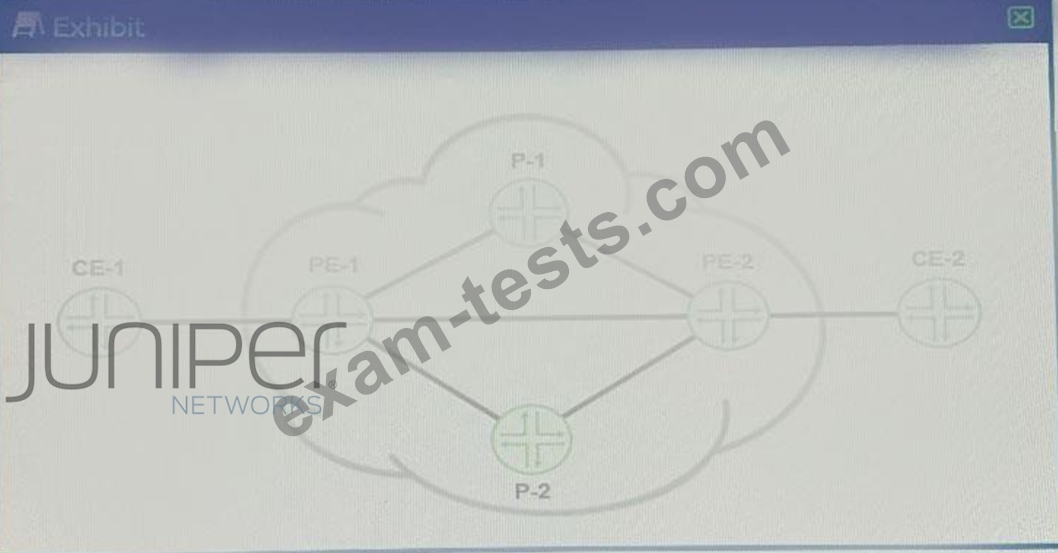
A Layer 3 VPN exists in the provider network and the CE devices are connecting to the PE devices using BGP. The PE devices are receiving BGP routes from the CE devices and the PE devices have the CE BGP routes in their respective routing tables. However, the remote CE devices are not receiving the BGP routes.
Referring to the exhibit, what is the problem?