Question 6
In Anypoint Platform, a company wants to configure multiple identity providers (IdPs) for multiple lines of business (LOBs). Multiple business groups, teams, and environments have been defined for these LOBs.
What Anypoint Platform feature can use multiple IdPs across the company's business groups, teams, and environments?
What Anypoint Platform feature can use multiple IdPs across the company's business groups, teams, and environments?
Question 7
A travel company wants to publish a well-defined booking service API to be shared with its business partners. These business partners have agreed to ONLY consume SOAP services and they want to get the service contracts in an easily consumable way before they start any development. The travel company will publish the initial design documents to Anypoint Exchange, then share those documents with the business partners. When using an API-led approach, what is the first design document the travel company should deliver to its business partners?
Question 8
A Mule application is being designed to do the following:
Step 1: Read a SalesOrder message from a JMS queue, where each SalesOrder consists of a header and a list of SalesOrderLineltems.
Step 2: Insert the SalesOrder header and each SalesOrderLineltem into different tables in an RDBMS.
Step 3: Insert the SalesOrder header and the sum of the prices of all its SalesOrderLineltems into a table In a different RDBMS.
No SalesOrder message can be lost and the consistency of all SalesOrder-related information in both RDBMSs must be ensured at all times.
What design choice (including choice of transactions) and order of steps addresses these requirements?
Step 1: Read a SalesOrder message from a JMS queue, where each SalesOrder consists of a header and a list of SalesOrderLineltems.
Step 2: Insert the SalesOrder header and each SalesOrderLineltem into different tables in an RDBMS.
Step 3: Insert the SalesOrder header and the sum of the prices of all its SalesOrderLineltems into a table In a different RDBMS.
No SalesOrder message can be lost and the consistency of all SalesOrder-related information in both RDBMSs must be ensured at all times.
What design choice (including choice of transactions) and order of steps addresses these requirements?
Question 9
What metrics about API invocations are available for visualization in custom charts using Anypoint Analytics?
Question 10
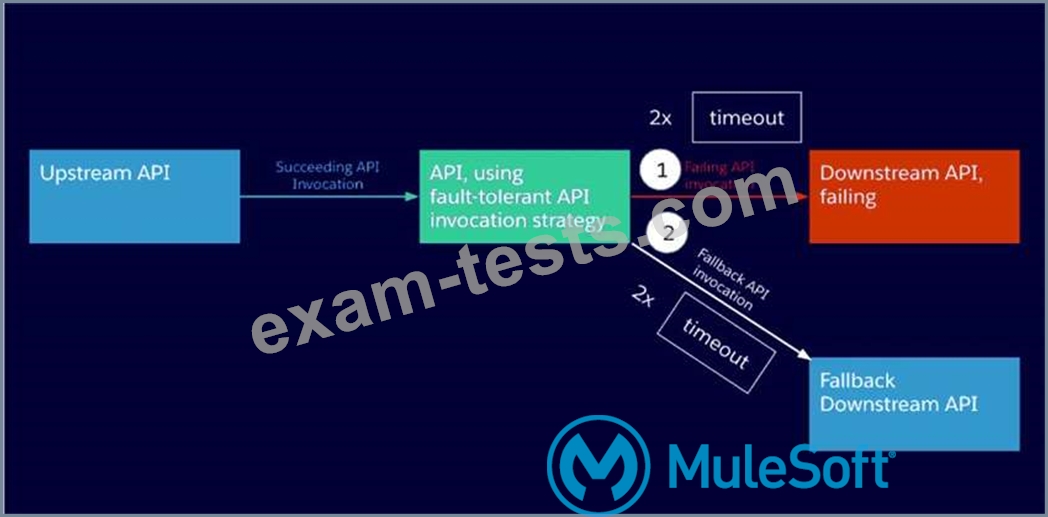
An API implementation is being designed that must invoke an Order API which is known to repeatedly experience downtime. For this reason a fallback API is to be called when the Order API is unavailable. What approach to designing invocation of the fallback API provides the best resilience?