

Question 151
An API implementation is being designed that must invoke an Order API which is known to repeatedly experience downtime. For this reason a fallback API is to be called when the Order API is unavailable. What approach to designing invocation of the fallback API provides the best resilience?

Question 152
Refer to the exhibit.
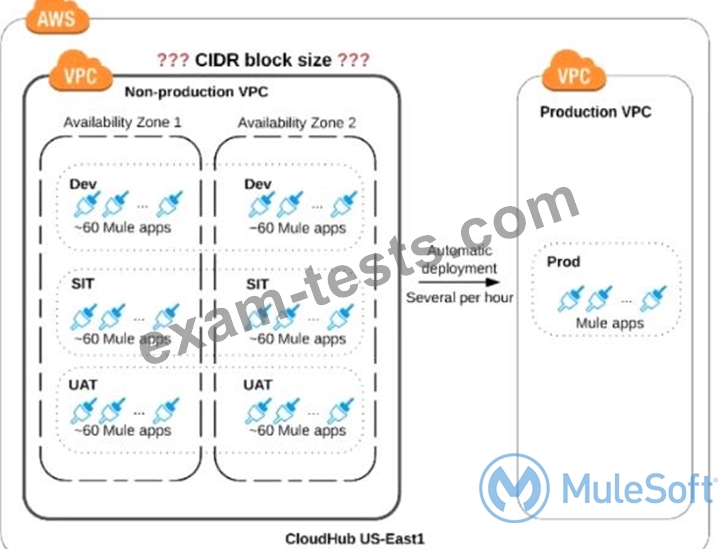
An organization is sizing an Anypoint VPC for the non-production deployments of those Mule applications that connect to the organization's on-premises systems. This applies to approx. 60 Mule applications. Each application is deployed to two CloudHub i workers. The organization currently has three non-production environments (DEV, SIT and UAT) that share this VPC. The AWS region of the VPC has two AZs.
The organization has a very mature DevOps approach which automatically progresses each application through all non-production environments before automatically deploying to production. This process results in several Mule application deployments per hour, using CloudHub's normal zero-downtime deployment feature.
What is a CIDR block for this VPC that results in the smallest usable private IP address range?
An organization is sizing an Anypoint VPC for the non-production deployments of those Mule applications that connect to the organization's on-premises systems. This applies to approx. 60 Mule applications. Each application is deployed to two CloudHub i workers. The organization currently has three non-production environments (DEV, SIT and UAT) that share this VPC. The AWS region of the VPC has two AZs.
The organization has a very mature DevOps approach which automatically progresses each application through all non-production environments before automatically deploying to production. This process results in several Mule application deployments per hour, using CloudHub's normal zero-downtime deployment feature.
What is a CIDR block for this VPC that results in the smallest usable private IP address range?
Question 153
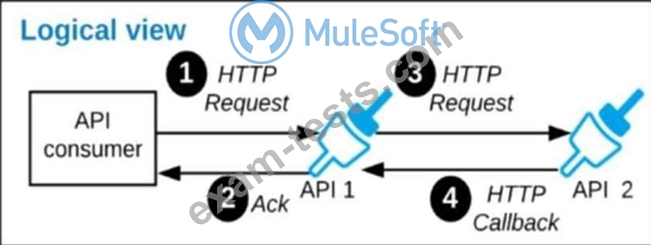
Refer to the exhibit. A business process involves two APIs that interact with each other asynchronously over HTTP. Each API is implemented as a Mule application. API 1 receives the initial HTTP request and invokes API 2 (in a fire and forget fashion) while API 2, upon completion of the processing, calls back into API 1 to notify about completion of the asynchronous process.
Each API is deployed to multiple redundant Mule runtimes and a separate load balancer, and is deployed to a separate network zone.
In the network architecture, how must the firewall rules be configured to enable the above interaction between API 1 and API 2?
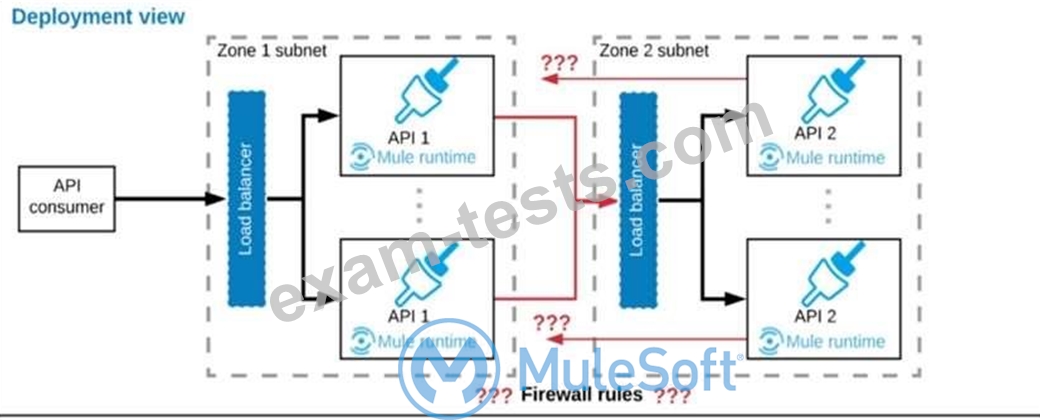
Each API is deployed to multiple redundant Mule runtimes and a separate load balancer, and is deployed to a separate network zone.
In the network architecture, how must the firewall rules be configured to enable the above interaction between API 1 and API 2?
Question 154
Additional nodes are being added to an existing customer-hosted Mule runtime cluster to improve performance. Mule applications deployed to this cluster are invoked by API clients through a load balancer.
What is also required to carry out this change?
What is also required to carry out this change?
Question 155
What is a key difference between synchronous and asynchronous logging from Mule applications?

