

Question 51
In an organization, the InfoSec team is investigating Anypoint Platform related data traffic.
From where does most of the data available to Anypoint Platform for monitoring and alerting originate?
From where does most of the data available to Anypoint Platform for monitoring and alerting originate?
Question 52
An API experiences a high rate of client requests (TPS) vwth small message paytoads. How can usage limits be imposed on the API based on the type of client application?
Question 53
An API implementation is updated. When must the RAML definition of the API also be updated?
Question 54
An organization is implementing a Quote of the Day API that caches today's quote.
What scenario can use the CloudHub Object Store via the Object Store connector to persist the cache's state?
What scenario can use the CloudHub Object Store via the Object Store connector to persist the cache's state?
Question 55
Refer to the exhibit.
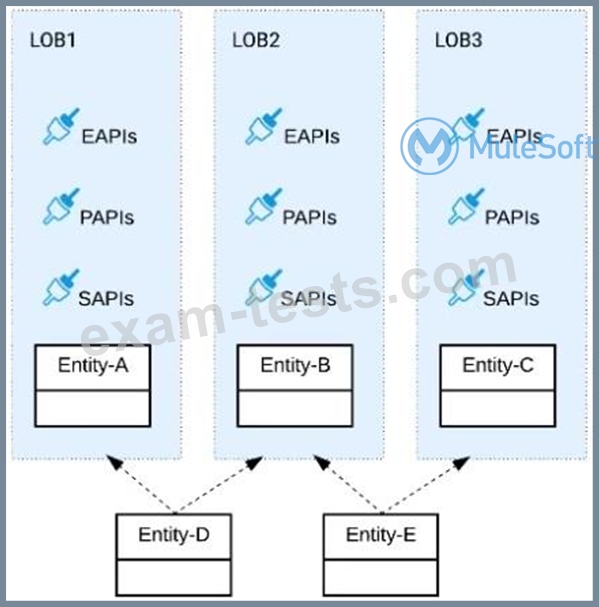
Three business processes need to be implemented, and the implementations need to communicate with several different SaaS applications.
These processes are owned by separate (siloed) LOBs and are mainly independent of each other, but do share a few business entities. Each LOB has one development team and their own budget In this organizational context, what is the most effective approach to choose the API data models for the APIs that will implement these business processes with minimal redundancy of the data models?
A) Build several Bounded Context Data Models that align with coherent parts of the business processes and the definitions of associated business entities
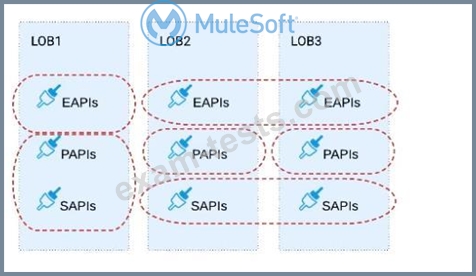
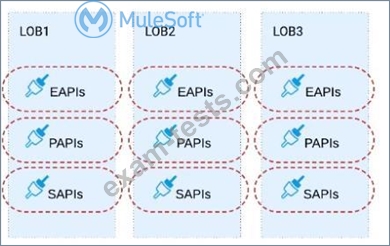
B) Build distinct data models for each API to follow established micro-services and Agile API-centric practices
C) Build all API data models using XML schema to drive consistency and reuse across the organization

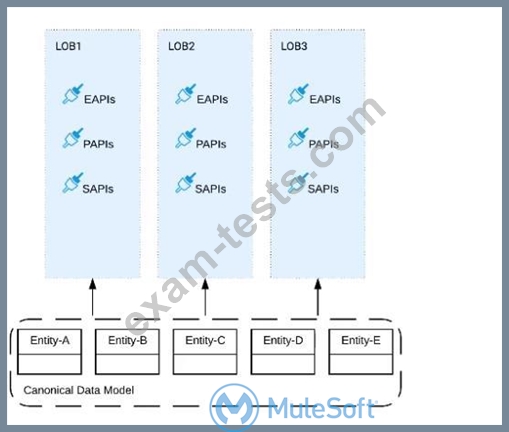
D) Build one centralized Canonical Data Model (Enterprise Data Model) that unifies all the data types from all three business processes, ensuring the data model is consistent and non-redundant
Three business processes need to be implemented, and the implementations need to communicate with several different SaaS applications.
These processes are owned by separate (siloed) LOBs and are mainly independent of each other, but do share a few business entities. Each LOB has one development team and their own budget In this organizational context, what is the most effective approach to choose the API data models for the APIs that will implement these business processes with minimal redundancy of the data models?
A) Build several Bounded Context Data Models that align with coherent parts of the business processes and the definitions of associated business entities
B) Build distinct data models for each API to follow established micro-services and Agile API-centric practices
C) Build all API data models using XML schema to drive consistency and reuse across the organization
D) Build one centralized Canonical Data Model (Enterprise Data Model) that unifies all the data types from all three business processes, ensuring the data model is consistent and non-redundant