

Question 206
Your company plans to migrate to Microsoft Teams from Microsoft Skype for Business Online. The org-wide coexistence mode for Microsoft Teams is set to Teams Only.
The company has two named User1 and User2.
You need to implement a migration solution that meets the following requirements:
User1 must be able to chat and create meetings by using Skype for Business only.
User1 must be able to read and post messages by using Microsoft Teams channels.
User2 must use Microsoft Teams only.
How should you complete the PowerShell command? To answer, select the appropriate options in the answer area.
NOTE: Each correct selection is worth one point.

The company has two named User1 and User2.
You need to implement a migration solution that meets the following requirements:
User1 must be able to chat and create meetings by using Skype for Business only.
User1 must be able to read and post messages by using Microsoft Teams channels.
User2 must use Microsoft Teams only.
How should you complete the PowerShell command? To answer, select the appropriate options in the answer area.
NOTE: Each correct selection is worth one point.


Question 207
Your company uses Teams.
You plan to deploy Teams to a branch office that has limited bandwidth.
Which Two features can he used when the Teams client has a bandwidth restriction of 150 kilobit/s up and 150 kilobit/s down? Each correct answer presents a complete solution.
NOTE: Each correct selection is worth one point.
You plan to deploy Teams to a branch office that has limited bandwidth.
Which Two features can he used when the Teams client has a bandwidth restriction of 150 kilobit/s up and 150 kilobit/s down? Each correct answer presents a complete solution.
NOTE: Each correct selection is worth one point.
Question 208
You have a Microsoft 365 subscription that uses Microsoft Teams and contains three users named User1, User2, and User3.
You need to configure Microsoft Teams to meet the following requirements:
Prevent User1 and User2 from creating private channels.
Ensure that User3 can control who can create private channels.
Minimize administrative effort.
Which three actions should you perform in sequence? To answer, move all actions from the list of actions to the answer area and arrange them in the correct order.
NOTE: More than one order of answer choices is correct. You will receive credit for any of the correct orders you select.
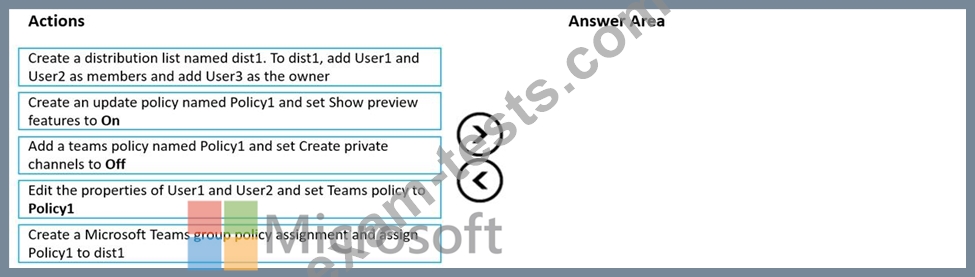
You need to configure Microsoft Teams to meet the following requirements:
Prevent User1 and User2 from creating private channels.
Ensure that User3 can control who can create private channels.
Minimize administrative effort.
Which three actions should you perform in sequence? To answer, move all actions from the list of actions to the answer area and arrange them in the correct order.
NOTE: More than one order of answer choices is correct. You will receive credit for any of the correct orders you select.

Question 209
You need to recommend a solution to perform the network validation tasks for the platform upgrade.
Which tool and role should you recommend for each user? To answer, select the appropriate options in the answer area.
NOTE: Each correct selection is worth one point.

Which tool and role should you recommend for each user? To answer, select the appropriate options in the answer area.
NOTE: Each correct selection is worth one point.


Question 210
You have a Microsoft 365 subscription that uses Microsoft Teams and contains a user named User1 and three groups named Group1 , Group2 and Group3. User1 is a member of Group1, Group2, and Group3.
The subscription has the meeting policies shown in the following table.


The subscription has the meeting policies shown in the following table.

