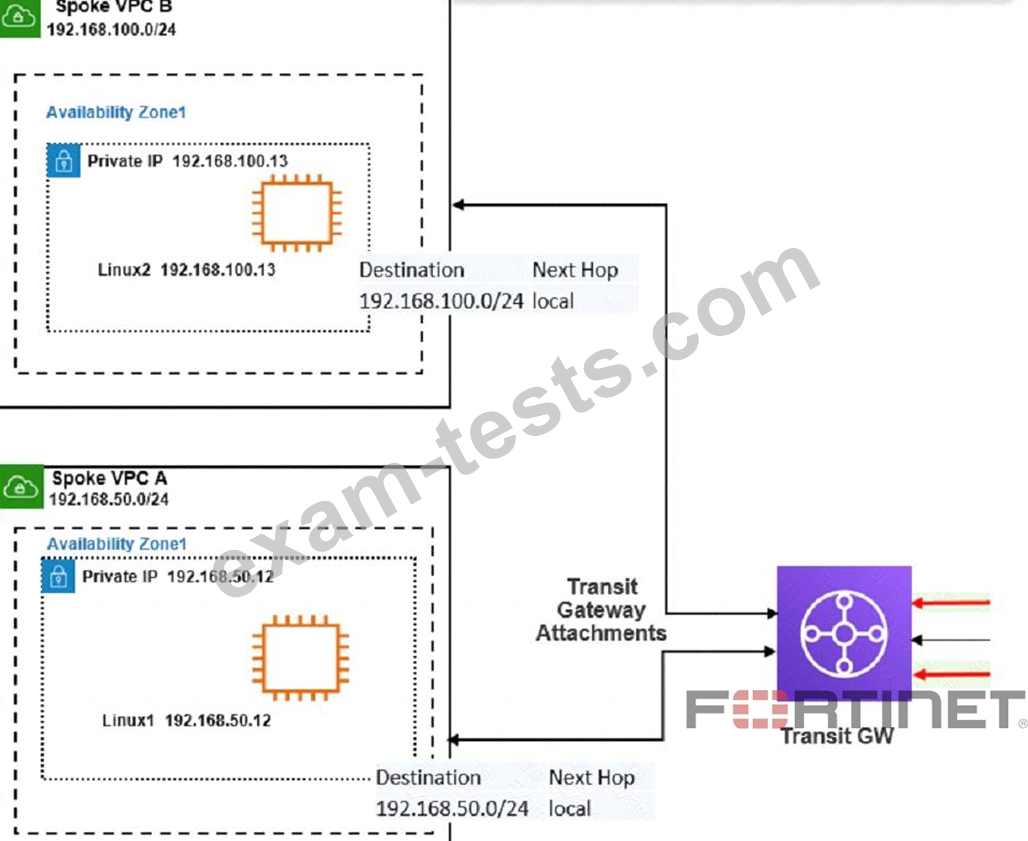
Refer to the exhibit The exhibit shows a customer deployment of two Linux instances and their main routing table in Amazon Web Services (AWS). The customer also created a Transit Gateway (TGW) and two attachments Which two steps are required to route traffic from Linux instances to the TGWQ (Choose two.)
Correct Answer: C,D
Explanation According to the AWS documentation for Transit Gateway, a Transit Gateway is a network transit hub that connects VPCs and on-premises networks. To route traffic from Linux instances to the TGW, you need to do the following steps: In the TGW route table, associate two attachments. An attachment is a resource that connects a VPC or VPN to a Transit Gateway. By associating the attachments to the TGW route table, you enable the TGW to route traffic between the VPCs and the VPN. In the main subnet routing table in VPC A and B, add a new route with destination 0_0.0.0/0, next hop TGW. This route directs all traffic from the Linux instances to the TGW, which can then forward it to the appropriate destination based on the TGW route table. The other options are incorrect because: In the TGW route table, adding route propagation to 192.168.0 0/16 is not necessary, as this is already the default route for the TGW. Route propagation allows you to automatically propagate routes from your VPC or VPN to your TGW route table. In the main subnet routing table in VPC A and B, adding a new route with destination 0_0.0.0/0, next hop Internet gateway (IGW) is not correct, as this would bypass the TGW and send all traffic directly to the internet. An IGW is a VPC component that enables communication between instances in your VPC and the internet. [Transit Gateways - Amazon Virtual Private Cloud]
Question 27
What are two main features in Amazon Web Services (AWS) network access control lists (ACLs)? (Choose two.)
Correct Answer: B,C
The default network ACL is configured to allow all traffic. This means that when you create a VPC, AWS automatically creates a default network ACL for that VPC, and associates it with all the subnets in the VPC. By default, the default network ACL allows all inbound and outbound IPv4 traffic and, if applicable, IPv6 traffic. You can modify the default network ACL, but you cannot delete it. Network ACLs are stateless, and inbound and outbound rules are used for traffic filtering. This means that network ACLs do not keep track of the traffic that they allow or deny, and they evaluate each packet separately. Therefore, you need to create both inbound and outbound rules for each type of traffic that you want to allow or deny. For example, if you want to allow SSH traffic from a specific IP address to your subnet, you need to create an inbound rule to allow TCP port 22 from that IP address, and an outbound rule to allow TCP port 1024-65535 (the ephemeral ports) to that IP address.
Question 28
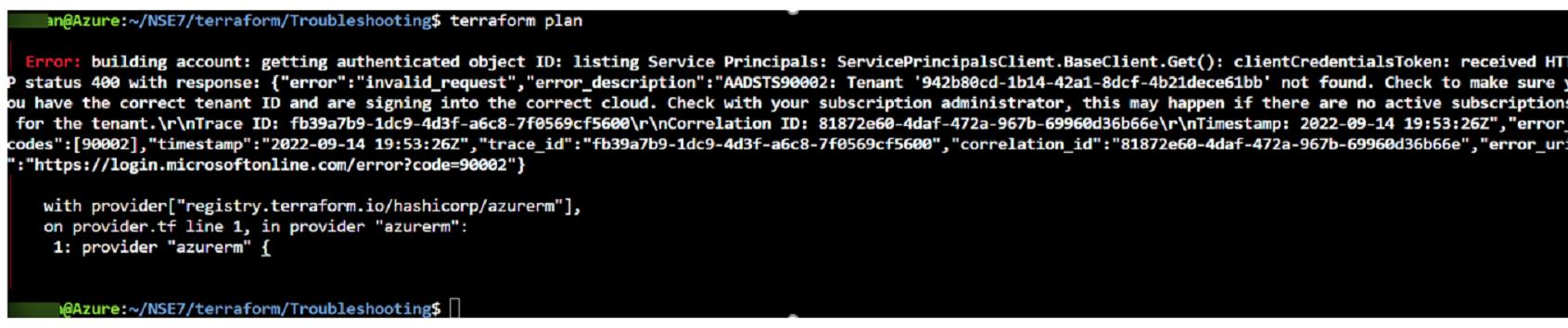
Refer to Exhibit: After the initial Terraform configuration in Microsoft Azure, the terraform plan command is run Which two statements about running the plan command are true? (Choose two.)
Correct Answer: C,D
A is incorrect because the terraform plan command will not deploy any resources at all. It will only show the changes that would be made if the terraform apply command was run. The error message in the exhibit indicates that the service principal details are invalid, which means that Terraform cannot authenticate to Azure and cannot create any resources1. B is incorrect because you can run the terraform apply command without running the terraform plan command first. The terraform apply command will automatically generate a new plan and prompt you to approve it before applying it2. However, running the terraform plan command first can help you preview the changes and avoid any unwanted or unexpected actions. C is correct because you must run the terraform init command once before the terraform plan command. The terraform init command initializes a working directory containing Terraform configuration files. It downloads and installs the provider plugins required for your configuration, such as the Azure provider2. It also creates a hidden directory called .terraform to store the plugin binaries and other metadata1. Without running the terraform init command, the terraform plan command will fail because it cannot find the required plugins or modules. D is correct because the terraform plan command makes Terraform do a dry run. A dry run is a simulation of what would happen if you executed a certain action, without actually performing it. The terraform plan command creates an execution plan, which is a description of the actions that Terraform would take to make your infrastructure match your configuration2. The execution plan shows you what resources will be created, modified, or destroyed, and what attributes will be changed. The execution plan does not affect your infrastructure or state file until you apply it with the terraform apply command1.
Question 29
An administrator would like to keep track of sensitive data files located in the Amazon Web Services (AWS) S3 bucket and protect it from malware. Which Fortinet product or feature should the administrator use?
Correct Answer: C
To keep track of sensitive data files located in AWS S3 buckets and protect them from malware, the administrator should use: C:FortiCNP DLP policies. * Data Loss Prevention (DLP):DLP policies are designed to detect and prevent unauthorized access or sharing of sensitive data. In the context of AWS S3, DLP policies can be used to scan for sensitive information stored in S3 objects and enforce protective measures to prevent data exfiltration or compromise. * FortiCNP Integration:FortiCNP is Fortinet's cloud-native protection platform that offers security and compliance solutions across cloud environments. By applying DLP policies within FortiCNP, the administrator can ensure sensitive data within S3 is monitored and protected consistently. References:Fortinet's FortiCNP documentation provides information on implementing DLP policies within cloud environments, highlighting the capabilities for protecting sensitive data within cloud storage services like AWS S3.
Question 30
A Network security administrator is searching for a solution to secure traffic going in and out of the container infrastructure. In which two ways can Fortinet container security help secure container infrastructure?(Choose two.)
Correct Answer: C,D
Explanation The correct answer is C and D. FortiGate NGFW can inspect north-south container traffic with label aware policies and FortiGate NGFW and FortiSandbox can be used to secure container traffic. According to the Fortinet documentation for container security1, FortiGate NGFW can provide the following benefits for securing container infrastructure: It can inspect north-south traffic between containers and external networks using label aware policies, which allow for dynamic policy enforcement based on Kubernetes labels and metadata. It can integrate with FortiSandbox to provide advanced threat protection for container traffic, by sending suspicious files or URLs to a cloud-based sandbox for analysis and detection. It can leverage FortiGuard Security Services to provide real-time threat intelligence and updates for container traffic, such as antivirus, web filtering, IPS, and application control. The other options are incorrect because: FortiGate NGFW cannot be placed between each application container for north-south traffic inspection, as this would create unnecessary complexity and overhead. Instead, FortiGate NGFW can be deployed at the edge of the container network or as a sidecar proxy to inspect traffic at the ingress and egress points. FortiGate NGFW cannot connect to the worker node and protect the container, as this would not provide sufficient visibility and control over the container traffic. Instead, FortiGate NGFW can leverage the native Kubernetes APIs and services to monitor and secure the container traffic. 1:Fortinet Documentation Library - Container Security