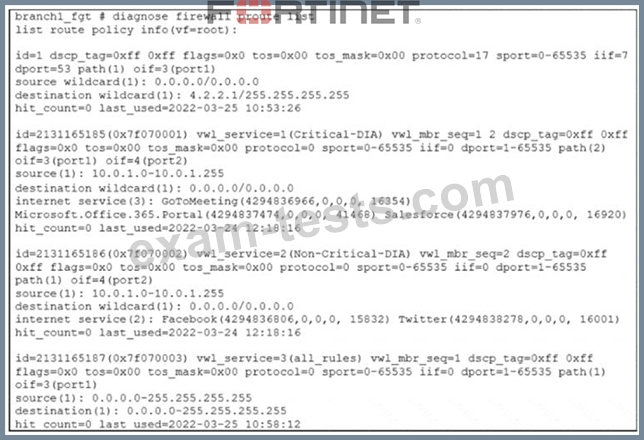
Correct Answer: B
Full Explanation:
* Option Ais incorrect because SD-WAN zones can include multiple interface types (e.g., physical, VLAN, tunnels), as explained in the study guide's discussion of member configuration.
* Option Bis correct because an SD-WAN zone can logically have zero members (an empty zone) and up to a large number of members, with 512 being a reasonable upper bound supported by Fortinet's scalability, even if not explicitly stated in the study guide.
* Option Cis incorrect because the study guide clearly states that SD-WAN zones can be used in static route definitions, enhancing routing flexibility.
* Option D, while possibly true based on Fortinet's typical limits, lacks a definitive reference in the Fortinet SD-WAN Study Guide for FortiOS 7.2to confirm "32" as the exact number, making it less certain than Option B.
References:
* Fortinet SD-WAN Study Guide for FortiOS 7.2, Section 3: Members, Zones, and Performance SLAs (description of interface types and zones).
* Fortinet SD-WAN Study Guide for FortiOS 7.2, Section 4: Routing and Sessions (use of SD-WAN zones in static routes).
* Fortinet Documentation:SD-WAN members and zones | FortiGate / FortiOS 7.2.4(general behavior and flexibility of zones).