

Question 26
You are migrating the branches of a customer to FortiGate devices. They require independent routing tables on the LAN side of the network.
After reviewing the design, you notice the firewall will have many BGP sessions as you have two data centers (DC) and two ISPs per DC while each branch is using at least 10 internal segments.
Based on this scenario, what would you suggest as the more efficient solution, considering that in the future the number of internal segments, DCs or internet links per DC will increase?
After reviewing the design, you notice the firewall will have many BGP sessions as you have two data centers (DC) and two ISPs per DC while each branch is using at least 10 internal segments.
Based on this scenario, what would you suggest as the more efficient solution, considering that in the future the number of internal segments, DCs or internet links per DC will increase?
Question 27
Refer to the exhibit.
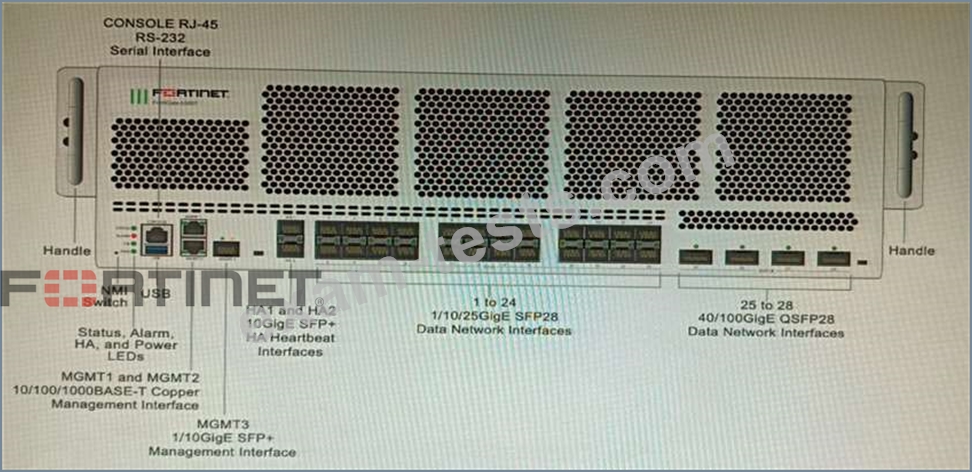
You are deploying a FortiGate 6000F. The device should be directly connected to a switch. In the future, a new hardware module providing higher speed will be installed in the switch, and the connection to the FortiGate must be moved to this higher-speed port.
You must ensure that the initial FortiGate interface connected to the switch does not affect any other port when the new module is installed and the new port speed is defined.
How should the initial connection be made?
You are deploying a FortiGate 6000F. The device should be directly connected to a switch. In the future, a new hardware module providing higher speed will be installed in the switch, and the connection to the FortiGate must be moved to this higher-speed port.
You must ensure that the initial FortiGate interface connected to the switch does not affect any other port when the new module is installed and the new port speed is defined.
How should the initial connection be made?
Question 28
Refer to the exhibit.
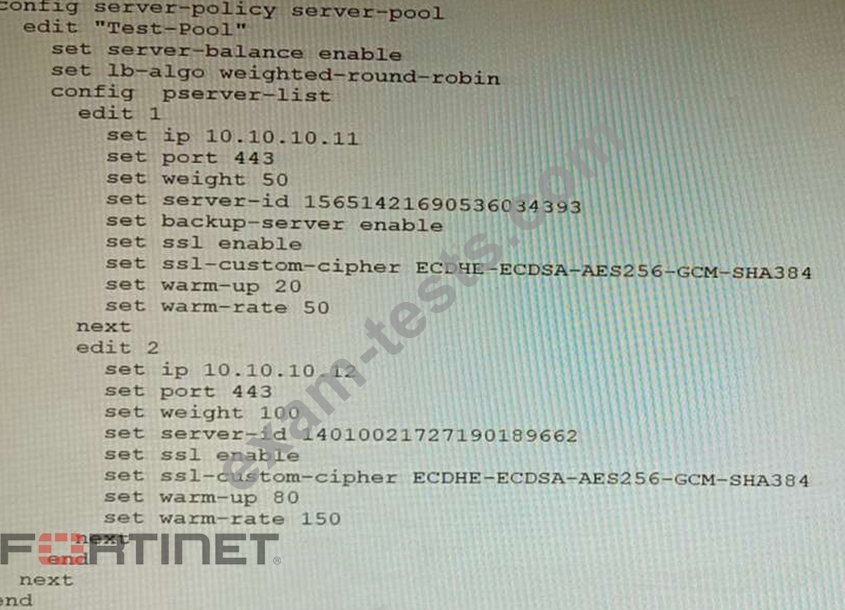
A FortiWeb appliance is configured for load balancing web sessions to internal web servers. The Server Pool is configured as shown in the exhibit.
How will the sessions be load balanced between server 1 and server 2 during normal operation?
A FortiWeb appliance is configured for load balancing web sessions to internal web servers. The Server Pool is configured as shown in the exhibit.
How will the sessions be load balanced between server 1 and server 2 during normal operation?
Question 29
Refer to the exhibits.

A customer has deployed a FortiGate with iBGP and eBGP routing enabled. HQ is receiving routes over eBGP from ISP 2; however, only certain routes are showing up in the routing table-Assume that BGP is working perfectly and that the only possible modifications to the routing table are solely due to the prefix list that is applied on HQ.
Given the exhibits, which two routes will be active in the routing table on the HQ firewall? (Choose two.)
A customer has deployed a FortiGate with iBGP and eBGP routing enabled. HQ is receiving routes over eBGP from ISP 2; however, only certain routes are showing up in the routing table-Assume that BGP is working perfectly and that the only possible modifications to the routing table are solely due to the prefix list that is applied on HQ.
Given the exhibits, which two routes will be active in the routing table on the HQ firewall? (Choose two.)
Question 30
You want to use the MTA adapter feature on FortiSandbox in an HA-Cluster. Which statement about this solution is true?