
- Home
- The Open Group Certification
- OGEA-101 Exam
- TheOpenGroup.OGEA-101.v2025-05-29.q40 Practice Test

Question 21
What is the purpose of the Preliminary Phase?
Correct Answer: A
An Enterprise Architecture Capability is the ability of the organization to perform effective and efficient architecture work, including the definition, governance, and management of its architectures2. The Preliminary Phase involves the following activities1:
* Reviewing the organizational context, scope, and drivers for conducting Enterprise Architecture
* Establishing the Architecture Capability desired by the organization, including the maturity level, roles, responsibilities, processes, and tools
* Defining and establishing the Organizational Model for Enterprise Architecture, which describes how the architecture function is organized and integrated within the enterprise
* Defining and establishing the Architecture Governance framework, which provides the mechanisms for ensuring the quality, consistency, and compliance of the architecture work
* Selecting and implementing the tools that support the Architecture Capability, such as repositories, modeling tools, and communication tools
* Defining the Architecture Principles that will guide and constrain the architecture work, based on the business principles, goals, and drivers of the organization
* Defining the Organization-Specific Architecture Framework, which is an adaptation of the generic TOGAF ADM to suit the specific requirements, standards, and practices of the organization The Preliminary Phase is essential for preparing the organization for the successful development and implementation of its architectures, as well as for ensuring the alignment of the architecture work with the business strategy and objectives1.
* Reviewing the organizational context, scope, and drivers for conducting Enterprise Architecture
* Establishing the Architecture Capability desired by the organization, including the maturity level, roles, responsibilities, processes, and tools
* Defining and establishing the Organizational Model for Enterprise Architecture, which describes how the architecture function is organized and integrated within the enterprise
* Defining and establishing the Architecture Governance framework, which provides the mechanisms for ensuring the quality, consistency, and compliance of the architecture work
* Selecting and implementing the tools that support the Architecture Capability, such as repositories, modeling tools, and communication tools
* Defining the Architecture Principles that will guide and constrain the architecture work, based on the business principles, goals, and drivers of the organization
* Defining the Organization-Specific Architecture Framework, which is an adaptation of the generic TOGAF ADM to suit the specific requirements, standards, and practices of the organization The Preliminary Phase is essential for preparing the organization for the successful development and implementation of its architectures, as well as for ensuring the alignment of the architecture work with the business strategy and objectives1.
Question 22
Consider the following descriptions of deliverables consumed and produced across the TOGAF ADM cycle.
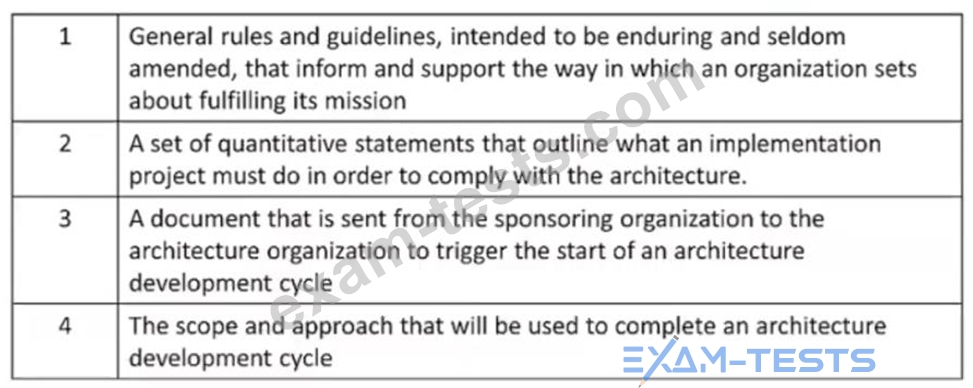
Which deliverables match these descriptions?
Which deliverables match these descriptions?
Correct Answer: D
The Request for Architecture Work is a deliverable that is sent from the sponsor and triggers the start of an architecture development cycle. It defines the scope, budget, schedule, and deliverables for a specific architecture project. The Statement of Architecture Work is a deliverable that is produced by the architect and defines the approach and resources needed to complete an architecture project. It forms the basis of a contractual agreement between the sponsor and the architecture organization. The Architecture Principles are a deliverable that is produced by the architect and defines the general rules and guidelines for the architecture work. They reflect the business principles, business goals, and business drivers of the organization. The Architecture Requirements Specification is a deliverable that is produced by the architect and defines the requirements that govern the architecture work. It covers both functional and non-functional requirements as well as constraints and assumptions.
Question 23
Exhibit
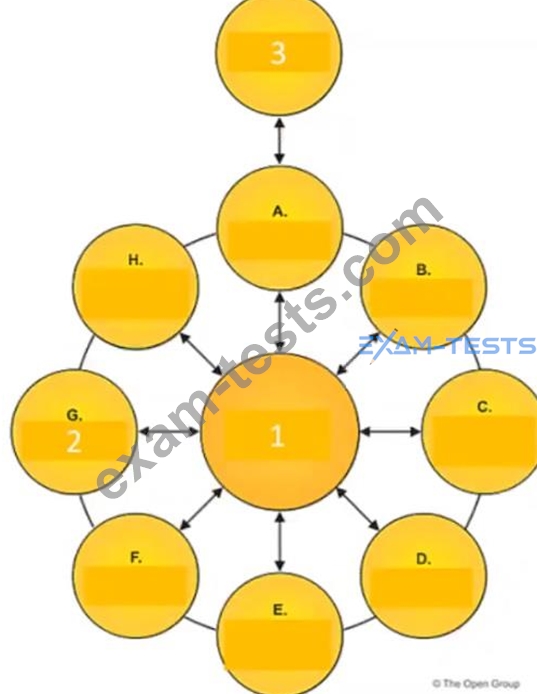
Consider the illustration showing an architecture development cycle Which description matches the phase of the ADM labeled as item 1?
Consider the illustration showing an architecture development cycle Which description matches the phase of the ADM labeled as item 1?
Correct Answer: C
* The illustration shows an architecture development cycle based on the TOGAF ADM (Architecture Development Method), which is a method for developing and managing an enterprise architecture1.
* The ADM consists of nine phases, each with a specific purpose and output. The phases are1:
oPreliminary Phase: To prepare and initiate the architecture development cycle, including defining the architecture framework, principles, and governance.
oPhase A: Architecture Vision: To define the scope, vision, and stakeholders of the architecture initiative, and to obtain approval to proceed.
oPhase B: Business Architecture: To describe the baseline and target business architecture, and to identify the gaps between them.
oPhase C: Information Systems Architectures: To describe the baseline and target data and application architectures, and to identify the gaps between them.
oPhase D: Technology Architecture: To describe the baseline and target technology architecture, and to identify the gaps between them.
oPhase E: Opportunities and Solutions: To identify and evaluate the opportunities and solutions for implementing the target architecture, and to define the work packages and transition architectures.
oPhase F: Migration Planning: To finalize the implementation and migration plan, and to ensure alignment with the enterprise portfolio and project management.
oPhase G: Implementation Governance: To provide architecture oversight and guidance for the implementation projects, and to manage any architecture change requests.
oPhase H: Architecture Change Management: To monitor the changes in the business and technology environment, and to assess the impact and performance of the architecture.
* In addition to these phases, there is a central process called Requirements Management, which is labeled as item 1 in the illustration. This process operates throughout the ADM cycle, and its purpose is to manage the architecture requirements throughout the architecture development, ensuring that they are aligned with the business requirements and the stakeholder concerns2.
* Therefore, the description that matches the phase of the ADM labeled as item 1 is C. Operates the process of managing architecture requirements.
Reference:
* 1: The TOGAF Standard, Version 9.2, Chapter 5: Architecture Development Method (ADM)
* 2: The TOGAF Standard, Version 9.2, Chapter 17: Requirements Management
* The ADM consists of nine phases, each with a specific purpose and output. The phases are1:
oPreliminary Phase: To prepare and initiate the architecture development cycle, including defining the architecture framework, principles, and governance.
oPhase A: Architecture Vision: To define the scope, vision, and stakeholders of the architecture initiative, and to obtain approval to proceed.
oPhase B: Business Architecture: To describe the baseline and target business architecture, and to identify the gaps between them.
oPhase C: Information Systems Architectures: To describe the baseline and target data and application architectures, and to identify the gaps between them.
oPhase D: Technology Architecture: To describe the baseline and target technology architecture, and to identify the gaps between them.
oPhase E: Opportunities and Solutions: To identify and evaluate the opportunities and solutions for implementing the target architecture, and to define the work packages and transition architectures.
oPhase F: Migration Planning: To finalize the implementation and migration plan, and to ensure alignment with the enterprise portfolio and project management.
oPhase G: Implementation Governance: To provide architecture oversight and guidance for the implementation projects, and to manage any architecture change requests.
oPhase H: Architecture Change Management: To monitor the changes in the business and technology environment, and to assess the impact and performance of the architecture.
* In addition to these phases, there is a central process called Requirements Management, which is labeled as item 1 in the illustration. This process operates throughout the ADM cycle, and its purpose is to manage the architecture requirements throughout the architecture development, ensuring that they are aligned with the business requirements and the stakeholder concerns2.
* Therefore, the description that matches the phase of the ADM labeled as item 1 is C. Operates the process of managing architecture requirements.
Reference:
* 1: The TOGAF Standard, Version 9.2, Chapter 5: Architecture Development Method (ADM)
* 2: The TOGAF Standard, Version 9.2, Chapter 17: Requirements Management
Question 24
Consider the following ADM phases objectives.
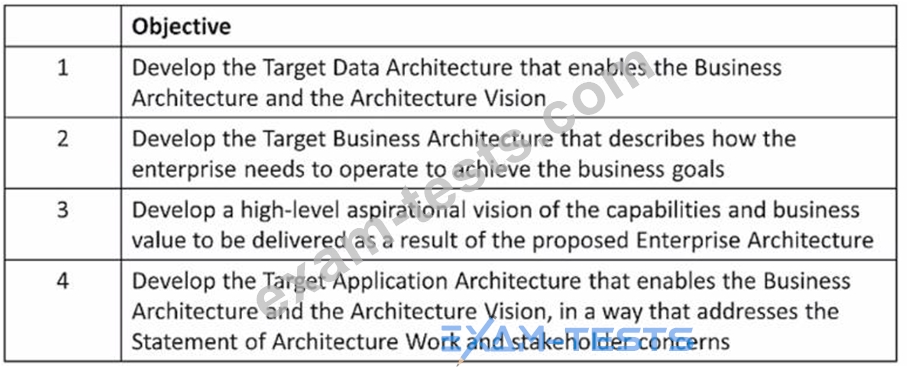
Which phase does each objective match?
Which phase does each objective match?
Correct Answer: A
* The objectives listed in the question correspond to the objectives of different phases of the TOGAF ADM (Architecture Development Method), which is a method for developing and managing an enterprise architecture1.
* The ADM consists of nine phases, each with a specific purpose and output. The phases are1:
oPreliminary Phase: To prepare and initiate the architecture development cycle, including defining the architecture framework, principles, and governance.
oPhase A: Architecture Vision: To define the scope, vision, and stakeholders of the architecture initiative, and to obtain approval to proceed.
oPhase B: Business Architecture: To describe the baseline and target business architecture, and to identify the gaps between them.
oPhase C: Information Systems Architectures: To describe the baseline and target data and application architectures, and to identify the gaps between them.
oPhase D: Technology Architecture: To describe the baseline and target technology architecture, and to identify the gaps between them.
oPhase E: Opportunities and Solutions: To identify and evaluate the opportunities and solutions for implementing the target architecture, and to define the work packages and transition architectures.
oPhase F: Migration Planning: To finalize the implementation and migration plan, and to ensure alignment with the enterprise portfolio and project management.
oPhase G: Implementation Governance: To provide architecture oversight and guidance for the implementation projects, and to manage any architecture change requests.
oPhase H: Architecture Change Management: To monitor the changes in the business and technology environment, and to assess the impact and performance of the architecture.
* Based on the above definitions, we can match each objective with the corresponding phase as follows:
oObjective 1: Develop the Target Data Architecture that enables the Business Architecture and the Architecture Vision. This objective is achieved in Phase C: Information Systems Architectures, where the data architecture is defined as a subset of the information systems architecture2.
oObjective 2: Develop the Target Business Architecture that describes how the enterprise needs to operate to achieve the business goals. This objective is achieved in Phase B: Business Architecture, where the business architecture is defined as a subset of the enterprise architecture3.
oObjective 3: Develop a high-level aspirational vision of the capabilities and business value to be delivered as a result of the proposed Enterprise Architecture. This objective is achieved in Phase A: Architecture Vision, where the architecture vision is defined as a high-level description of the target architecture and its benefits4.
oObjective 4: Develop the Target Application Architecture that enables the Business Architecture and the Architecture Vision, in a way that addresses the Statement of Architecture Work and stakeholder concerns. This objective is achieved in Phase C: Information Systems Architectures, where the application architecture is defined as a subset of the information systems architecture2.
Reference:
* 1: The TOGAF Standard, Version 9.2, Chapter 5: Architecture Development Method (ADM)
* 2: The TOGAF Standard, Version 9.2, Chapter 9: Phase C: Information Systems Architectures
* 3: The TOGAF Standard, Version 9.2, Chapter 8: Phase B: Business Architecture
* 4: The TOGAF Standard, Version 9.2, Chapter 7: Phase A: Architecture Vision
* The ADM consists of nine phases, each with a specific purpose and output. The phases are1:
oPreliminary Phase: To prepare and initiate the architecture development cycle, including defining the architecture framework, principles, and governance.
oPhase A: Architecture Vision: To define the scope, vision, and stakeholders of the architecture initiative, and to obtain approval to proceed.
oPhase B: Business Architecture: To describe the baseline and target business architecture, and to identify the gaps between them.
oPhase C: Information Systems Architectures: To describe the baseline and target data and application architectures, and to identify the gaps between them.
oPhase D: Technology Architecture: To describe the baseline and target technology architecture, and to identify the gaps between them.
oPhase E: Opportunities and Solutions: To identify and evaluate the opportunities and solutions for implementing the target architecture, and to define the work packages and transition architectures.
oPhase F: Migration Planning: To finalize the implementation and migration plan, and to ensure alignment with the enterprise portfolio and project management.
oPhase G: Implementation Governance: To provide architecture oversight and guidance for the implementation projects, and to manage any architecture change requests.
oPhase H: Architecture Change Management: To monitor the changes in the business and technology environment, and to assess the impact and performance of the architecture.
* Based on the above definitions, we can match each objective with the corresponding phase as follows:
oObjective 1: Develop the Target Data Architecture that enables the Business Architecture and the Architecture Vision. This objective is achieved in Phase C: Information Systems Architectures, where the data architecture is defined as a subset of the information systems architecture2.
oObjective 2: Develop the Target Business Architecture that describes how the enterprise needs to operate to achieve the business goals. This objective is achieved in Phase B: Business Architecture, where the business architecture is defined as a subset of the enterprise architecture3.
oObjective 3: Develop a high-level aspirational vision of the capabilities and business value to be delivered as a result of the proposed Enterprise Architecture. This objective is achieved in Phase A: Architecture Vision, where the architecture vision is defined as a high-level description of the target architecture and its benefits4.
oObjective 4: Develop the Target Application Architecture that enables the Business Architecture and the Architecture Vision, in a way that addresses the Statement of Architecture Work and stakeholder concerns. This objective is achieved in Phase C: Information Systems Architectures, where the application architecture is defined as a subset of the information systems architecture2.
Reference:
* 1: The TOGAF Standard, Version 9.2, Chapter 5: Architecture Development Method (ADM)
* 2: The TOGAF Standard, Version 9.2, Chapter 9: Phase C: Information Systems Architectures
* 3: The TOGAF Standard, Version 9.2, Chapter 8: Phase B: Business Architecture
* 4: The TOGAF Standard, Version 9.2, Chapter 7: Phase A: Architecture Vision
Question 25
In which part of the ADM cycle do building block gaps become associated with work packages that will address the gaps?
Correct Answer: D
In Phase E of the ADM cycle, building block gaps become associated with work packages that will address the gaps. This phase involves creating an Implementation and Migration Plan that defines a set of work packages and Transition Architectures that will deliver the Target Architecture. Reference: The TOGAF Standard | The Open Group Website, Section 3.2.5 Phase E: Opportunities & Solutions.
- Latest Upload
- 173NAHQ.CPHQ.v2026-09-03.q481
- 113SAP.C-S4CPB-2602.v2026-09-02.q7
- 109Cisco.700-805.v2026-09-02.q86
- 161MSSC.CLT-4.0.v2026-09-02.q43
- 126Fitness.NCSF-CPT.v2026-09-02.q18
- 174Google.Generative-AI-Leader.v2026-09-02.q77
- 139PECB.ISO-14001-Lead-Auditor.v2026-09-01.q39
- 126Google.GCP-DE.v2026-09-01.q27
- 160Cisco.300-820.v2026-09-01.q105
- 154Cisco.500-220.v2026-09-01.q72
[×]
Download PDF File
Enter your email address to download TheOpenGroup.OGEA-101.v2025-05-29.q40 Practice Test