As Chief Enterprise Architect, you want to select an extension option that follows SAP's clean-core strategy. What are your recommendations to implement the clean-core strategy best?
Correct Answer: A
Explanation The clean-core strategy is a SAP initiative to keep the core of SAP S/4HANA as clean as possible by moving customizations and extensions to the side-by-side layer. This allows SAP to more easily deliver new releases of S/4HANA without having to worry about breaking custom code. There are two main ways to extend SAP S/4HANA: Developer Extensibility: This allows developers to extend the core of SAP S/4HANA by modifying the source code. This is not allowed under the clean-core strategy. Side-by-Side Extensibility: This allows developers to extend SAP S/4HANA by creating new applications that run alongside the core system. These applications can communicate with the core system using public APIs. The following are the benefits of using Side-by-Side Extensibility: Flexibility: Side-by-Side Extensibility allows developers to extend SAP S/4HANA in any way they see fit. Scalability: Side-by-Side Extensibility can be scaled to meet the needs of any organization. Maintainability: Side-by-Side Extensibility is easier to maintain than Developer Extensibility, because custom code is not embedded in the core system. Therefore, the best way to implement the clean-core strategy is to use Side-by-Side Extensibility. This will allow you to extend SAP S/4HANA in a flexible, scalable, and maintainable way.
Question 7
The Wanderlust CIO, along with you, the Chief Enterprise Architect, are in the process of deciding on the application that can potentially replace your existing online marketing application, and you are trying to create the artifact Business Footprint Diagram for decision support ( See table below) Which of the following combinations of goals, business capabilities, and applications would you recommend? Note: There are 2 correct answers to this question,
Correct Answer: A,D
Question 8
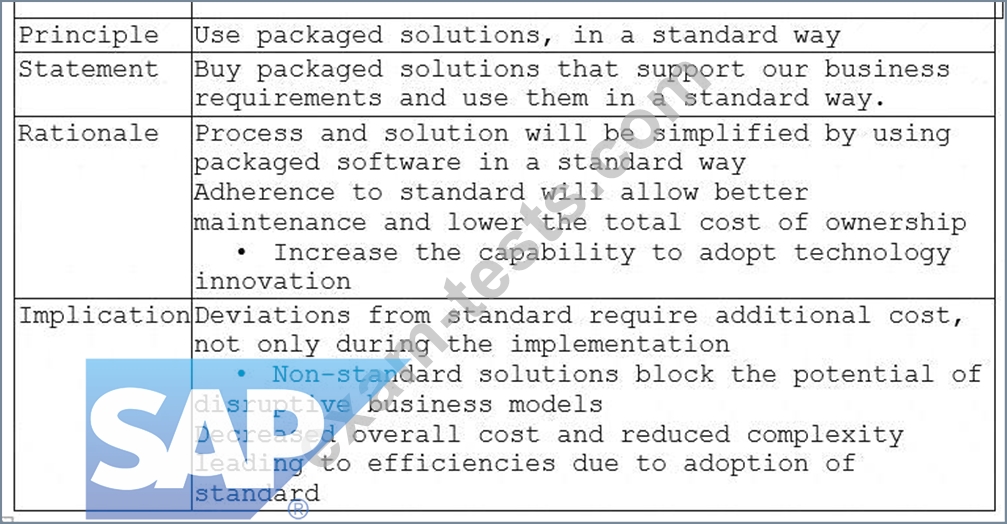
Green Elk & Company is the world s leading manufacturer of agricultural and forestry machinery. The former company slogan "Elk always runs has recently been changed to Elk feeds the world". One of Green Elk's strategic goals is to increase its revenue in the emerging markets of China, India, and other parts of Asia by 80 % within three years. This requires a new business model that caters to significantly smaller farms with limited budgets. You are the Chief Enterprise Architect and the CIO asks you to assess the new business model for smaller farms with smaller budgets. Given the principle and statement, which of the following combinations of rationale and implication do you consider well-defined?
Correct Answer: D
Explanation The rationale and implication in this combination are well-defined because they both support the principle of using packaged solutions in a standard way. The rationale explains the benefits of using packaged solutions, while the implication outlines the steps that need to be taken to ensure that packaged solutions are used in a standard way. According to the SAP Enterprise Architecture Framework, which is a methodology and toolset by the German multinational software company SAP that helps enterprise architects define and implement an architecture strategy for their organizations, a principle is a general rule or guideline that expresses a fundamental value or belief, and that guides the design and implementation of the architecture. A principle consists of four elements: a name, a statement, a rationale, and an implication. The name is a short and memorable label that summarizes the principle. The statement is a concise and precise description of the principle. The rationale is an explanation of why the principle is important and beneficial for the organization. The implication is a description of the consequences or impacts of applying or not applying the principle. The principle in option D is: Name: Use packaged solutions, in a standard way. Statement: Buy packaged solutions that support our business requirements and use them in a standard way. Rationale: Process and solution will be simplified by using packaged software in a standard way. Adherence to standard will allow better maintenance and lower the total cost of ownership. Increase the capability to adopt technology innovation. Implication: In case custom developments are required, adhere to defined best practices, standards, and guidelines (extensibility concept, side-by-side extensions). Reuse before buy, before build. Enable easier transition to the cloud in the future. This combination of rationale and implication is well-defined because it clearly and logically explains the benefits and consequences of following or not following the principle. The rationale shows how using packaged solutions in a standard way can simplify the process and solution, reduce the cost and effort of maintenance, and increase the ability to adopt new technologies. The implication shows how custom developments should be minimized and standardized, how reuse should be preferred over buying or building new solutions, and how cloud readiness should be considered for future scalability. The other options (A, B, C) are not correct for the combination of rationale and implication that is well-defined because they either mix up or confuse some of the elements of the principle. For example: Option A is not correct because it mixes up the rationale and implication elements. The first sentence of the rationale ("Process and solution will be simplified by using packaged software in a standard way") is actually an implication of following the principle, not a reason for following it. The first sentence of the implication ("Reuse vendor and industry best practices, reference architectures and pre-delivered content") is actually a rationale for following the principle, not a consequence of following it. Option B is not correct because it confuses the rationale and implication elements. The first sentence of the rationale ("In case custom developments are required, adhere to defined best practices, standards, and guidelines (extensibility concept, side-by-side extensions)") is actually an implication of following the principle, not a reason for following it. The first sentence of the implication ("Process and solution will be simplified by using packaged software in a standard way") is actually a rationale for following the principle, not a consequence of following it. Option C is not correct because it confuses the rationale and implication elements. The second sentence of the rationale ("Adherence to standard will allow better maintenance and lower the total cost of ownership") is actually an implication of following the principle, not a reason for following it. The second sentence of the implication ("Reuse before buy, before build") is actually a rationale for following the principle, not a consequence of following it.
Question 9
Having identified the appropriate sel of Business Activities, as the Chie Enterprise Architect of Wanderlust, assisted by the sap Enterprise Architects. you have been trying to relate to Lead to Cash Business Capabilities in the SAP Reference Business Architecture content repository. In light of the two key goals outlined by the Wanderlust CIO, what are the most appropriate Business Capabilities? Note: There are 3 correct answers to this question.
Correct Answer: A,B,C
Question 10
The CIO of Wanderlust strongly feels that the seldom-used legacy Marketing application cannot be the platform to rejuvenate their online marketing business. As Chief Enterprise Architect, the CIO has entrusted you with the responsibility of finding a suitable replacement that can support all current processes and also address the issues plaguing the existing application. Which of the following should you do to conclusively shortlist possible applications to replace the existing one? Note: There are 2 correct answers to this question.
Correct Answer: A,C
Explanation Starting with the current processes will help to understand the capabilities that are needed in a new application. This will help to narrow down the field of potential applications and identify those that are most likely to meet the needs of Wanderlust. Mapping business capabilities to these processes will help to identify the gaps in the current capabilities and the areas where improvement is needed. This will help to ensure that the new application meets the needs of Wanderlust and addresses the issues plaguing the existing application. Relating Wanderlust processes to industry standard processes will help to identify applications that are already being used by other organizations. This can be a good way to ensure that the new application is compatible with other systems and that it can be easily integrated with existing systems. The other two options, Comparing the costs of those market leading online marketing applications and Understanding the features of leading online marketing applications available in the market through product demonstrations and ranking the applications in terms of features, are not as critical at this stage. The costs of the applications can be compared once the shortlist of applications has been finalized. The features of the applications can be understood through product demonstrations once the shortlist has been finalized. Therefore, the best course of action is to start with the current processes, map business capabilities to these processes, and identify which application(s) in the market can deliver such capabilities. This will help to narrow down the field of potential applications and identify those that are most likely to meet the needs of Wanderlust. Here are some of the benefits of taking a process-centric approach to selecting a new marketing application: It can help to ensure that the new application meets the needs of the business. It can help to identify applications that are already being used by other organizations. It can help to ensure that the new application is compatible with other systems and that it can be easily integrated with existing systems.