The CIO of Wanderlust strongly feels that the seldom-used legacy Marketing application cannot be the platform to rejuvenate their online marketing business. As Chief Enterprise Architect, the CIO has entrusted you with the responsibility of finding a suitable replacement that can support all current processes and also address the issues plaguing the existing application. Which of the following should you do to conclusively shortlist possible applications to replace the existing one? Note: There are 2 correct answers to this question.
Correct Answer: A,C
Explanation Starting with the current processes will help to understand the capabilities that are needed in a new application. This will help to narrow down the field of potential applications and identify those that are most likely to meet the needs of Wanderlust. Mapping business capabilities to these processes will help to identify the gaps in the current capabilities and the areas where improvement is needed. This will help to ensure that the new application meets the needs of Wanderlust and addresses the issues plaguing the existing application. Relating Wanderlust processes to industry standard processes will help to identify applications that are already being used by other organizations. This can be a good way to ensure that the new application is compatible with other systems and that it can be easily integrated with existing systems. The other two options, Comparing the costs of those market leading online marketing applications and Understanding the features of leading online marketing applications available in the market through product demonstrations and ranking the applications in terms of features, are not as critical at this stage. The costs of the applications can be compared once the shortlist of applications has been finalized. The features of the applications can be understood through product demonstrations once the shortlist has been finalized. Therefore, the best course of action is to start with the current processes, map business capabilities to these processes, and identify which application(s) in the market can deliver such capabilities. This will help to narrow down the field of potential applications and identify those that are most likely to meet the needs of Wanderlust. Here are some of the benefits of taking a process-centric approach to selecting a new marketing application: It can help to ensure that the new application meets the needs of the business. It can help to identify applications that are already being used by other organizations. It can help to ensure that the new application is compatible with other systems and that it can be easily integrated with existing systems.
Question 42
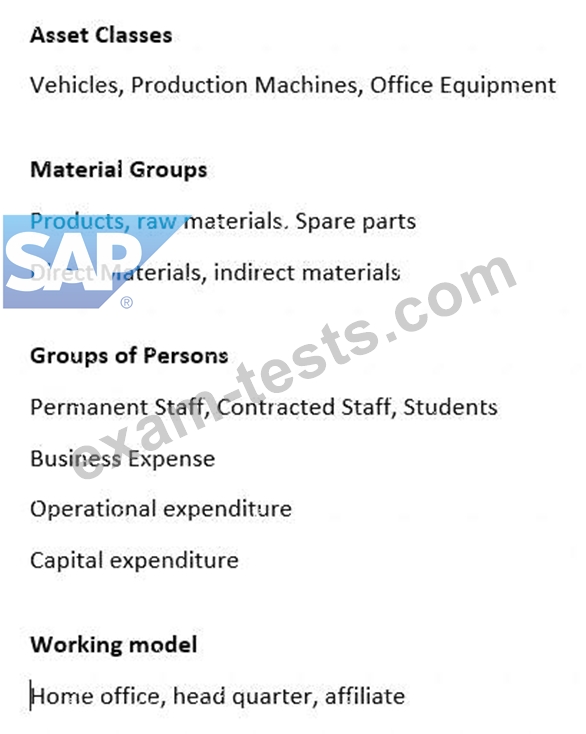
When creating an application architecture roadmap, the WHAT and WHERE are defined in a rather straightforward way, while the WHOM may differ by context. Multiple roadmap clusters may apply a variety of WHOM dimensions. For example, procurement vs. asset management. Which of the following definitions are correct? Note. There are 3 correct answers to this question.
Correct Answer: B,C,D
Explanation The WHOM dimension of an application architecture roadmap defines the different groups of stakeholders or users that are involved in or affected by the application. The WHOM dimension can vary depending on the context and the scope of the roadmap. For example, in the context of procurement vs. asset management, the WHOM dimension could include material groups/products, groups of persons, and working model as possible clusters. These clusters represent different categories of items, people, and locations that are relevant for the procurement and asset management processes. For example: Material groups/products: This cluster could include different types of materials or products that are procured or managed by the organization, such as raw materials, spare parts, direct materials, or indirect materials. These categories could have different requirements, standards, or regulations that affect the application architecture. Groups of persons: This cluster could include different types of people that are involved in or benefit from the procurement and asset management processes, such as permanent staff, contracted staff, or students. These groups could have different roles, responsibilities, or access rights that affect the application architecture. Working model: This cluster could include different modes or locations of work that are supported by the procurement and asset management processes, such as home office, head quarter, or affiliate. These modes or locations could have different technical, legal, or organizational implications that affect the application architecture. The other option (A) is not a correct definition of a WHOM dimension cluster, because it does not represent a group of stakeholders or users, but rather a group of assets or resources that are managed by the organization. Asset classes/vehicles, production machines, and office equipment are examples of WHAT dimension clusters, which define the different types of assets or resources that are relevant for the application architecture. Verified References: Strategic Architecture Roadmap for Composable Enterprise Applications, What is an application architecture?, Phase C: Information Systems Architectures - Application Architecture
Question 43
Having identified the appropriate sel of Business Activities, as the Chief Enterprise Architect of Wanderlust, assisted by the sap Enterprise Architects. you have been trying to relate to Lead to Cash Business Capabilities in the SAP Reference Business Architecture content repository. In light of the two key goals outlined by the Wanderlust CIO, what are the most appropriate Business Capabilities? Note: There are 3 correct answers to this question.
Correct Answer: A,C,D
The business capabilities 'Marketing Analytics' and 'Recommendation Management' align with the goal of enhancing the number of leads through targeted campaigns and cross-selling opportunities. 'Marketing Campaign Management' is central to designing and executing effective campaigns. 'Social Media Management' is pivotal for achieving high visibility on platforms where potential customers are most active. Reference = These capabilities should be part of Wanderlust's business architecture to support the CIO's objectives, and they are likely detailed in the SAP Reference Business Architecture content, which includes capabilities needed to execute comprehensive marketing strategies.
Question 44
As the Chief Enterprise Architect of your company you have been asked by the CIO to apply agile principles instead of following the sequential phases of TOGAFS ADM. How do you respond?
Correct Answer: D
In the context of incorporating agile principles into the TOGAF's Architecture Development Method (ADM), Option D is accurate. The TOGAF® ADM is inherently iterative and dynamic, which means that it doesn't strictly have to be a linear process. It allows for feedback at any stage of the development cycle and can be adapted to include agile practices. The SAP Enterprise Architecture (EA) Framework is built to be flexible and can incorporate agile principles, supporting rapid iterations and adaptive planning. The agile approach is integrated into the SAP EA Framework to enhance responsiveness and to enable a continuous delivery model that aligns with the iterative nature of the ADM. Agile principles can be applied within and across the different phases of the ADM, promoting a more flexible and responsive architecture development process that is suited for organizations following agile methodologies. : TOGAF documentation outlining the iterative nature of ADM. SAP EA Framework documentation discussing integration with agile methodologies.
Question 45
Which of the following roles are missing from Wanderlust's current Enterprise Architecture practice structure? Note: There are 2 correct answers to this question.
Correct Answer: A,B
Explanation Wanderlust's current Enterprise Architecture practice structure includes the following roles: Business Architect: This role is responsible for understanding the business requirements and translating them into technical requirements. Application Architect: This role is responsible for designing and implementing applications that meet the business requirements. Technical Architect: This role is responsible for designing and implementing the underlying infrastructure that supports the applications. However, the structure is missing the following roles: Data Architect: This role is responsible for designing and managing the data architecture. This includes defining the data models, data warehouses, and data lakes. Architecture Board: This role is responsible for overseeing the Enterprise Architecture practice and ensuring that it is aligned with the business goals. The Architecture Board is responsible for setting the overall direction of the Enterprise Architecture practice and ensuring that it is aligned with the business goals. The Board also provides oversight and guidance to the other roles in the practice. The Data Architect is responsible for designing and managing the data architecture. This includes defining the data models, data warehouses, and data lakes. The Data Architect also works with the Business Architect to ensure that the data architecture meets the business requirements. The absence of these two roles in Wanderlust's current Enterprise Architecture practice structure suggests that the practice is not fully mature. The addition of these roles would help to ensure that the practice is more effective and aligned with the business goals.