

Question 76
A company produces trays of pre-prepared meals that are sold to restaurants and food retailers. Three varieties of meals are sold: economy, premium and deluxe.
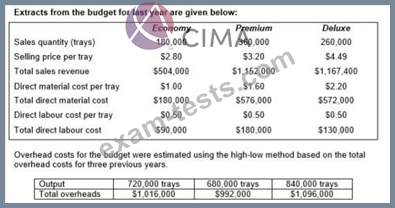
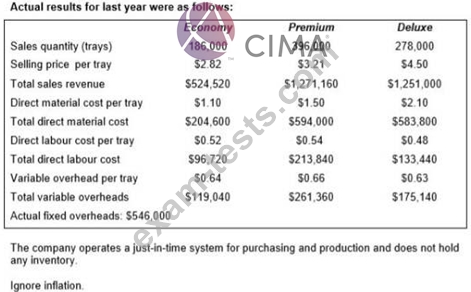
Calculate, for the original budget, the budgeted fixed overhead costs, the budgeted variable overhead cost per tray and the budgeted total overheads costs.
Calculate, for the original budget, the budgeted fixed overhead costs, the budgeted variable overhead cost per tray and the budgeted total overheads costs.
Question 77
A manager has to decide between four mutually exclusive projects, A, B, C and D:
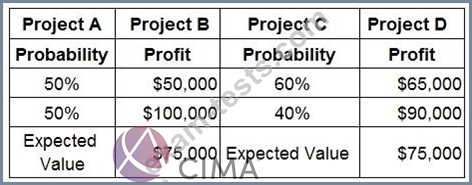
Using the above information, which Project would a risk seeking manager choose?
Using the above information, which Project would a risk seeking manager choose?
Question 78
RT produces two products from different quantities of the same resources using a just-in-time (JIT) production system. The selling price and resource requirements of each of the products are shown below:
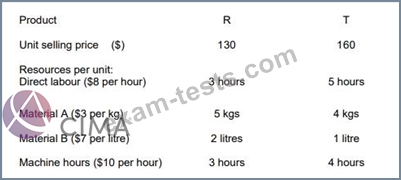
Market research shows that the maximum demand for products R and T during June 2010 is 500 units and 800 units respectively. This does not include an order that RT has agreed with a commercial customer for the supply of 250 units of R and 350 units of T at selling prices of $100 and $135 per unit respectively. Although the customer will accept part of the order, failure by RT to deliver the order in full by the end of June will cause RT to incur a $10,000 financial penalty. At a recent meeting of the purchasing and production managers to discuss the production plans of RT for June, the following resource restrictions for June were identified: Direct labour hours 7,500 hours Material A 8,500 kgs Material B 3,000 litres Machine hours 7,500 hours (Refer to previous 2 questions.) You have now presented your optimum production plan to the purchasing and production managers of RT. During your presentation it became clear that the predicted resource restrictions were rather optimistic. In fact, the managers agreed that the availability of all of the resources could be as much as
10% lower than their original predictions.
Assuming that RT completes the order with the commercial customer, and using linear programming, show the optimum production plan for RT for June 2010 on the basis that the availability of all resources is 10% lower than originally predicted.
Market research shows that the maximum demand for products R and T during June 2010 is 500 units and 800 units respectively. This does not include an order that RT has agreed with a commercial customer for the supply of 250 units of R and 350 units of T at selling prices of $100 and $135 per unit respectively. Although the customer will accept part of the order, failure by RT to deliver the order in full by the end of June will cause RT to incur a $10,000 financial penalty. At a recent meeting of the purchasing and production managers to discuss the production plans of RT for June, the following resource restrictions for June were identified: Direct labour hours 7,500 hours Material A 8,500 kgs Material B 3,000 litres Machine hours 7,500 hours (Refer to previous 2 questions.) You have now presented your optimum production plan to the purchasing and production managers of RT. During your presentation it became clear that the predicted resource restrictions were rather optimistic. In fact, the managers agreed that the availability of all of the resources could be as much as
10% lower than their original predictions.
Assuming that RT completes the order with the commercial customer, and using linear programming, show the optimum production plan for RT for June 2010 on the basis that the availability of all resources is 10% lower than originally predicted.
Question 79
A company's budget for the next period shows that it would breakeven at sales revenue of $800,000 and fixed costs of $320,000.
The sales revenue needed to achieve a profit of $200,000 in the next period would be:
The sales revenue needed to achieve a profit of $200,000 in the next period would be:
Question 80
A company is considering two mutually exclusive projects.
The returns on each project, at both high and low demand, have been multipled by the estimated probabilities to calculate the expected values shown in the table below:

Market research would be able to determine with certainty what the level of demand will be.
What is the maximum amount that the company should pay for this certainty?
The returns on each project, at both high and low demand, have been multipled by the estimated probabilities to calculate the expected values shown in the table below:
Market research would be able to determine with certainty what the level of demand will be.
What is the maximum amount that the company should pay for this certainty?