

Question 166
You have broken down a legacy monolithic application into a few containerized RESTful microservices. You want to run those microservices on Cloud Run. You also want to make sure the services are highly available with low latency to your customers. What should you do?
Question 167
Your company's test suite is a custom C++ application that runs tests throughout each day on Linux virtual
machines. The full test suite takes several hours to complete, running on a limited number of on-premises
servers reserved for testing. Your company wants to move the testing infrastructure to the cloud, to reduce
the amount of time it takes to fully test a change to the system, while changing the tests as little as
possible.
Which cloud infrastructure should you recommend?
machines. The full test suite takes several hours to complete, running on a limited number of on-premises
servers reserved for testing. Your company wants to move the testing infrastructure to the cloud, to reduce
the amount of time it takes to fully test a change to the system, while changing the tests as little as
possible.
Which cloud infrastructure should you recommend?
Question 168
Case Study: 6 - TerramEarth
Company Overview
TerramEarth manufactures heavy equipment for the mining and agricultural industries. About
80% of their business is from mining and 20% from agriculture. They currently have over 500 dealers and service centers in 100 countries. Their mission is to build products that make their customers more productive.
Solution Concept
There are 20 million TerramEarth vehicles in operation that collect 120 fields of data per second.
Data is stored locally on the vehicle and can be accessed for analysis when a vehicle is serviced.
The data is downloaded via a maintenance port. This same port can be used to adjust operational parameters, allowing the vehicles to be upgraded in the field with new computing modules.
Approximately 200,000 vehicles are connected to a cellular network, allowing TerramEarth to collect data directly. At a rate of 120 fields of data per second with 22 hours of operation per day, TerramEarth collects a total of about 9 TB/day from these connected vehicles.
Existing Technical Environment
TerramEarth's existing architecture is composed of Linux and Windows-based systems that reside in a single U.S. west coast based data center. These systems gzip CSV files from the field and upload via FTP, and place the data in their data warehouse. Because this process takes time, aggregated reports are based on data that is 3 weeks old.
With this data, TerramEarth has been able to preemptively stock replacement parts and reduce unplanned downtime of their vehicles by 60%. However, because the data is stale, some customers are without their vehicles for up to 4 weeks while they wait for replacement parts.
Business Requirements
Decrease unplanned vehicle downtime to less than 1 week.
* Support the dealer network with more data on how their customers use their equipment to better
* position new products and services
Have the ability to partner with different companies - especially with seed and fertilizer suppliers
* in the fast-growing agricultural business - to create compelling joint offerings for their customers.
Technical Requirements
Expand beyond a single datacenter to decrease latency to the American Midwest and east
* coast.
Create a backup strategy.
* Increase security of data transfer from equipment to the datacenter.
* Improve data in the data warehouse.
* Use customer and equipment data to anticipate customer needs.
* Application 1: Data ingest
A custom Python application reads uploaded datafiles from a single server, writes to the data warehouse.
Compute:
Windows Server 2008 R2
* - 16 CPUs
- 128 GB of RAM
- 10 TB local HDD storage
Application 2: Reporting
An off the shelf application that business analysts use to run a daily report to see what equipment needs repair. Only 2 analysts of a team of 10 (5 west coast, 5 east coast) can connect to the reporting application at a time.
Compute:
Off the shelf application. License tied to number of physical CPUs
* - Windows Server 2008 R2
- 16 CPUs
- 32 GB of RAM
- 500 GB HDD
Data warehouse:
A single PostgreSQL server
* - RedHat Linux
- 64 CPUs
- 128 GB of RAM
- 4x 6TB HDD in RAID 0
Executive Statement
Our competitive advantage has always been in the manufacturing process, with our ability to build better vehicles for lower cost than our competitors. However, new products with different approaches are constantly being developed, and I'm concerned that we lack the skills to undergo the next wave of transformations in our industry. My goals are to build our skills while addressing immediate market needs through incremental innovations.
For this question, refer to the TerramEarth case study. A new architecture that writes all incoming data to BigQuery has been introduced. You notice that the data is dirty, and want to ensure data quality on an automated daily basis while managing cost.
What should you do?
Company Overview
TerramEarth manufactures heavy equipment for the mining and agricultural industries. About
80% of their business is from mining and 20% from agriculture. They currently have over 500 dealers and service centers in 100 countries. Their mission is to build products that make their customers more productive.
Solution Concept
There are 20 million TerramEarth vehicles in operation that collect 120 fields of data per second.
Data is stored locally on the vehicle and can be accessed for analysis when a vehicle is serviced.
The data is downloaded via a maintenance port. This same port can be used to adjust operational parameters, allowing the vehicles to be upgraded in the field with new computing modules.
Approximately 200,000 vehicles are connected to a cellular network, allowing TerramEarth to collect data directly. At a rate of 120 fields of data per second with 22 hours of operation per day, TerramEarth collects a total of about 9 TB/day from these connected vehicles.
Existing Technical Environment
TerramEarth's existing architecture is composed of Linux and Windows-based systems that reside in a single U.S. west coast based data center. These systems gzip CSV files from the field and upload via FTP, and place the data in their data warehouse. Because this process takes time, aggregated reports are based on data that is 3 weeks old.
With this data, TerramEarth has been able to preemptively stock replacement parts and reduce unplanned downtime of their vehicles by 60%. However, because the data is stale, some customers are without their vehicles for up to 4 weeks while they wait for replacement parts.
Business Requirements
Decrease unplanned vehicle downtime to less than 1 week.
* Support the dealer network with more data on how their customers use their equipment to better
* position new products and services
Have the ability to partner with different companies - especially with seed and fertilizer suppliers
* in the fast-growing agricultural business - to create compelling joint offerings for their customers.
Technical Requirements
Expand beyond a single datacenter to decrease latency to the American Midwest and east
* coast.
Create a backup strategy.
* Increase security of data transfer from equipment to the datacenter.
* Improve data in the data warehouse.
* Use customer and equipment data to anticipate customer needs.
* Application 1: Data ingest
A custom Python application reads uploaded datafiles from a single server, writes to the data warehouse.
Compute:
Windows Server 2008 R2
* - 16 CPUs
- 128 GB of RAM
- 10 TB local HDD storage
Application 2: Reporting
An off the shelf application that business analysts use to run a daily report to see what equipment needs repair. Only 2 analysts of a team of 10 (5 west coast, 5 east coast) can connect to the reporting application at a time.
Compute:
Off the shelf application. License tied to number of physical CPUs
* - Windows Server 2008 R2
- 16 CPUs
- 32 GB of RAM
- 500 GB HDD
Data warehouse:
A single PostgreSQL server
* - RedHat Linux
- 64 CPUs
- 128 GB of RAM
- 4x 6TB HDD in RAID 0
Executive Statement
Our competitive advantage has always been in the manufacturing process, with our ability to build better vehicles for lower cost than our competitors. However, new products with different approaches are constantly being developed, and I'm concerned that we lack the skills to undergo the next wave of transformations in our industry. My goals are to build our skills while addressing immediate market needs through incremental innovations.
For this question, refer to the TerramEarth case study. A new architecture that writes all incoming data to BigQuery has been introduced. You notice that the data is dirty, and want to ensure data quality on an automated daily basis while managing cost.
What should you do?
Question 169
For this question, refer to the Mountkirk Games case study. Mountkirk Games wants to design their solution for the future in order to take advantage of cloud and technology improvements as they become available. Which two steps should they take? (Choose two.)
Question 170
One of the developers on your team deployed their application in Google Container Engine with the Dockerfile below. They report that their application deployments are taking too long.
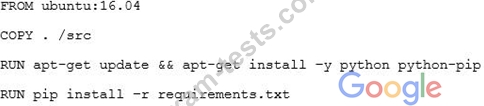
You want to optimize this Dockerfile for faster deployment times without adversely affecting the app's functionality.
Which two actions should you take? Choose 2 answers.
You want to optimize this Dockerfile for faster deployment times without adversely affecting the app's functionality.
Which two actions should you take? Choose 2 answers.
Premium Bundle
Newest Professional-Cloud-Architect Exam PDF Dumps shared by BraindumpsPass.com for Helping Passing Professional-Cloud-Architect Exam! BraindumpsPass.com now offer the updated Professional-Cloud-Architect exam dumps, the BraindumpsPass.com Professional-Cloud-Architect exam questions have been updated and answers have been corrected get the latest BraindumpsPass.com Professional-Cloud-Architect pdf dumps with Exam Engine here: