

Question 31
You need to configure a Google Kubernetes Engine (GKE) cluster. The initial deployment should have 5 nodes with the potential to scale to 10 nodes. The maximum number of Pods per node is 8. The number of services could grow from 100 to up to 1024. How should you design the IP schema to optimally meet this requirement?
Question 32
You want to set up two Cloud Routers so that one has an active Border Gateway Protocol (BGP) session, and the other one acts as a standby.
Which BGP attribute should you use on your on-premises router?
Which BGP attribute should you use on your on-premises router?
Question 33
You created a new VPC network named Dev with a single subnet. You added a firewall rule for the network Dev to allow HTTP traffic only and enabled logging. When you try to log in to an instance in the subnet via Remote Desktop Protocol, the login fails. You look for the Firewall rules logs in Stackdriver Logging, but you do not see any entries for blocked traffic. You want to see the logs for blocked traffic.
What should you do?
What should you do?
Question 34
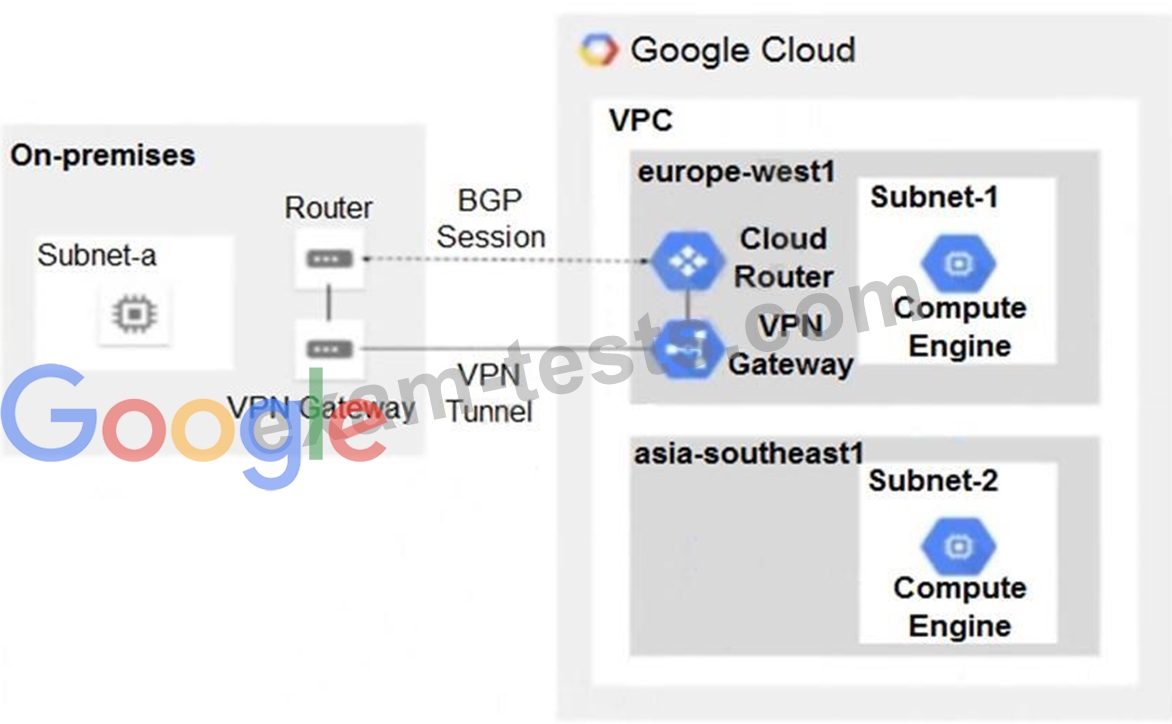
You have the following routing design. You discover that Compute Engine instances in Subnet-2 in the asia-southeast1 region cannot communicate with compute resources on-premises. What should you do?
Question 35
Your organization is implementing a new security policy to control how firewall rules are applied to control flows between virtual machines (VMs). Using Google-recommended practices, you need to set up a firewall rule to enforce strict control of traffic between VM A and VM B. You must ensure that communications flow only from VM A to VM B within the VPC, and no other communication paths are allowed. No other firewall rules exist in the VPC. Which firewall rule should you configure to allow only this communication path?