

Question 56
MJTelco Case Study
Company Overview
MJTelco is a startup that plans to build networks in rapidly growing, underserved markets around the world. The company has patents for innovative optical communications hardware. Based on these patents, they can create many reliable, high-speed backbone links with inexpensive hardware.
Company Background
Founded by experienced telecom executives, MJTelco uses technologies originally developed to overcome communications challenges in space. Fundamental to their operation, they need to create a distributed data infrastructure that drives real-time analysis and incorporates machine learning to continuously optimize their topologies. Because their hardware is inexpensive, they plan to overdeploy the network allowing them to account for the impact of dynamic regional politics on location availability and cost.
Their management and operations teams are situated all around the globe creating many-to-many relationship between data consumers and provides in their system. After careful consideration, they decided public cloud is the perfect environment to support their needs.
Solution Concept
MJTelco is running a successful proof-of-concept (PoC) project in its labs. They have two primary needs:
Scale and harden their PoC to support significantly more data flows generated when they ramp to more

than 50,000 installations.
Refine their machine-learning cycles to verify and improve the dynamic models they use to control
topology definition.
MJTelco will also use three separate operating environments - development/test, staging, and production
- to meet the needs of running experiments, deploying new features, and serving production customers.
Business Requirements
Scale up their production environment with minimal cost, instantiating resources when and where
needed in an unpredictable, distributed telecom user community.
Ensure security of their proprietary data to protect their leading-edge machine learning and analysis.
Provide reliable and timely access to data for analysis from distributed research workers
Maintain isolated environments that support rapid iteration of their machine-learning models without
affecting their customers.
Technical Requirements
Ensure secure and efficient transport and storage of telemetry data
Rapidly scale instances to support between 10,000 and 100,000 data providers with multiple flows
each.
Allow analysis and presentation against data tables tracking up to 2 years of data storing approximately
100m records/day
Support rapid iteration of monitoring infrastructure focused on awareness of data pipeline problems
both in telemetry flows and in production learning cycles.
CEO Statement
Our business model relies on our patents, analytics and dynamic machine learning. Our inexpensive hardware is organized to be highly reliable, which gives us cost advantages. We need to quickly stabilize our large distributed data pipelines to meet our reliability and capacity commitments.
CTO Statement
Our public cloud services must operate as advertised. We need resources that scale and keep our data secure. We also need environments in which our data scientists can carefully study and quickly adapt our models. Because we rely on automation to process our data, we also need our development and test environments to work as we iterate.
CFO Statement
The project is too large for us to maintain the hardware and software required for the data and analysis.
Also, we cannot afford to staff an operations team to monitor so many data feeds, so we will rely on automation and infrastructure. Google Cloud's machine learning will allow our quantitative researchers to work on our high-value problems instead of problems with our data pipelines.
You create a new report for your large team in Google Data Studio 360. The report uses Google BigQuery as its data source. It is company policy to ensure employees can view only the data associated with their region, so you create and populate a table for each region. You need to enforce the regional access policy to the data.
Which two actions should you take? (Choose two.)
Company Overview
MJTelco is a startup that plans to build networks in rapidly growing, underserved markets around the world. The company has patents for innovative optical communications hardware. Based on these patents, they can create many reliable, high-speed backbone links with inexpensive hardware.
Company Background
Founded by experienced telecom executives, MJTelco uses technologies originally developed to overcome communications challenges in space. Fundamental to their operation, they need to create a distributed data infrastructure that drives real-time analysis and incorporates machine learning to continuously optimize their topologies. Because their hardware is inexpensive, they plan to overdeploy the network allowing them to account for the impact of dynamic regional politics on location availability and cost.
Their management and operations teams are situated all around the globe creating many-to-many relationship between data consumers and provides in their system. After careful consideration, they decided public cloud is the perfect environment to support their needs.
Solution Concept
MJTelco is running a successful proof-of-concept (PoC) project in its labs. They have two primary needs:
Scale and harden their PoC to support significantly more data flows generated when they ramp to more
than 50,000 installations.
Refine their machine-learning cycles to verify and improve the dynamic models they use to control
topology definition.
MJTelco will also use three separate operating environments - development/test, staging, and production
- to meet the needs of running experiments, deploying new features, and serving production customers.
Business Requirements
Scale up their production environment with minimal cost, instantiating resources when and where
needed in an unpredictable, distributed telecom user community.
Ensure security of their proprietary data to protect their leading-edge machine learning and analysis.
Provide reliable and timely access to data for analysis from distributed research workers
Maintain isolated environments that support rapid iteration of their machine-learning models without
affecting their customers.
Technical Requirements
Ensure secure and efficient transport and storage of telemetry data
Rapidly scale instances to support between 10,000 and 100,000 data providers with multiple flows
each.
Allow analysis and presentation against data tables tracking up to 2 years of data storing approximately
100m records/day
Support rapid iteration of monitoring infrastructure focused on awareness of data pipeline problems
both in telemetry flows and in production learning cycles.
CEO Statement
Our business model relies on our patents, analytics and dynamic machine learning. Our inexpensive hardware is organized to be highly reliable, which gives us cost advantages. We need to quickly stabilize our large distributed data pipelines to meet our reliability and capacity commitments.
CTO Statement
Our public cloud services must operate as advertised. We need resources that scale and keep our data secure. We also need environments in which our data scientists can carefully study and quickly adapt our models. Because we rely on automation to process our data, we also need our development and test environments to work as we iterate.
CFO Statement
The project is too large for us to maintain the hardware and software required for the data and analysis.
Also, we cannot afford to staff an operations team to monitor so many data feeds, so we will rely on automation and infrastructure. Google Cloud's machine learning will allow our quantitative researchers to work on our high-value problems instead of problems with our data pipelines.
You create a new report for your large team in Google Data Studio 360. The report uses Google BigQuery as its data source. It is company policy to ensure employees can view only the data associated with their region, so you create and populate a table for each region. You need to enforce the regional access policy to the data.
Which two actions should you take? (Choose two.)
Question 57
Your company uses a proprietary system to send inventory data every 6 hours to a data ingestion service in the cloud. Transmitted data includes a payload of several fields and the timestamp of the transmission. If there are any concerns about a transmission, the system re-transmits the data. How should you deduplicate the data most efficiency?
Question 58
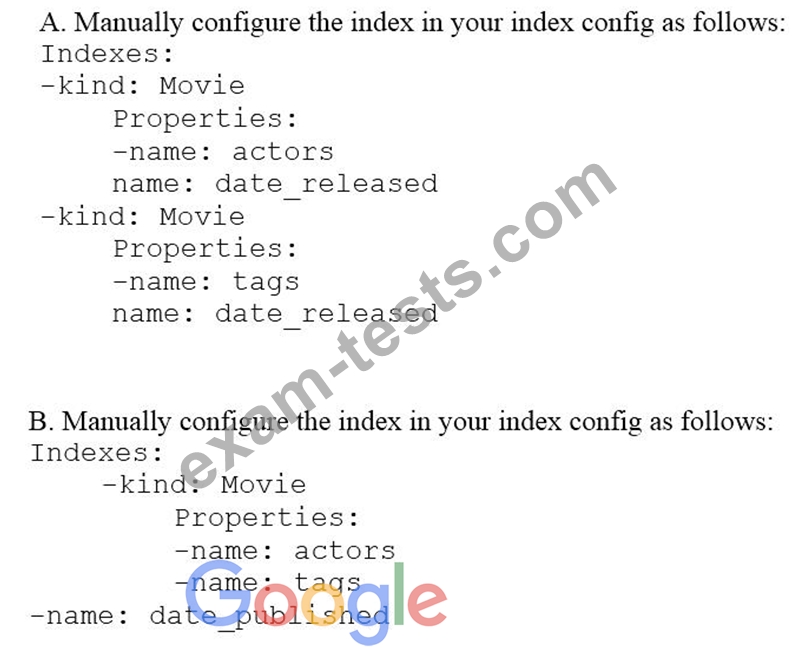
You are deploying a new storage system for your mobile application, which is a media streaming service. You decide the best fit is Google Cloud Datastore. You have entities with multiple properties, some of which can take on multiple values. For example, in the entity 'Movie' the property 'actors' and the property 'tags' have multiple values but the property 'date released' does not. A typical query would ask for all movies with actor=<actorname> ordered by date_released or all movies with tag=Comedy ordered by date_released. How should you avoid a combinatorial explosion in the number of indexes?

Question 59
You are running your BigQuery project in the on-demand billing model and are executing a change data capture (CDC) process that ingests dat a. The CDC process loads 1 GB of data every 10 minutes into a temporary table, and then performs a merge into a 10 TB target table. This process is very scan intensive and you want to explore options to enable a predictable cost model. You need to create a BigQuery reservation based on utilization information gathered from BigQuery Monitoring and apply the reservation to the CDC process. What should you do?
Question 60
You are developing a model to identify the factors that lead to sales conversions for your customers. You have completed processing your dat a. You want to continue through the model development lifecycle. What should you do next?