Which operation should be used to check if the difference of two values is greater than 1?
Correct Answer: B
To determine if the difference between two values is greater than 1, the subtraction operation should be used. By subtracting one value from the other, you obtain the difference. If this difference is greater than 1, it confirms that the two values are separated by more than a single unit. This is a fundamental operation in programming and mathematics for comparing magnitudes and is supported by the logical comparison operator > which checks if the result of the subtraction is greater than 1123. References: * Using Logical Operator to Test 'If Greater Than' Condition1. * Comparison Operators in Excel2. * Assembly language comparison technique3.
Question 2
What is an example of an algorithm?
Correct Answer: D
An algorithm is a set of instructions designed to perform a specific task or solve a problem. It is a sequence of steps that are followed to achieve a particular outcome. In the context of the given options, the correct example of an algorithm is option D. This option outlines a series of steps to troubleshoot a device, which is a common algorithmic procedure known as "power cycling" or "resetting." It involves turning off a device, waiting for a short period, and then turning it back on. This process can resolve temporary issues by clearing the device's memory and resetting its state. Option A is incorrect because it is simply a list of items, not a sequence of steps with a specific goal. Option B is also incorrect as it describes a file type used in web development, not a set of instructions. Option C is a statement about a mathematical property, not an algorithm. References: The definition and examples of algorithms can be found in various educational resources and programming literature. For instance, Scribbr provides a clear explanation of what an algorithm is and how it functions in both daily life and computer science1. Additionally, GeeksforGeeks offers insights into the definition, types, complexity, and examples of algorithms2. These sources corroborate the explanation provided here and offer further reading on the subject.
Question 3
Which phase of an agile application would create a function that calculates shipping costs based on an item's weight and delivery zip code?
Correct Answer: A
In the Agile software development life cycle, the Implementation phase is where the actual coding and development of the project take place. This is the stage where a function to calculate shipping costs based on an item's weight and delivery zip code would be created. The Implementation phase involves translating the design and analysis work into functional software components. It's during this phase that developers write code and build features that will eventually be tested and refined in subsequent phases. References: * Agile methodologies emphasize incremental development and delivery, where the Implementation phase is key for developing new functions1. * The Agile Software Development Life Cycle outlines the Implementation phase as the stage where the actual product development happens2. * Wrike's Agile Guide also describes the Implementation (or Iteration) phase as the time when the team builds the software3.
Question 4
What is required for all function calls?
Correct Answer: D
When calling a function in Python, you simply give the name of the function followed by parentheses. Even if the function doesn't take any arguments, you still need to include the parentheses. For example, print("Hello!") is a function call. The function name should describe what it's supposed to do. Function definitions begin with the def keyword, followed by the function name and parameters (if any). The statements within the function definition are indented and carry out the task the function is supposed to perform2. References: * Function Calls and Definitions - Real Python * Function Calls | Microsoft Learn * Stack Overflow: Find all function calls by a function
Question 5
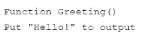
What is put to output by calling Greeting() twice
Correct Answer: B
The output of calling Greeting() twice depends on the implementation of the Greeting() function. Since the question does not provide the actual code for Greeting(), I'll provide a general explanation. * If the Greeting() function simply prints "Hello!" without any additional characters or spaces, then calling it twice would result in the output: "Hello!Hello!" (Option B). * If the Greeting() function prints "Hello!" followed by a newline character (or any other separator), then calling it twice would result in the output: "Hello!\nHello!" (where \n represents the newline character). * If the Greeting() function prints "Hello!" with a space after it, then calling it twice would result in the output: "Hello! Hello!". Without the actual implementation of Greeting(), we cannot definitively determine the exact output. However, the most common interpretation would be Option B: Hello!Hello!. References * Scripting and Programming Foundations documents.