A large-scale enterprise is migrating a substantial portion of its on-premises virtual machine (VM) infrastructure to a public cloud provider (e.g., AWS EC2, Azure VMs). They currently use Cortex XDR for endpoint protection on-premises and wish to extend this coverage seamlessly to their cloud VMs. The enterprise has a 'cloud-first' security posture and aims for automated, scalable deployment. Beyond simply installing the agent, what advanced considerations and methods are crucial for optimal Cortex XDR agent management and deployment in this dynamic cloud environment, particularly regarding lifecycle management and cost optimization?
Correct Answer: A,B,C,D
This question seeks advanced, crucial considerations for cloud deployments. A: Bake into Golden Image: This is a fundamental and highly efficient practice for cloud deployments. Pre-installing the agent ensures consistent versions and reduces post-launch overhead. A post-deployment script (e.g., cloud-init, user data) would then handle the specific tenant registration. B: Cloud-native Orchestration: Using AWS Systems Manager or Azure Automation for agent deployment is a best practice. It provides centralized management, patch compliance, and scalable deployment capabilities in a cloud context. C: Tag-based Group Assignment: Cloud environments heavily rely on tagging for resource management, cost allocation, and security. Mapping these tags to Cortex XDR groups provides dynamic policy application and enhanced visibility, aligning with a cloud-first security posture. D: Auto-Delete Dormant Endpoints: Ephemeral cloud instances are a common challenge for agent-based licensing. This feature is crucial for managing licenses effectively by automatically unregistering agents from terminated instances, preventing license 'leakage'. E: Serverless Functions for API-driven lifecycle: While technically possible, building and maintaining custom serverless functions for every agent install/uninstall event is overly complex and generally unnecessary for standard XDR agent lifecycle management. Native cloud orchestration tools and XDR's built-in features (like dormant endpoint deletion) usually suffice. The XDR agent is designed to handle instance termination gracefully. This is typically an advanced use case for highly bespoke or niche requirements, not a 'crucial' general consideration for optimal management.
Question 92
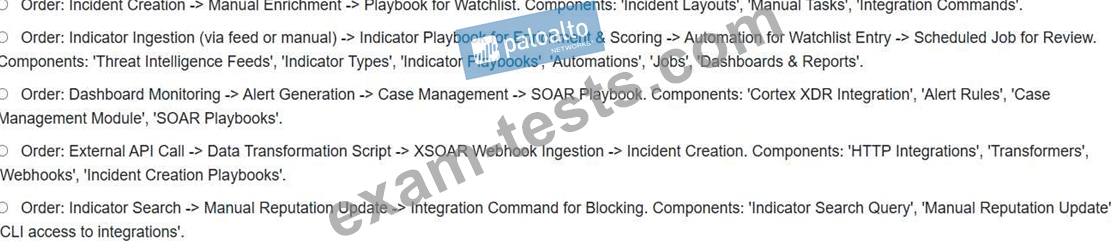
A SOC needs to establish a robust process in Cortex XSOAR for handling newly identified malicious domains. This process must include: 1) Automatic enrichment from multiple public and private sources. 2) A confidence score assignment based on the number of sources flagging the domain. 3) Automatic creation of a 'watchlist' entry for security devices if the confidence score exceeds a certain threshold. 4) A periodic review mechanism for domains that remain in the watchlist for an extended period without new activity. Which XSOAR components and configurations are essential to implement this entire workflow, and what is the typical order of operations?
Correct Answer: B
Option B provides the most comprehensive and accurate workflow using the correct XSOAR components for managing malicious domains as indicators. 1. Indicator Ingestion: Threat Intelligence Feeds or manual ingestion bring in the domains. 2. Indicator Playbook for Enrichment & Scoring: An Indicator Playbook (triggered upon ingestion or reputation change) runs integrations to enrich the domain (e.g., WHOIS, VirusTotal), and custom automation scripts can be used to calculate a confidence score based on the number of hits. 3. Automation for Watchlist Entry: If the score exceeds the threshold, the playbook can trigger an automation that uses relevant integration commands (e.g., firewall integration, SIEM integration) to add the domain to a watchlist. 4. Scheduled Job for Review: A XSOAR Job can be configured to run periodically, querying for domains on the watchlist that meet the 'extended period' criteria and then potentially triggering another playbook for review or removal. 'Dashboards & Reports' are crucial for monitoring this process. Options A, C, D, and E either miss key XSOAR threat intel features or propose less efficient/incomplete workflows.
Question 93
A critical supply chain attack has been identified, where a trusted software update has been tampered with, containing a hidden backdoor. Your Cortex XSIAM deployment needs to not only detect the presence of this backdoor across hundreds of endpoints but also rapidly contain its spread and gather forensic artifacts for deeper analysis. Which XSIAM processes and capabilities are paramount for executing this response effectively and at scale?
Correct Answer: B
A supply chain attack requires rapid, scalable response. XSIAM's 'Live Terminal' allows for real-time interaction and forensic collection. Its ability to enforce network isolation at the endpoint level quickly contains the threat. Crucially, the ability to deploy new, custom behavioral rules across the entire fleet enables widespread detection of the specific backdoor and its variants. This comprehensive approach is essential for a large-scale incident.
Question 94
A Palo Alto Networks Security Operations Professional suspects that an internal host is infected with a remote access Trojan (RAT) that uses encrypted communications over a standard port (e.g., 443) to evade detection. The RAT establishes outbound connections and communicates in a low-and-slow manner, making it difficult to detect with traditional signature-based methods. The organization uses Palo Alto Networks firewalls with Decryption, WildFire, and Advanced Threat Prevention. Which of the following hunting techniques, combining firewall capabilities and analysis, would be most effective in identifying this evasive C2 channel?
Correct Answer: C
The core challenge is 'encrypted communications over a standard port' and 'low-and-slow' evasion. Option C is the most effective. Implementing SSL Decryption is crucial to gain visibility into the encrypted traffic on port 443. Once decrypted, Advanced Threat Prevention can inspect the actual payload for RAT C2 communication patterns, and WildFire can analyze any transferred files. This combination allows for deep packet inspection and behavioral analysis of the encrypted flow, which is exactly what's needed for evasive RATs. Option A and E are too broad or solely containment. Option B's efficacy is limited without decryption. Option D relies on known signatures, which evasive RATS often circumvent.
Question 95
A security analyst needs to integrate a newly deployed custom threat intelligence feed, delivered via a REST API, into Cortex XSOAR. The feed provides indicators of compromise (IOCs) that need to be automatically ingested, de-duplicated, enriched with internal asset data, and then used to trigger alerts in a SIEM. Which of the following XSOAR features are MOST critical for building this integration efficiently and robustly?
Correct Answer: B
To integrate a custom REST API, the XSOAR SDK and Python integrations are essential for programmatically interacting with the API, parsing data, and normalizing it. Playbooks are crucial for orchestrating the subsequent steps: de-duplication, enrichment, and SIEM alerting. While A and C are useful features, they don't directly address the custom API integration. D and E are too manual or focused on different phases of incident response.