An organization wants to extend the functionality of an existing 'Certified' Marketplace pack, specifically to add a new command that retrieves a very niche piece of information from an API endpoint not covered by the original pack, without forking the entire pack or losing future updates from Palo Alto Networks. How can this be achieved in Cortex XSOAR, and what are the implications for maintaining this extended functionality?
Correct Answer: B
Option B is the correct and most effective approach for extending Certified Marketplace packs without losing update capabilities. XSOAR supports creating a new 'Private' pack (or even a 'Community' pack if intended for broader use) that declares the existing Certified pack as a dependency. This new pack can then include custom integrations with the desired new commands. Playbooks can then seamlessly use commands from both the certified parent pack and the custom dependent pack. When Palo Alto Networks releases updates for the certified pack, the organization can update it without affecting their custom extensions in the dependent pack, maintaining clean separation and leveraging the benefits of both. Options A, C, D, and E are either incorrect, lead to maintenance nightmares, or are not the most effective way to handle this scenario.
Question 37
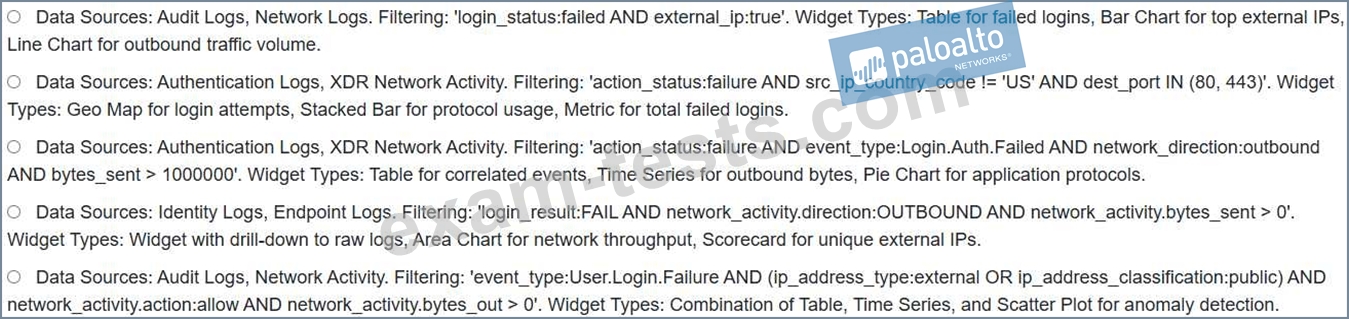
A Security Analyst needs to create a custom dashboard in Cortex XDR to visualize the correlation between failed login attempts from external IPs and the presence of unusual outbound network traffic from internal hosts. Which combination of data sources, filtering techniques, and widget types would be most effective for this scenario, ensuring real-time visibility and actionable insights?
Correct Answer: C
Option C provides the most precise and actionable combinatiom Authentication Logs directly capture login failures, and XDR Network Activity is crucial for outbound network traffic. The filtering 'action_status:failure AND event_type:Login.Auth.Failed' specifically targets failed logins, and 'network_direction:outbound AND bytes_sent > 1000000' pinpoints significant outbound traffic. The suggested widget types (Table for correlated events, Time Series for outbound bytes, Pie Chart for application protocols) are ideal for visualizing this specific correlation and identifying potential exfiltration after a failed intrusion.
Question 38
Correct Answer: B,C,D
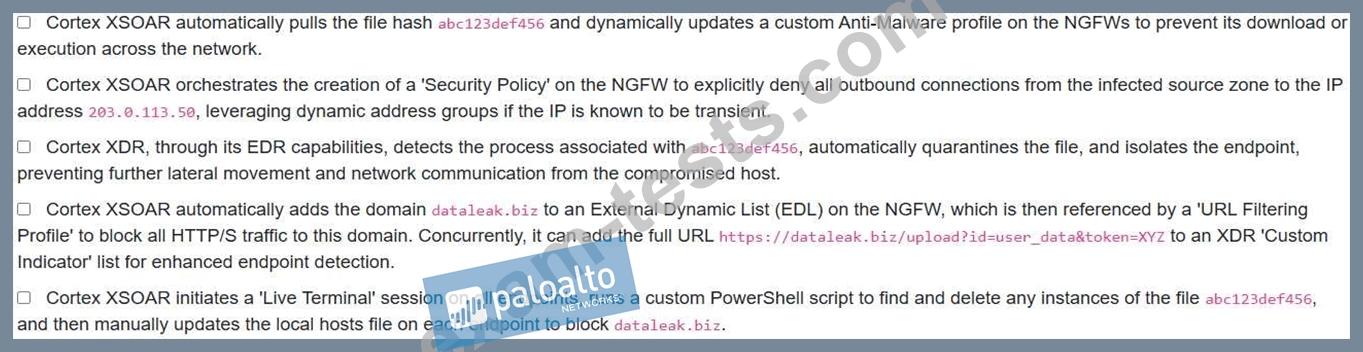
This question assesses the ability to integrate multiple indicator types dynamically across Cortex products for Zero Trust enforcement. A (Incorrect): While XSOAR can integrate with NGFWs, updating an Anti-Malware profile with a specific file hash is not a typical dynamic or real-time action for NGFWs. NGFWs primarily use WildFire for file-based prevention, which receives dynamic updates from Palo Alto Networks. XDR is better suited for endpoint file blocking. B (Correct): This is a prime example of dynamic micro-segmentation. XSOAR can automatically create or update NGFW security policies. Using dynamic address groups for the ephemeral IP allows for flexible blocking as the IP changes. This directly enforces Zero Trust by limiting network access based on threat intelligence (IP indicator). C (Correct): This is a core capability of Cortex XDR. Upon detection of a malicious file (file hash indicator), XDR's EDR functions will automatically quarantine the file and isolate the endpoint. This is crucial for preventing lateral movement and containing the threat at the host level, aligning with Zero Trust principles of 'never trust, always verify'. D (Correct): XSOAR can effectively operationalize domain and URL indicators. Automatically adding the domain to an EDL consumed by the NGFW's URL Filtering Profile provides immediate network-wide blocking of communication to the suspicious domain. Additionally, adding the full URL to XDR's 'Custom Indicator' list enhances endpoint-specific detection, allowing XDR to alert or prevent access to that exact URL pattern, even if the domain is partially allowed for other purposes. This comprehensive approach covers both network and endpoint layers for URL/domain indicators. E (Incorrect): While 'Live Terminal' can be used for remediation, relying on manual PowerShell scripts and local hosts file updates is not scalable, automated, or aligned with dynamic Zero Trust enforcement for an enterprise. XDR's built-in prevention policies and XSOAR's orchestration are the correct tools.
Question 39
During a Red Team exercise, a penetration tester successfully evades initial detection by using living-off-the-land binaries (LoLBins) and polymorphic malware. The activities include rund1132 .exe executing a malicious DLL, followed by certutil. exe for data download, and then schtasks . exe to establish persistence. No single activity triggers a high-severity alert. Which of the following Log Stitching and analysis principles within Cortex XDR would be most instrumental in identifying this attack chain as a unified incident?
Correct Answer: C
LoLBins and polymorphic malware are designed to evade signature-based detection (A) and often appear as normal system activity when viewed in isolation (B). Manual correlation (E) is inefficient and prone to human error at scale. Deep packet inspection (D) is valuable but won't capture the full endpoint-level execution chain. The power of Cortex XDR's Log Stitching against such sophisticated attacks lies in its integration with advanced Behavioral Analytics and ML (C). These engines identify subtle, anomalous behaviors (e.g., rund1132. exe behaving unusually, certutil . exe downloading from suspicious URLs, schtasks . exe creating unusual tasks). Log Stitching then connects these 'dots' based on their causal relationships (e.g., rund1132 leading to certutil leading to schtasks ), shared host/user context, and temporal proximity, culminating in a single, high-fidelity incident that reveals the entire attack. This is fundamental for detecting attacks that 'live off the land'.
Question 40
During a malware outbreak, a Palo Alto Networks security engineer needs to quickly determine if any newly submitted files to WildFire from endpoints are exhibiting specific command-and-control (C2) beaconing patterns or attempting to exploit a recently discovered zero-day vulnerability. Which of the following Cortex XDR and WildFire features or functionalities would be most effective for this real- time monitoring and proactive threat hunting, and why?
Correct Answer: D
Option D is the most comprehensive and effective approach. Cortex XDR's Threat Hunting with XQL allows proactive searching across endpoint data, including network connections and file executions, to identify C2 patterns. Concurrently, WildFire's core strength lies in dynamic analysis (sandboxing) of unknown files, where it executes the file in a safe environment to observe its true behavior, including C2 beaconing attempts and exploitation techniques, even for zero-days not yet covered by static signatures. This combination provides both proactive hunting and behavioral analysis for unknown threats.