

Question 6
Which statement is true regarding the default behavior of the ORDER BYclause?
Question 7
View the Exhibit and examine the details of PRODUCT_INFORMATIONtable.
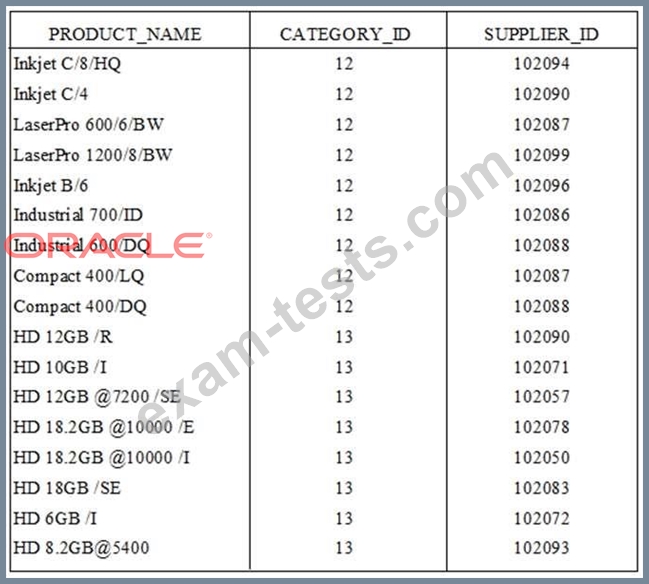
You have the requirement to display PRODUCT_NAMEfrom the table where the CATEGORY_IDcolumn has values 12or 13, and the SUPPLIER_IDcolumn has the value 102088. You executed the following SQL statement:
SELECT product_name
FROM product_information
WHERE (category_id = 12 AND category_id = 13) AND supplier_id = 102088; Which statement is true regarding the execution of the query?
You have the requirement to display PRODUCT_NAMEfrom the table where the CATEGORY_IDcolumn has values 12or 13, and the SUPPLIER_IDcolumn has the value 102088. You executed the following SQL statement:
SELECT product_name
FROM product_information
WHERE (category_id = 12 AND category_id = 13) AND supplier_id = 102088; Which statement is true regarding the execution of the query?
Question 8
View the exhibit and examine the structure in ORDERS and ORDER_ITEMS tables.
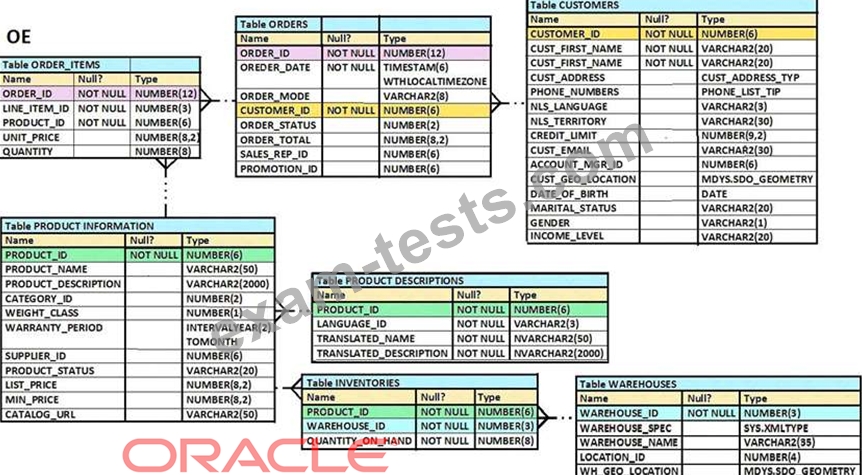
You need to create a view that displays the ORDER_ID, ORDER_DATE, and the total number of items in each order.
Which CREATE VIEW statement would create the view successfully?
You need to create a view that displays the ORDER_ID, ORDER_DATE, and the total number of items in each order.
Which CREATE VIEW statement would create the view successfully?
Question 9
Evaluate the following SQL statement:
SQL> select cust_id, cust_last_name "Last name"
FROM customers
WHERE country_id = 10
UNION
SELECT cust_id CUST_NO, cust_last_name
FROM customers
WHERE country_id = 30
Identify three ORDER BY clauses either one of which can complete the query.
SQL> select cust_id, cust_last_name "Last name"
FROM customers
WHERE country_id = 10
UNION
SELECT cust_id CUST_NO, cust_last_name
FROM customers
WHERE country_id = 30
Identify three ORDER BY clauses either one of which can complete the query.
Question 10
View the exhibit for the structure of the STUDENTand FACULTYtables.

You need to display the faculty name followed by the number of students handled by the faculty at the base location.
Examine the following two SQL statements:
Statement 1
SQL>SELECT faculty_name, COUNT(student_id)
FROM student JOIN faculty
USING (faculty_id, location_id)
GROUP BY faculty_name;
Statement 2
SQL>SELECT faculty_name, COUNT(student_id)
FROM student NATURAL JOIN faculty
GROUP BY faculty_name;
Which statement is true regarding the outcome?
You need to display the faculty name followed by the number of students handled by the faculty at the base location.
Examine the following two SQL statements:
Statement 1
SQL>SELECT faculty_name, COUNT(student_id)
FROM student JOIN faculty
USING (faculty_id, location_id)
GROUP BY faculty_name;
Statement 2
SQL>SELECT faculty_name, COUNT(student_id)
FROM student NATURAL JOIN faculty
GROUP BY faculty_name;
Which statement is true regarding the outcome?