

Question 26
Which two tasks can be performed by using Oracle SQL statements? (Choose two.)
Question 27
Which statement is true regarding external tables?
Question 28
Which two statements are true about a full outer join? (Choose two.)
Question 29
View the Exhibit and examine the details of the ORDER_ITEMS table.

Evaluate the following SQL statements:
Statement 1:
SELECT MAX(unit_price*quantity) "Maximum Order"
FROM order_items;
Statement 2:
SELECT MAX(unit_price*quantity) "Maximum Order"
FROM order_items
GROUP BY order_id;
Which statements are true regarding the output of these SQL statements? (Choose all that apply.)
Evaluate the following SQL statements:
Statement 1:
SELECT MAX(unit_price*quantity) "Maximum Order"
FROM order_items;
Statement 2:
SELECT MAX(unit_price*quantity) "Maximum Order"
FROM order_items
GROUP BY order_id;
Which statements are true regarding the output of these SQL statements? (Choose all that apply.)
Question 30
View the Exhibit and examine the structure of ORDERS and CUSTOMERStables.
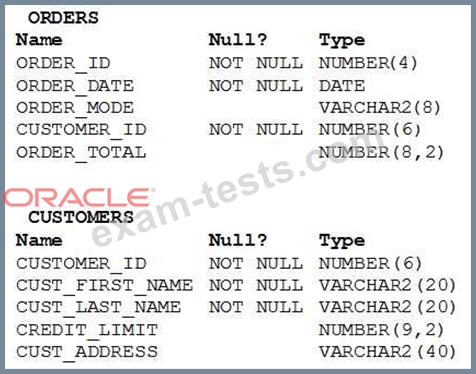
There is only one customer with the cust_last_namecolumn having value Roberts. Which INSERT statement should be used to add a row into the ORDERStable for the customer whose CUST_LAST_NAMEis Robertsand CREDIT_LIMITis 600?
There is only one customer with the cust_last_namecolumn having value Roberts. Which INSERT statement should be used to add a row into the ORDERStable for the customer whose CUST_LAST_NAMEis Robertsand CREDIT_LIMITis 600?