

Question 211
You are designing the structure of a table in which two columns have the specifications:
COMPONENT_ID - must be able to contain a maximum of 12 alphanumeric characters and must uniquely identify the row
EXECUTION_DATETIME - contains Century, Year, Month, Day, Hour, Minute, Second to the maximum precision and is used for calculations and comparisons between components.
Which two options define the data types that satisfy these requirements most efficiently? (Choose two.)
COMPONENT_ID - must be able to contain a maximum of 12 alphanumeric characters and must uniquely identify the row
EXECUTION_DATETIME - contains Century, Year, Month, Day, Hour, Minute, Second to the maximum precision and is used for calculations and comparisons between components.
Which two options define the data types that satisfy these requirements most efficiently? (Choose two.)
Question 212
View the exhibit and examine the description of the DEPARTMENTSand EMPLOYEEStables.

You wrote this SQL statement to retrieve EMPLOYEE_ID, FIRST_NAME, and DEPARTMENT NAME, for all employees:
SELECT employee_id, first_name, department_name
FROM employees
NATURAL JOIN departments;
The desired output is not obtained after executing the above SQL statement. What could be the reason for this?
You wrote this SQL statement to retrieve EMPLOYEE_ID, FIRST_NAME, and DEPARTMENT NAME, for all employees:
SELECT employee_id, first_name, department_name
FROM employees
NATURAL JOIN departments;
The desired output is not obtained after executing the above SQL statement. What could be the reason for this?
Question 213
Examine this statement which returns the name of each employee and their manager:

You want to extend the query to include employees with no manager. What must you add before JOINto do this?
You want to extend the query to include employees with no manager. What must you add before JOINto do this?
Question 214
Which two statements are true regarding the execution of the correlated subqueries? (Choose two.)
Question 215
View the Exhibit and examine the structure of the ORDER_ITEMS and ORDERS tables.
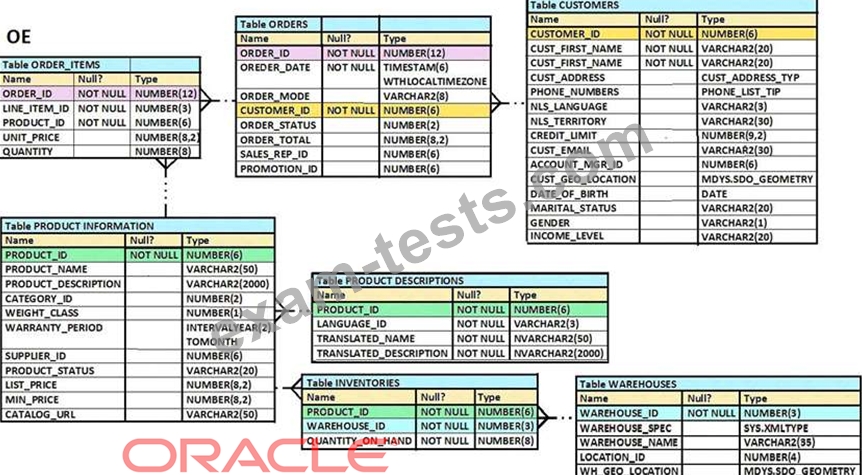
You are asked to retrieve the ORDER_ID, product_ID, and total price (UNIT_PRICE multiplied by QUANTITY), where the total price is greater than 50,000.
You executed the following SQL statement:
SELECT prder_id, product_id, unit_price*quantity "Total Price"
FROM order_items
WHERE unit_price*quantity > 50000
NATURAL JOIN orders;
Which statement is true regarding the execution of the statement?
You are asked to retrieve the ORDER_ID, product_ID, and total price (UNIT_PRICE multiplied by QUANTITY), where the total price is greater than 50,000.
You executed the following SQL statement:
SELECT prder_id, product_id, unit_price*quantity "Total Price"
FROM order_items
WHERE unit_price*quantity > 50000
NATURAL JOIN orders;
Which statement is true regarding the execution of the statement?