

Question 156
Given the code fragment:
public void recDelete (String dirName) throws IOException {
File [ ] listOfFiles = new File (dirName) .listFiles();
if (listOfFiles ! = null && listOfFiles.length >0) {
for (File aFile : listOfFiles) {
if (aFile.isDirectory ()) {
recDelete (aFile.getAbsolutePath ());
} else {
if (aFile.getName ().endsWith (".class"))
aFile.delete ();
}
}
}
}
Assume that Projectscontains subdirectories that contain .classfiles and is passed as an argument to the recDelete ()method when it is invoked.
What is the result?
public void recDelete (String dirName) throws IOException {
File [ ] listOfFiles = new File (dirName) .listFiles();
if (listOfFiles ! = null && listOfFiles.length >0) {
for (File aFile : listOfFiles) {
if (aFile.isDirectory ()) {
recDelete (aFile.getAbsolutePath ());
} else {
if (aFile.getName ().endsWith (".class"))
aFile.delete ();
}
}
}
}
Assume that Projectscontains subdirectories that contain .classfiles and is passed as an argument to the recDelete ()method when it is invoked.
What is the result?
Question 157
Given the code fragment:
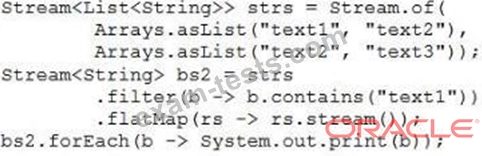
What is the result?
What is the result?
Question 158
Given:
public class SampleClass {
public static void main(String[] args) {
AnotherSampleClass asc = new AnotherSampleClass(); SampleClass sc = new SampleClass(); sc = asc; System.out.println("sc: " + sc.getClass()); System.out.println("asc: " + asc.getClass());
}}
class AnotherSampleClass extends SampleClass {
}
What is the result?
public class SampleClass {
public static void main(String[] args) {
AnotherSampleClass asc = new AnotherSampleClass(); SampleClass sc = new SampleClass(); sc = asc; System.out.println("sc: " + sc.getClass()); System.out.println("asc: " + asc.getClass());
}}
class AnotherSampleClass extends SampleClass {
}
What is the result?
Question 159
Given:

and the code fragment:
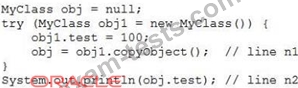
What is the result?
and the code fragment:
What is the result?
Question 160
You want to create a singleton class by using the Singleton design pattern.
Which two statements enforce the singleton nature of the design?
Which two statements enforce the singleton nature of the design?