

Question 176
Given the code fragment:
List<Double> doubles = Arrays.asList (100.12, 200.32);
DoubleFunction funD = d -> d + 100.0;
doubles.stream (). forEach (funD); // line n1
doubles.stream(). forEach(e -> System.out.println(e)); // line n2
What is the result?
List<Double> doubles = Arrays.asList (100.12, 200.32);
DoubleFunction funD = d -> d + 100.0;
doubles.stream (). forEach (funD); // line n1
doubles.stream(). forEach(e -> System.out.println(e)); // line n2
What is the result?

Question 177
Given the code fragment:
LocalDate valentinesDay =LocalDate.of(2015, Month.FEBRUARY, 14);
LocalDate next15days = valentinesDay.plusDays (15);
LocalDate nextYear = next15days.plusYears(1); // line n1
System.out.println(nextYear);
What is the result?
LocalDate valentinesDay =LocalDate.of(2015, Month.FEBRUARY, 14);
LocalDate next15days = valentinesDay.plusDays (15);
LocalDate nextYear = next15days.plusYears(1); // line n1
System.out.println(nextYear);
What is the result?
Question 178
You want to create a singleton class by using the Singleton design pattern.
Which two statements enforce the singleton nature of the design?
Which two statements enforce the singleton nature of the design?
Question 179
Given the code fragment:
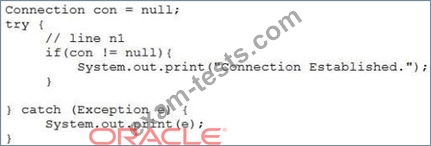
Assume that dbURL, userName, and password are valid.
Which code fragment can be inserted at line n1 to enable the code to print Connection Established?
Assume that dbURL, userName, and password are valid.
Which code fragment can be inserted at line n1 to enable the code to print Connection Established?
Question 180
Given:
public class Test<T> {
private T t;
public T get () {
return t;
}
public void set (T t) {
this.t = t;
}
public static void main (String args [ ] ) {
Test<String> type = new Test<>();
Test type 1 = new Test (); //line n1
type.set("Java");
type1.set(100); //line n2
System.out.print(type.get() + " " + type1.get());
}
}
What is the result?
public class Test<T> {
private T t;
public T get () {
return t;
}
public void set (T t) {
this.t = t;
}
public static void main (String args [ ] ) {
Test<String> type = new Test<>();
Test type 1 = new Test (); //line n1
type.set("Java");
type1.set(100); //line n2
System.out.print(type.get() + " " + type1.get());
}
}
What is the result?