

Question 46
Refer to the exhibit.

All routers on this network have been configured with P1M-SM and R1 is the rendezvous point However, when asymmetric routing is implemented to modify link usage the network begins to drop certain multicast traffic Which action corrects the problem?
All routers on this network have been configured with P1M-SM and R1 is the rendezvous point However, when asymmetric routing is implemented to modify link usage the network begins to drop certain multicast traffic Which action corrects the problem?
Question 47
Which two routing protocols have extensions capable of running SRv6? (Choose two.)
Question 48
Refer to the exhibit.
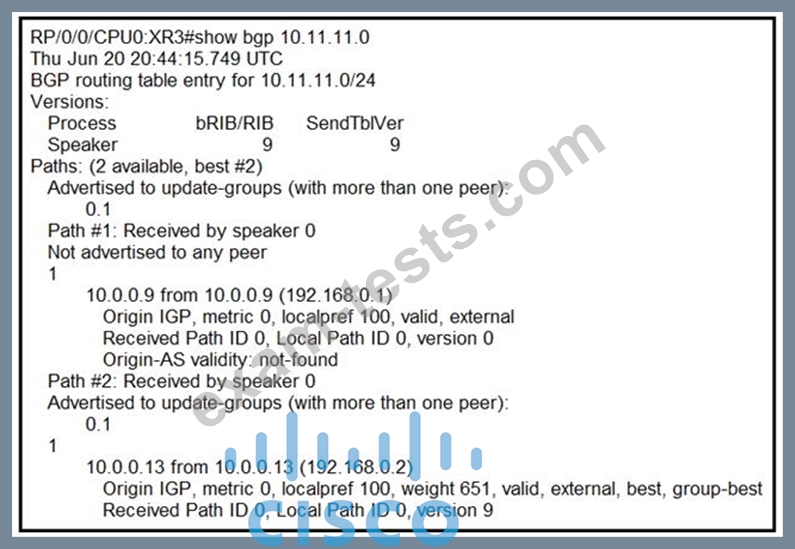
A network operator is getting the route for 10.11.11 0/24 from two upstream providers on
#XR3. The network operator must configure #XR3 to force the 10.11.11.0/24 prefix to route via next hop of 10.0.0.9 as primary when available. Which of these can the operator use the routing policy language for, to enforce this traffic forwarding path?
A network operator is getting the route for 10.11.11 0/24 from two upstream providers on
#XR3. The network operator must configure #XR3 to force the 10.11.11.0/24 prefix to route via next hop of 10.0.0.9 as primary when available. Which of these can the operator use the routing policy language for, to enforce this traffic forwarding path?
Question 49
Which difference must an engineer consider when Implementing Inter-domain and Intra-domain multicast routing on the network?
Question 50
Refer to the exhibit.
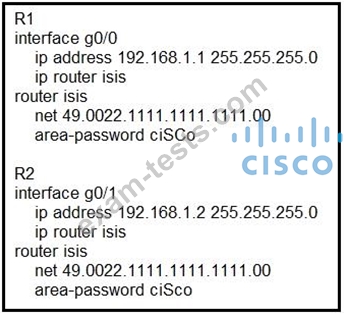
After you applied these configurations to routers R1 and R2, the two devices could not form a neighbor relationship. Which reason for the problem is the most likely?
After you applied these configurations to routers R1 and R2, the two devices could not form a neighbor relationship. Which reason for the problem is the most likely?