

Question 146
Guidelines
This is a lab item in which tasks will be performed on virtual devices.
Refer to the Tasks tab to view the tasks for this lab item.
Refer to the Topology tab to access the device console(s) and perform the tasks.
Console access is available for all required devices by clicking the device icon or using the tab(s) above the console window.
All necessary preconfigurations have been applied.
Do not change the enable password or hostname for any device.
Save your configurations to NVRAM before moving to the next item.
Click Next at the bottom of the screen to submit this lab and move to the next question.
When Next is clicked, the lab doses and cannot be reopened.
Topology

Tasks
Configure and verify an OSPF neighbor adjacency between R1 and R2 in OSPF area 0 according to the topology to achieve these goals:
1. R1 pings the Loopback0 interface of R2. Use interface-level configuration to complete this task.
2. R2 pings the Loopback0 interface of R1. Use interface-level configuration to complete this task.
3. R2 receives a single summary route 172.16.100.0/22 for networks 172.16.100.0/24, 172.16.101.0/24, and 172.16.103.0/24.
This is a lab item in which tasks will be performed on virtual devices.
Refer to the Tasks tab to view the tasks for this lab item.
Refer to the Topology tab to access the device console(s) and perform the tasks.
Console access is available for all required devices by clicking the device icon or using the tab(s) above the console window.
All necessary preconfigurations have been applied.
Do not change the enable password or hostname for any device.
Save your configurations to NVRAM before moving to the next item.
Click Next at the bottom of the screen to submit this lab and move to the next question.
When Next is clicked, the lab doses and cannot be reopened.
Topology
Tasks
Configure and verify an OSPF neighbor adjacency between R1 and R2 in OSPF area 0 according to the topology to achieve these goals:
1. R1 pings the Loopback0 interface of R2. Use interface-level configuration to complete this task.
2. R2 pings the Loopback0 interface of R1. Use interface-level configuration to complete this task.
3. R2 receives a single summary route 172.16.100.0/22 for networks 172.16.100.0/24, 172.16.101.0/24, and 172.16.103.0/24.


Question 147
Refer to the exhibit. CE1 and CE2 cannot communicate through the service provider BGP peering is established between PE1 and PE2.
IS-IS is the only routing protocol running in the service provider core.
What step can be done to troubleshoot the issue?

IS-IS is the only routing protocol running in the service provider core.
What step can be done to troubleshoot the issue?
Question 148
Refer to the exhibit. Which router does R1 install as an alternate next hop when trying to reach R3 if LFA is enabled?

Question 149
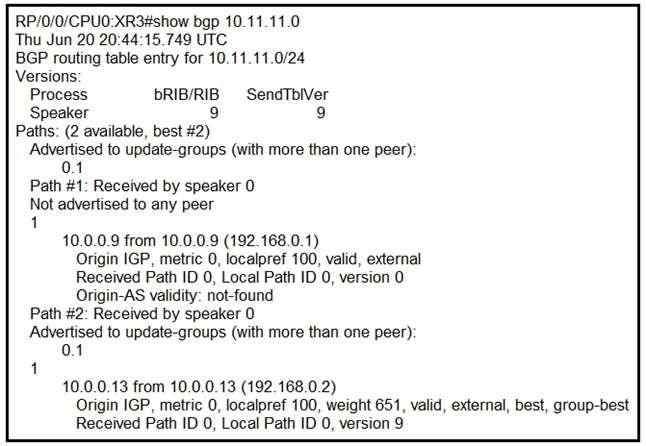
Refer to the exhibit. A network operator is getting the route for 10.11.11 0/24 from two upstream providers on
#XR3. The network operator must configure #XR3 to force the 10.11.11.0/24 prefix to route via next hop of
10.0.0.9 as primary when available. Which of these can the operator use the routing policy language for, to enforce this traffic forwarding path?
Question 150
Drag and Drop Question
Drag and drop the characteristics from the left onto the corresponding routing protocols on the right.

Drag and drop the characteristics from the left onto the corresponding routing protocols on the right.
