Which suspicious pattern enables the Cisco Tetration platform to learn the normal behavior of users?
Correct Answer: C
The various suspicious patterns for which the Cisco Tetration platform looks in the current release are: + Shell code execution: Looks for the patterns used by shell code. + Privilege escalation: Watches for privilege changes from a lower privilege to a higher privilege in the process lineage tree. + Side channel attacks: Cisco Tetration platform watches for cache-timing attacks and page table fault bursts. Using these, it can detect Meltdown, Spectre, and other cache-timing attacks. + Raw socket creation: Creation of a raw socket by a nonstandard process (for example, ping). + User login suspicious behavior: Cisco Tetration platform watches user login failures and user login methods. + Interesting file access: Cisco Tetration platform can be armed to look at sensitive files. + File access from a different user: Cisco Tetration platform learns the normal behavior of which file is accessed by which user. + Unseen command: Cisco Tetration platform learns the behavior and set of commands as well as the lineage of each command over time. Any new command or command with a different lineage triggers the interest of the Tetration Analytics platform. The various suspicious patterns for which the Cisco Tetration platform looks in the current release are: + Shell code execution: Looks for the patterns used by shell code. + Privilege escalation: Watches for privilege changes from a lower privilege to a higher privilege in the process lineage tree. + Side channel attacks: Cisco Tetration platform watches for cache-timing attacks and page table fault bursts. Using these, it can detect Meltdown, Spectre, and other cache-timing attacks. + Raw socket creation: Creation of a raw socket by a nonstandard process (for example, ping). + User login suspicious behavior: Cisco Tetration platform watches user login failures and user login methods. + Interesting file access: Cisco Tetration platform can be armed to look at sensitive files. + File access from a different user: Cisco Tetration platform learns the normal behavior of which file is accessed by which user. + Unseen command: Cisco Tetration platform learns the behavior and set of commands as well as the lineage of each command over time. Any new command or command with a different lineage triggers the interest of the Tetration Analytics platform. The various suspicious patterns for which the Cisco Tetration platform looks in the current release are: + Shell code execution: Looks for the patterns used by shell code. + Privilege escalation: Watches for privilege changes from a lower privilege to a higher privilege in the process lineage tree. + Side channel attacks: Cisco Tetration platform watches for cache-timing attacks and page table fault bursts. Using these, it can detect Meltdown, Spectre, and other cache-timing attacks. + Raw socket creation: Creation of a raw socket by a nonstandard process (for example, ping). + User login suspicious behavior: Cisco Tetration platform watches user login failures and user login methods. + Interesting file access: Cisco Tetration platform can be armed to look at sensitive files. + File access from a different user: Cisco Tetration platform learns the normal behavior of which file is accessed by which user. + Unseen command: Cisco Tetration platform learns the behavior and set of commands as well as the lineage of each command over time. Any new command or command with a different lineage triggers the interest of the Tetration Analytics platform.
Question 432
Due to a traffic storm on the network, two interfaces were error-disabled, and both interfaces sent SNMP traps. Which two actions must be taken to ensure that interfaces are put back into service? (Choose two)
Correct Answer: C,E
Question 433
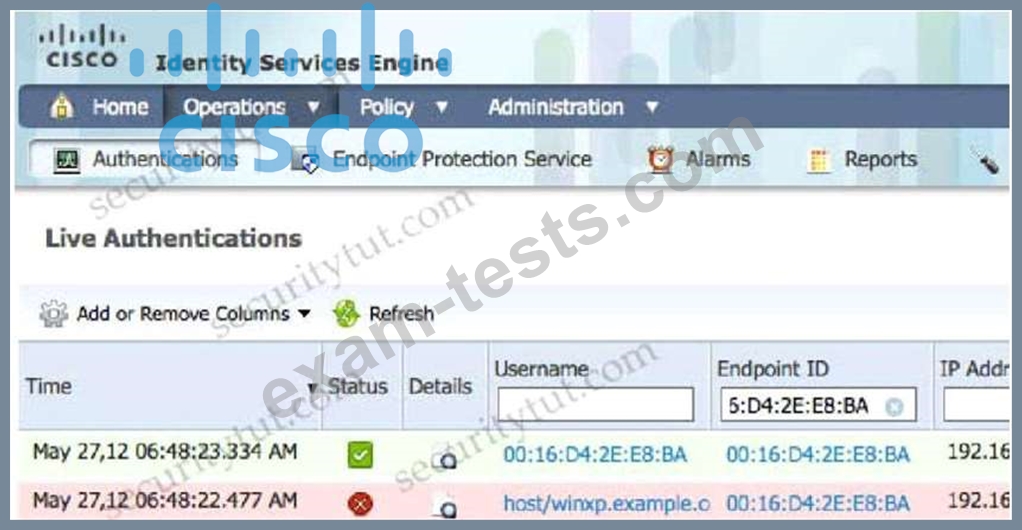
A network administrator is configuring a switch to use Cisco ISE for 802.1X. An endpoint is failing authentication and is unable to access the network. Where should the administrator begin troubleshooting to verify the authentication details?
Correct Answer: D
How To Troubleshoot ISE Failed Authentications & Authorizations Check the ISE Live Logs Login to the primary ISE Policy Administration Node (PAN). Go to Operations > RADIUS > Live Logs (Optional) If the event is not present in the RADIUS Live Logs, go to Operations > Reports > Reports > Endpoints and Users > RADIUS Authentications Check for Any Failed Authentication Attempts in the Log
Question 434
An organization has a Cisco ESA set up with DLP policies and would like to customize the action assigned for violations. The organization wants a copy of the message to be delivered with a message added to flag it as a DLP violation. Which actions must be performed in order to provide this capability?
Correct Answer: D
Question 435
Which suspicious pattern enables the Cisco Tetration platform to learn the normal behavior of users?
Correct Answer: C
The various suspicious patterns for which the Cisco Tetration platform looks in the current release are: + Shell code execution: Looks for the patterns used by shell code. + Privilege escalation: Watches for privilege changes from a lower privilege to a higher privilege in the process lineage tree. + Side channel attacks: Cisco Tetration platform watches for cache-timing attacks and page table fault bursts. Using these, it can detect Meltdown, Spectre, and other cache-timing attacks. + Raw socket creation: Creation of a raw socket by a nonstandard process (for example, ping). + User login suspicious behavior: Cisco Tetration platform watches user login failures and user login methods. + Interesting file access: Cisco Tetration platform can be armed to look at sensitive files. + File access from a different user: Cisco Tetration platform learns the normal behavior of which file is accessed by which user. + Unseen command: Cisco Tetration platform learns the behavior and set of commands as well as the lineage of each command over time. Any new command or command with a different lineage triggers the interest of the Tetration Analytics platform. Reference: https://www.cisco.com/c/en/us/products/collateral/data-center-analytics/tetration-analytics/whitepaper-c11-740380.html + Shell code execution: Looks for the patterns used by shell code. + Privilege escalation: Watches for privilege changes from a lower privilege to a higher privilege in the process lineage tree. + Side channel attacks: Cisco Tetration platform watches for cache-timing attacks and page table fault bursts. Using these, it can detect Meltdown, Spectre, and other cache-timing attacks. + Raw socket creation: Creation of a raw socket by a nonstandard process (for example, ping). + User login suspicious behavior: Cisco Tetration platform watches user login failures and user login methods. + Interesting file access: Cisco Tetration platform can be armed to look at sensitive files. + File access from a different user: Cisco Tetration platform learns the normal behavior of which file is accessed by which user. + Unseen command: Cisco Tetration platform learns the behavior and set of commands as well as the lineage of each command over time. Any new command or command with a different lineage triggers the interest of the Tetration Analytics platform. The various suspicious patterns for which the Cisco Tetration platform looks in the current release are: + Shell code execution: Looks for the patterns used by shell code. + Privilege escalation: Watches for privilege changes from a lower privilege to a higher privilege in the process lineage tree. + Side channel attacks: Cisco Tetration platform watches for cache-timing attacks and page table fault bursts. Using these, it can detect Meltdown, Spectre, and other cache-timing attacks. + Raw socket creation: Creation of a raw socket by a nonstandard process (for example, ping). + User login suspicious behavior: Cisco Tetration platform watches user login failures and user login methods. + Interesting file access: Cisco Tetration platform can be armed to look at sensitive files. + File access from a different user: Cisco Tetration platform learns the normal behavior of which file is accessed by which user. + Unseen command: Cisco Tetration platform learns the behavior and set of commands as well as the lineage of each command over time. Any new command or command with a different lineage triggers the interest of the Tetration Analytics platform. Reference: https://www.cisco.com/c/en/us/products/collateral/data-center-analytics/tetration-analytics/whitepaper-c11-740380.html