Question 176
You have an Azure subscription named Subscription1 that contains a virtual network named VNet1. VNet1 is in a resource group named RG1.
Subscription1 has a user named User1. User1 has the following roles;
* Reader
* Security Admin
* Security Reader
You need to ensure that User1 can assign the Reader role for VNet1 to other users. What should you do?
Subscription1 has a user named User1. User1 has the following roles;
* Reader
* Security Admin
* Security Reader
You need to ensure that User1 can assign the Reader role for VNet1 to other users. What should you do?
Question 177
You have an Azure subscription that contains the resources shown in the following table.

VMSS1 is set to VM (virtual machines) orchestration mode.
You need to deploy a new Azure virtual machine named VM1, and then add VM1 to VMSS1.
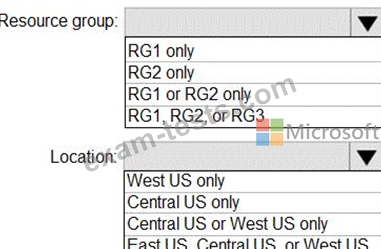
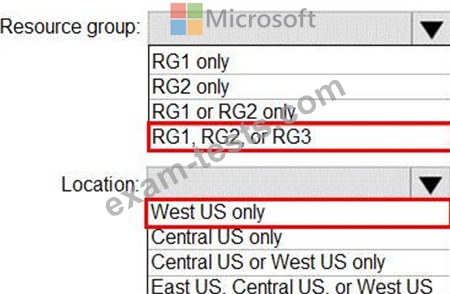
Which resource group and location should you use to deploy VM1? To answer, select the appropriate options in the answer area.
NOTE: Each correct selection is worth one point.
VMSS1 is set to VM (virtual machines) orchestration mode.
You need to deploy a new Azure virtual machine named VM1, and then add VM1 to VMSS1.
Which resource group and location should you use to deploy VM1? To answer, select the appropriate options in the answer area.
NOTE: Each correct selection is worth one point.
Question 178
Note: This question is part of a series of questions that present the same scenario. Each question in the series contains a unique solution that might meet the stated goals. Some question sets might have more than one correct solution, while others might not have a correct solution.
After you answer a question in this section, you will NOT be able to return to it. As a result, these questions will not appear in the review screen.
You have an app named App1 that is installed on two Azure virtual machines named VM1 and VM2.
Connections to App1 are managed by using an Azure Load Balancer.
The effective network security configurations for VM2 are shown in the following exhibit.
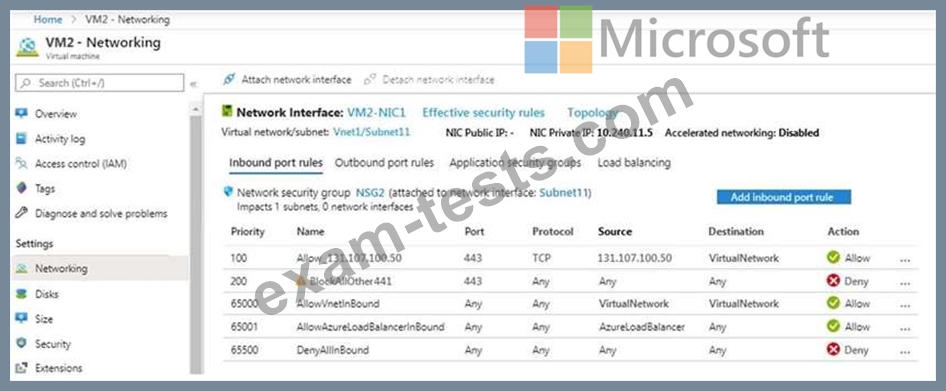
You discover that connections to App1 from 131.107.100.50 over TCP port 443 fail.
You verify that the Load Balancer rules are configured correctly.
You need to ensure that connections to App1 can be established successfully from 131.107.100.50 over TCP port 443.
Solution: You create an inbound security rule that denies all traffic from the 131.107.100.50 source and has a cost of 64999.
Does this meet the goal?
After you answer a question in this section, you will NOT be able to return to it. As a result, these questions will not appear in the review screen.
You have an app named App1 that is installed on two Azure virtual machines named VM1 and VM2.
Connections to App1 are managed by using an Azure Load Balancer.
The effective network security configurations for VM2 are shown in the following exhibit.
You discover that connections to App1 from 131.107.100.50 over TCP port 443 fail.
You verify that the Load Balancer rules are configured correctly.
You need to ensure that connections to App1 can be established successfully from 131.107.100.50 over TCP port 443.
Solution: You create an inbound security rule that denies all traffic from the 131.107.100.50 source and has a cost of 64999.
Does this meet the goal?
Question 179
You create a Recovery Services vault backup policy named Policy1 as shown in the following exhibit:
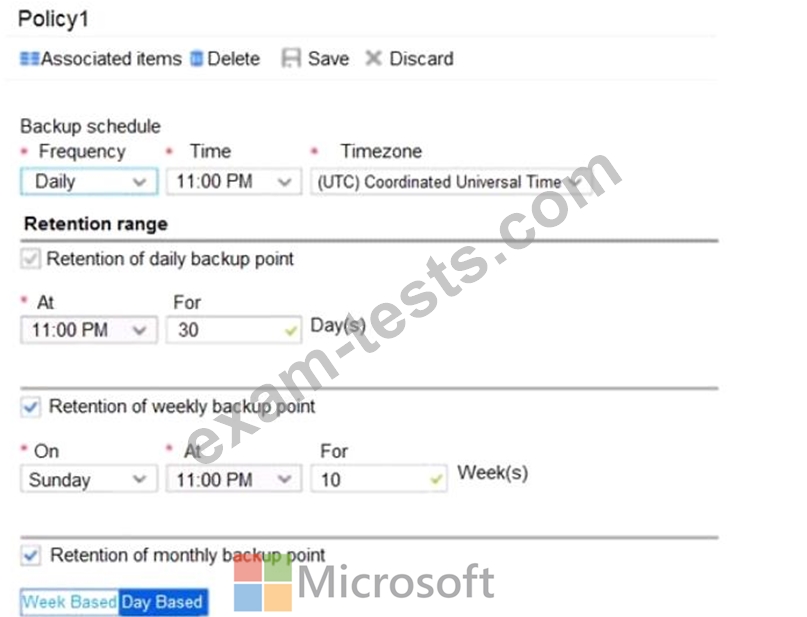
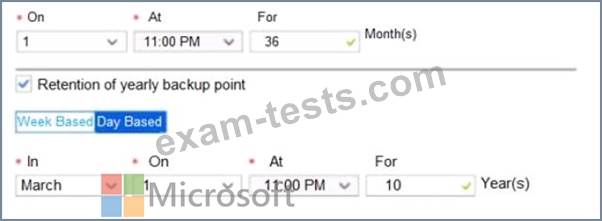
Use the drop-down menus to select the answer choice that completes each statement based on the
information presented in the graphic.
NOTE: Each correct selection is worth one point.
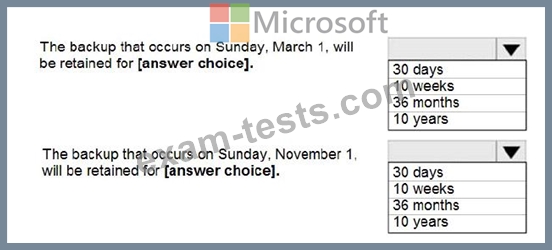
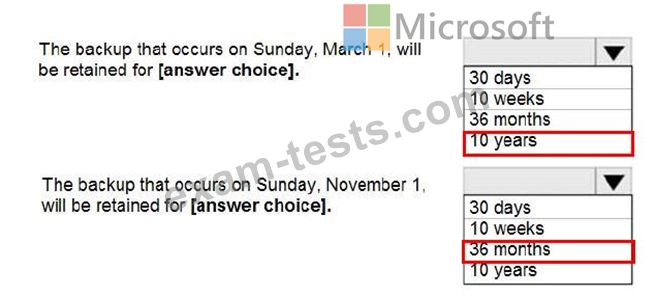
Use the drop-down menus to select the answer choice that completes each statement based on the
information presented in the graphic.
NOTE: Each correct selection is worth one point.
Question 180
You have an Azure Subscription named Subcription1.has
Subcription1 contains the virtual machines in the following table.

Subcription1 contains the virtual machines in the following table.

VM3 has multiple network, including a network adapter named NIC3, IP forwarding is enabled on NIC3. Routing is enabled on VM3.
You create a route table named RT1 that contains the routes in the following table.

You apply RT1 to subnet1 and Sybnet2.
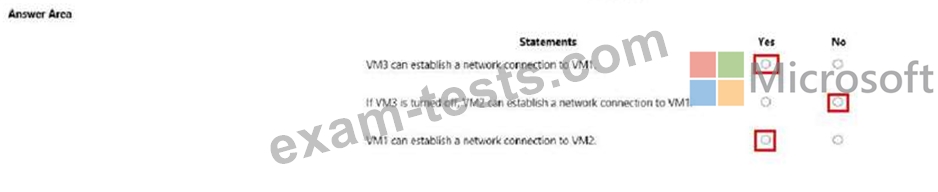
For each of the following statements, select Yes if the statements is true. Otherwise, select No.
NOTE: Each correct selection is worth one point.

Subcription1 contains the virtual machines in the following table.
Subcription1 contains the virtual machines in the following table.
VM3 has multiple network, including a network adapter named NIC3, IP forwarding is enabled on NIC3. Routing is enabled on VM3.
You create a route table named RT1 that contains the routes in the following table.
You apply RT1 to subnet1 and Sybnet2.
For each of the following statements, select Yes if the statements is true. Otherwise, select No.
NOTE: Each correct selection is worth one point.