

Question 1
Your network contains an on-premises Active Directory domain that syncs to an Azure Active Directory (Azure AD) tenant. The domain contains the domain controllers shown in the following table.

The DNS servers are configured to forward requests to an external DNS service.
You create a new virtual network named VNET2 that is peered to VNET1 and has gateway transit enabled.
You plan to implement an Azure Virtual Desktop host pool in VNET2. The session hosts will be joined to the Active Directory domain.
You need to configure DNS to meet the following requirements:
* Ensure that Azure Virtual Desktop users can resolve on-premises servers and Azure resources.
* Ensure that azure Virtual Desktop remains operational if a DNS server fails.
* Minimize administrative effort.
What should you configure?
The DNS servers are configured to forward requests to an external DNS service.
You create a new virtual network named VNET2 that is peered to VNET1 and has gateway transit enabled.
You plan to implement an Azure Virtual Desktop host pool in VNET2. The session hosts will be joined to the Active Directory domain.
You need to configure DNS to meet the following requirements:
* Ensure that Azure Virtual Desktop users can resolve on-premises servers and Azure resources.
* Ensure that azure Virtual Desktop remains operational if a DNS server fails.
* Minimize administrative effort.
What should you configure?
Question 2
You have a Windows Virtual Desktop deployment.
You have a session host named Host1 that has the disk layout shown in the exhibit. (Click the Exhibit tab.)

You plan to deploy an app that must be installed on D.
The app requires 500 GB of disk space.
You need to add a new data disk that will be assigned the drive letter D.
The solution must maintain the current performance of Host1.
Which four actions should you perform in sequence? To answer, move the appropriate actions from the list of actions to the answer area and arrange them in the correct order.

You have a session host named Host1 that has the disk layout shown in the exhibit. (Click the Exhibit tab.)
You plan to deploy an app that must be installed on D.
The app requires 500 GB of disk space.
You need to add a new data disk that will be assigned the drive letter D.
The solution must maintain the current performance of Host1.
Which four actions should you perform in sequence? To answer, move the appropriate actions from the list of actions to the answer area and arrange them in the correct order.


Question 3
You have the devices shown in the following table.
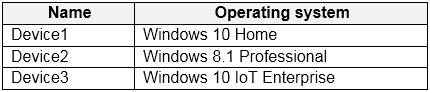
You plan to deploy Windows Virtual Desktop for client access to remove virtualized apps.
Which devices support the Remote Desktop client?
You plan to deploy Windows Virtual Desktop for client access to remove virtualized apps.
Which devices support the Remote Desktop client?
Question 4
Which three PowerShell modules should you install on Server1 to meet the technical requirements? Each correct answer presents part of the solution.
NOTE: Each correct selection is worth one point.
NOTE: Each correct selection is worth one point.
Question 5
You have an Azure Virtual Desktop deployment.
You are configuring the outbound firewall settings for the host pool.
Which outbound URL and outbound port should you configure to ensure that the host machines maintain Windows activation? To answer, select the appropriate options In the answer area.
NOTE: Each correct selection is worth one point.

You are configuring the outbound firewall settings for the host pool.
Which outbound URL and outbound port should you configure to ensure that the host machines maintain Windows activation? To answer, select the appropriate options In the answer area.
NOTE: Each correct selection is worth one point.
